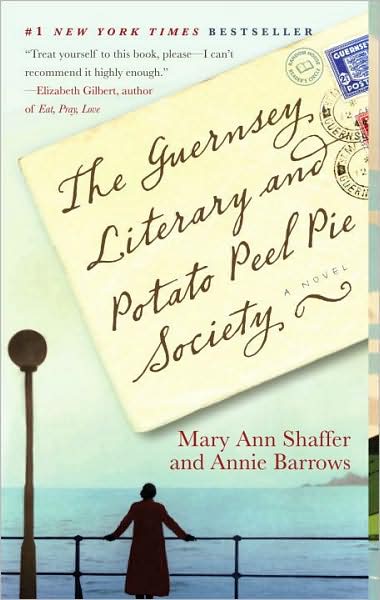
 Long on my TBR (to be read) pile, The Guernsey Literary and Potato Peel Pie Society had so many intriguing factors in its favor that I could not put it off any longer. Firstly, I cannot tell you how many of my customers come in searching for this novel even two years after publication. It was on the bestseller list for over a year and is a book group favorite. Secondly, it takes place during and after WWII, one of my favorite historical periods. And thirdly, it is filled with literary references. The puzzling bit is that it is written in epistolary format!
“Reading good books ruins you for enjoying bad books.” Isola Pribby, page 53
Yes, an entire novel written as a collection of letters. A very popular style in the mid seventeenth-century, the epistolary novel was utilized by the venerable Samuel Richardson, no less, in his bestselling novels Pamela (1740) and Clarissa (1749). This format has its challenges – like characters not being able to interface with each other directly and react in the moment. Jane Austen discovered this dilemma after writing Lady Susan in 1795, and the first drafts of Elinor and Marianne (later Sense and Sensibility) and First Impressions (later Pride and Prejudice). The latter two were rewritten into the third-person omniscient style that she is now famous for. Lady Susan remains unchanged, and for those who have read it, it is quite charming but not as accessible to modern readers as her later works. I was very curious to see how co-authors Mary Ann Shaffer and Annie Barrows could pull off a novel written in letters and why readers were clamoring to buy it.
“Sophie – what is the matter with me? Am I too particular? I don’t want to be married just to be married. I can’t think of anything lonelier than spending the rest of my life with someone I can’t talk to, or worse, someone I can’t be silent with.” Juliet Ashton, page 8
In 1946 post war England, our heroine and unmarried thirty-something Juliet Ashton is ready to move on from her comedic war-time newspaper column to more serious fare. Interested in writing a novel, she is searching for the inspiration for a new story. Living in bombed out London she has few personal connections that are still alive. Her parents and brother are dead, and besides her agent Sidney and his sister Sophie, she has few friends and only one suitor, the “great catch,” the wealthy and imposing American publishing heir Markham V. Reynolds, Jr. who woos a woman who has lived for five years on war ratios with champagne, lobster and dancing at the Savoy. Heady stuff.
“I wonder how the book got to Guernsey. Perhaps there is some secret sort of homing instinct in books that brings them to their perfect readers. How delightful if that were true.” From Dawsey Adams, page 10
Juliet is pleasantly surprised to receive a letter from one of her readers, Dawsey Adams, a farmer on Guernsey Island who is now the owner of a used book by Charles Lamb with her name inscribed on the flyleaf. They strike up a correspondence and she learns about his co-founding of The Guernsey Literary and Potato Peel Pie Society, an ad hock group first formed by residents to fool the Nazi’s into allowing after curfew movements during the German occupation of the island. Later, the book group would become the axis in their lives; both for fellowship and intellectual nourishment; building friendships and, changing perspectives. She was intrigued by his descriptions of the society’s eccentric members and activities and welcomes correspondence from them. What unfolds is a truly remarkable tale. As the society members retell firsthand accounts of their challenges and tragedies during their islands Nazi occupation, Juliet is drawn into their stories and feels that it would make a great subject for her next book. Her eventual visit to the island will change her life forever.
“We clung to books and to our friends; they reminded us that we had another part to us.” Eben Ramsey, page 64
At times the epistolary format from twenty different voices had its limitations, but the authors overcome the challenge of characters not being able to talk to each other in real-time by supplying detailed accounts and engaging stories with humorous undertones. The narrative is primarily told through the viewpoint of Juliet, but the heart of the story is Guernsey resident twenty-something Elizabeth McKenna, co-founder of the Literary Society and later prisoner of war in Germany. Many of the anecdotal reminiscences told by the residents circle back to Elizabeth’s life, her brave heroism during their horrendous occupation and how her fellowhip and honor affected her friends, residents and concentration camp inmates.
“After all, what’s good enough for Austen ought to be good enough for anyone.” Juliet Ashton, page 274
The ongoing glimmer of hope of romance for our heroine Juliet kept me intrigued, like a cat watching a mouse, but it was not the main focus of this novel and I found its dénouement predictable and mildly satisfying. The tragedy, and this is a war-time tale with some troubling and gruesome bits, is offset by occasional humor, the joy of literature as a tonic especially during the worst of times, and the resilience of the human spirit. As many classic authors are mentioned and discussed: Lamb, Dickens, Bronte, Chaucer, Shakespeare and Wilde, I was quite pleased that Jane Austen, my favorite author, was given her due deference and place of honor as the final to be discussed and her philosophies entrenched on the last page. The Guernsey Literary and Potato Peel Pie Society was a delightful exploration of strength, compassion, enduring friendships, and the irrepressible spirit of the British people during WWII. I enjoyed it greatly.
5 out of 5 Stars
The Guernsey Literary and Potato Peel Pie Society, by Mary Ann Shaffer and Annie Barrows
Random House (2009)
Trade paperback (304) pages
ISBN: 978-0385341004
© 2007-2010, Laurel Ann Nattress, Austenprose
Discover more from Austenprose
Subscribe to get the latest posts sent to your email.

I’m glad to see you loved this as much as I did! Thanks for linking to my review.
LikeLike
This is one of my all-time favorite books. I read it two years ago, and have recommended it countless times. I love the quote that you included (from page 8) – I called my daughter to share it when I read it, and copied it into my book journal.
LikeLike
I haven’t read this yet but it’s long been on my TBR! Thank you for the lovely review.
LikeLike
I enjoyed this one as well. I agree that the ending was predictable, but the ride was enjoyable.
LikeLike
> The tragedy, and this is a war-time tale with some troubling and gruesome bits, is offset by occasional humor, the joy of literature as a tonic especially during the worst of times, and the resilience of the human spirit.
You captured here what I loved about this book. Wonderful review of a wonderful book.
LikeLike
Great review,Laurel! I remember reading it when it first came out and what a delight that was-you’ve captured that feeling perfectly:)
LikeLike
I read this book this year too and loved it. Great review with some of my favorite quotes, but I’m pretty sure Juliet was an only child and Dawsey wasn’t one of Juliet’s readers when he first contacted her. Interesting, the book club might have been the axis of their lives…however, it was the Axis that controlled their lives. ;-)
I highly recommend the audio book; it is well done and hearing the different accents helps keep the many characters straight. The audio book is a little odd in that there are several readers, instead of the usual one, but because of the epistolary format of the novel this was helpful.
I seem to be in the minority in that I didn’t like the Elizabeth character…she was too perfect. Maybe this is because we only hear about her from other characters, but I didn’t want to hear more about perfect Elizabeth. I had some other nit-picks, but overall really enjoyed the book.
LikeLike
This was a novel that kept me up reading late and up early to finish, and I’ve thought about it often in the year or so since I picked it up! Glad you loved it, too, and thanks for linking to me. Definitely a book to treasure!
LikeLike
Great review! I read this book earlier this year and I loved it!
LikeLike
I read this book shortly after it was published and did something I’ve never done before: I immediately reread it. Then I traded it with the friend I’d gotten to read it for the audio version. I also bought an extra copy to loan as I couldn’t imagine letting loose of it for awhile. That book stayed with me for a long time. I can’t recommend it highly enough. Thanks for reviewing it!
LikeLike
I’m so glad you enjoyed this! It stands as one of my favorite books to date.
LikeLike
This book so made me want to go to the Channel Islands. Maybe someday…
LikeLike
You can google Guernsey and they have a website that sends out messages with invitations to come to special events. I’ve been receiving this since reading the book since I want to go there, too.
LikeLike
After reading this book, I went out and found a used copy of Lamb’s Elia essays; also the biography mentioned in the book. Lamb’s essays are amusing, but very very wordy by our standards. Have not read all of the biography, but have read bits and pieces. Lamb was born in the same year as our Jane.
LikeLike
I loved this book, too! I hope it’s okay to link to your review on War Through the Generations.
The epistolary style is hard to grasp sometimes, but I thought it worked well in this story.
LikeLike
Love, love, love this book! A great story of the strength and generosity of the human spirit. So glad to hear other reactions to it!
LikeLiked by 1 person
Laurel Ann, I loved this book! The tale of how this novel came to be written (explained in the Afterword) is almost as fascinating as the book itself. I enjoyed your review and especially the quotes you feature from it; there were so many good ones. The book was indeed painful to read in places, yet life affirming and funny in others– a wonderful, insightful, and realistic look at an unforgettable time and place in history.
LikeLiked by 1 person