 From the desk of Laurel Ann Nattress:
The new film adaptation of Jane Austen’s Emma starring Anya Taylor-Joy and Johnny Flynn opened in general release in the US on March 6th. This enchanting and visually stunning interpretation of Austen’s classic tale of Miss Emma Woodhouse as the misapplying matchmaker of Highbury has received raves from the press and viewers alike.
The costumes beautifully define the film, greatly adding to the characterization and the drama. Joining us here today is fashion historian Hilary Davidson who has generously contributed a guest blog to share her insights and impressions of the costumes made for the new film by Academy Award-winning designer Alexandra Byrne.
GUEST BLOG BY HILARY DAVIDSON
Emma. is the best-costumed screen adaptation of Austen ever made. Strong words but delighted ones from a dress historian who has recently written a book on Regency fashion and seen a lot of odd screen versions of the period’s dress. Costume designer Alexandra Byrne and her team studied many original garments in British historical collections and threw all their research into a gloriously realised vision of circa. 1815 dress.

Carl H. Pforzheimer Collection of Shelley and His Circle, The New York Public Library. “Comfort” The New York Public Library Digital Collections.
Director Autumn de Wilde clearly adores the details of dress and pays them great attention. Throughout the film, we are shown the components of women’s dress and how they were arranged, from the knee-high stockings to the chemise and stays that helped create the illusion of a natural body. Emma demonstrates that Regency women didn’t wear underpants in a pose taken straight from Comfort [image]. Mr. Knightley is dressed from the skin to coat in a sequence I’m going to use in teaching fashion history.
The film lingers long on such small details that are usually passed by. And the frequent setting of scenes in Fords emphasises the materiality of dress accessories such as ribbons, lace, and bonnets (though the novel’s essential village general store has been transformed into an extremely feminised haberdashers. Mr. Weston would not visit this shop six days a week). De Wilde has even included dressmaking. We see Emma being fitted in a half-finished blue woollen pelisse in summer, then wearing it completed with fur trim in winter.

Actress Anya Taylor-Joy as Miss Emma Woodhouse being fitted for a dress. Image courtesy of Focus Features © 2020
Overall, Emma’s wardrobe is quite simply gorgeous, historically and visually. The designer makes excellent use of muslin for her day gowns, not just for the ubiquitous ‘little white dress’ of the Regency period, but for accessories such as a spencer, and the frilly neck ruffs popular in the teens as a pseudo-sixteenth century fashion.
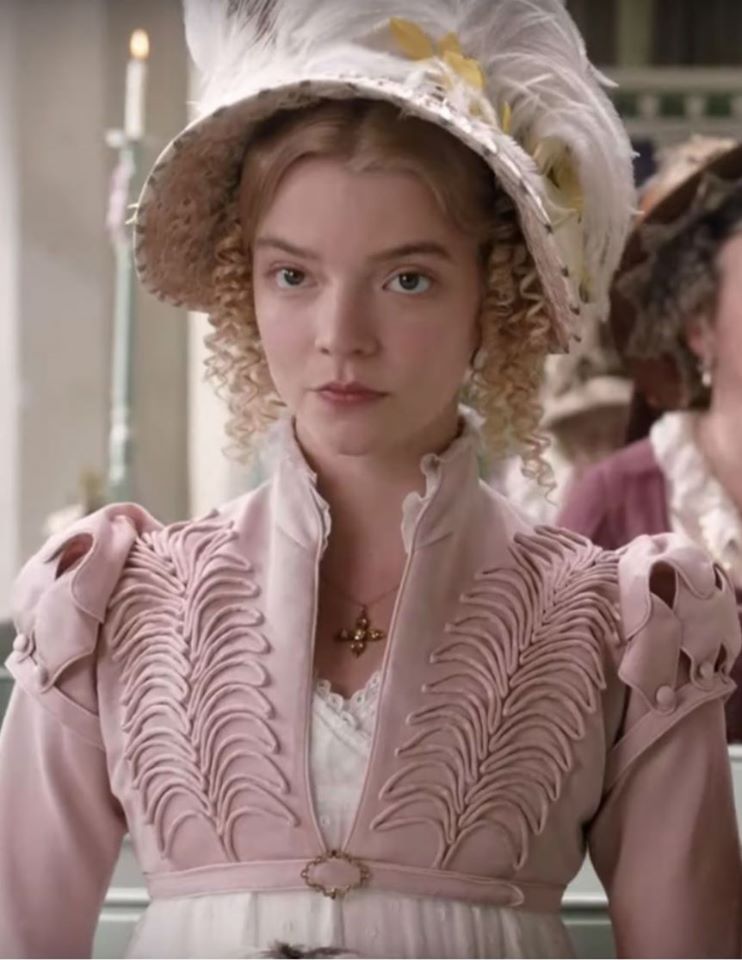
Miss Emma Woodhouse in a pink spencer jacket designed by Alexandra Byrne. Image courtesy of Focus Features © 2020.


A pink spencer jacket (front and back views) Chertsey Museum c1815, the original inspiration for the designer.
The use of coloured slips (silk petticoats) shows how the different shades created various pastel effects when worn under translucent muslin, a way of varying one’s wardrobe. The addition of a replica of the topaz cross Jane Austen owned is a lovely touch in Emma’s morning dress.

Left to right: actors Johnny Flynn and Anya Taylor-Joy in EMMA. Taylor-Joy is wearing a dress inspired by a c1810 original from the Victoria and Albert Museum in London.
When she dresses for evening, and for a ball, the popularity of newly-mechanised silk gauzes and nets is shown. Evening gowns of the late 1810s showed a trend for textiles even more translucent than muslin, festooned with decorative embellishment in the form of silk flowers, leaves, rouleaux, and geometric shapes. Here again white or coloured undergowns were essential as a ground for the airy confections to float over, as the wonderfully detailed 1818 painting by Rolinda Sharples shows.
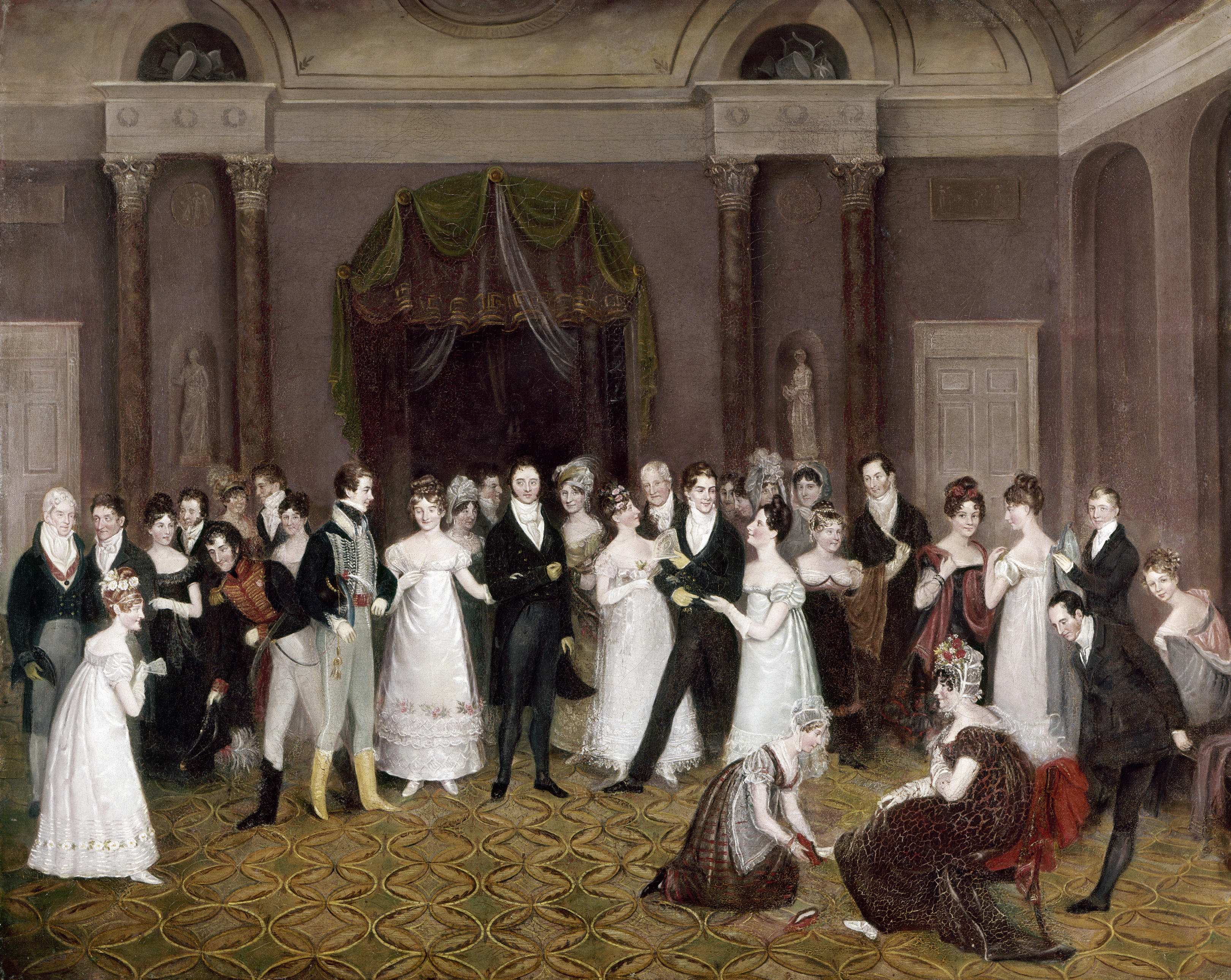
Clifton Assembly Rooms, by Rolinda Sharples (1818)
This sense of continuity in dress is also emphasised by how modular Emma’s wardrobe is. She wears the same dresses in different ways, changing the colour of the slip, adding a muslin, silk or wool spencer, or wearing one of fashion’s popular sleeveless bodices over a gown. Confusingly, these were also called corsets. Dresses reoccur in Emma’s wardrobe from season to season. Although she is wealthy, she is not extravagant, and the way she uses clothing reflects real-life gentry practices of the time found in account books and bills.

Red wool coats and cloaks were very popular during Regency times. Byrne included them for the parlor boarders’ uniform at Mrs. Goddard’s school.
Harriet Smith’s wardrobe is suitably and noticeably less fine, and her taste in hat decorations less refined. The stout red wool or worsted cloaks foreigners thought so peculiarly English, which appear in cheerful flashes across contemporary depictions of working women and those outside cities, here adorn a row of Smith’s fellow schoolgirls who punctuate the film like a row of scarlet ducks. Underneath, the girls wear a range of printed cottons underneath practical aprons. The other background characters’ costumes complete the rhythm of attentive world-building through their colours, cut and details, especially the servants’ livery.

Tea at Hartfield with Mr. and Mrs. Elton (Josh O’Connor and Tanya Reynolds). Mrs. Elton’s clothing reflects her personality: uptight, over the top, and insufferable.
By contrast, the excesses of the gloriously awful Mrs Elton are very well conveyed in dress. Her vulgarity shines through, silently counterpointing the understated elegance of Jane Fairfax in way that shows without telling what Austen’s prose revealed about the two women. Mrs. E’s over-trimmed dress is perfectly, periodly over-trimmed. Although her hair takes its extravagance from the next decade, its ridiculousness underscores her character.
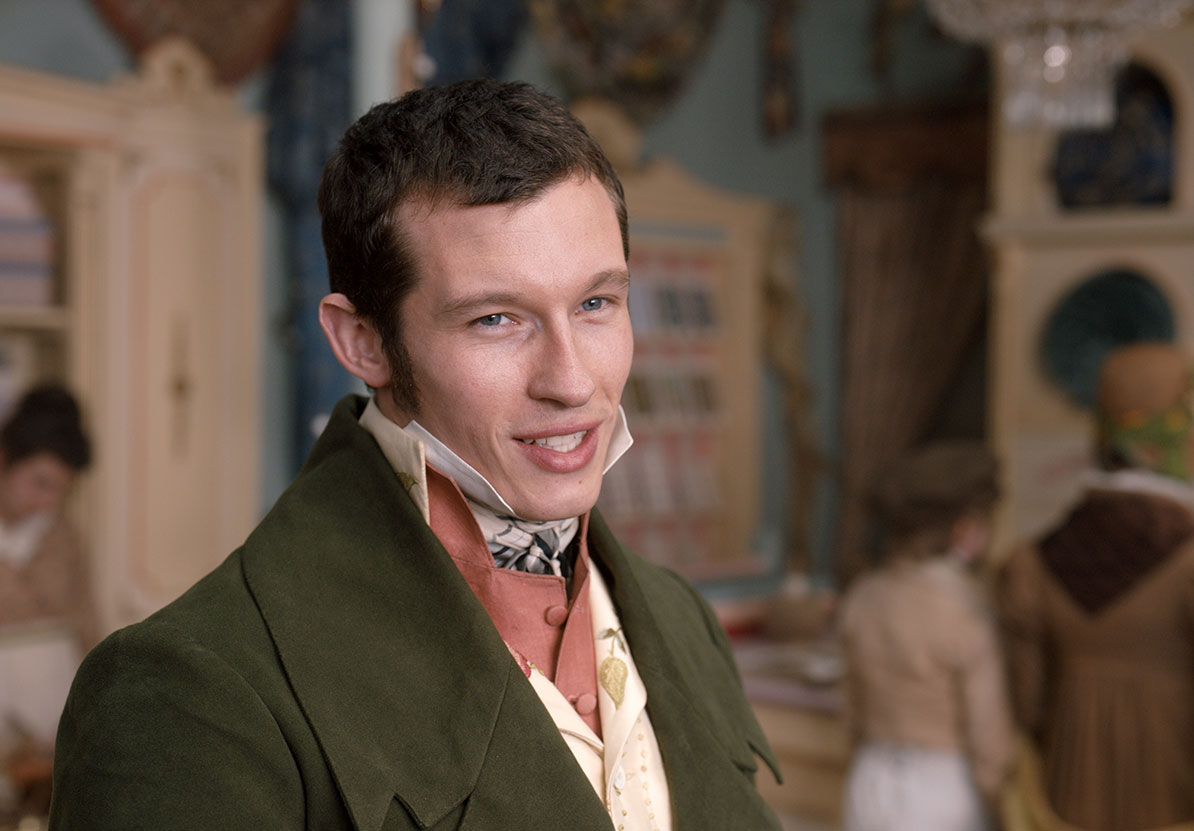
Callum Turner as Frank Churchill, Focus Features © 2020
I assess the quality of men’s Regency screen costumes by whether the edges of the wool coats are raw (the period way) or turned. Here, the heavily fulled wool of Mr Knightley’s buff coat sits crisp and cut at the edges of the typical M-shaped notch at the lapels. He and Frank Churchill wear two waistcoats. Churchill’s Hessian boots are pleated at the instep. The cravats are all tied differently. Lower status Robert Martin wears a fustian coat and flatter hat. These and many other small details of men’s dress create a period effect equal to the women’s costumes.

Bill Nighy as Mr. Woodhouse, Focus Features © 2020
My critique is that perhaps the homogeneity of the costuming’s fashionability lacks nuance in supporting the characters’ personalities, especially the older Highbury residents. Mr Woodhouse is bang up-to-date, and Mrs and Miss Bates are more directly of 1815 style than their income or inclinations would suggest. Likewise, the high collars which all the men affect was a dandiacal fashion. ‘Ears’ rising up past the chin were worn more by the young and those particularly concerned with appearance. Mr. Knightley’s collar points, I feel, would have been sensibly short, contrasting with the affectations of Messrs. Elton and Churchill, for whose characters the collar style is apt. The only big costume query is Harriet Smith’s knitted and crocheted spencers, garments for which I’ve never seen any evidence using those techniques.

The Dandy Club, by Richard Dighton (1818)
This is a very minor point though. Overall, what Emma.’s costumes share with the audience is the nuances of Regency fashion and the uses of clothing in a way rarely, if ever, depicted on screen. The attention to fabric, texture, dress practices, and countless other period details mean this film has set the Regency screen costume bar very high indeed. The next best is now the 1995 Persuasion – also designed by Alexandra Byrne. The film is a paean to dress and dressing and immerses the viewer into a world of Regency dress as Jane Austen would have understood it.
AUTHOR BIO
Hilary Davidson is a dress, textiles and fashion historian and curator. Her work encompasses making and knowing, things and theory, with an extraordinary understanding of how historic clothing objects come to be and how they function in culture. In 2007 Hilary became curator of fashion and decorative arts at the Museum of London. She contributed to the £20 million permanent gallery redevelopment opening in 2010, and curated an exhibition on pirates, while continuing to publish, teach and lecture in the UK and internationally.
Since 2012 Hilary has worked between Sydney and London as a freelance curator, historian, broadcaster, teacher, lecturer, consultant and designer. Current projects include Dress in the Age of Jane Austen (Yale, 2019), and completing a PhD by publication at La Trobe University, Melbourne, on knowledge making and materiality in pre-modern dress (2020).
WEBSITE | TWITTER | INSTAGRAM | GOODREADS
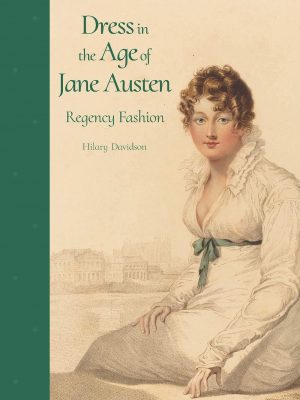 Dress in the Age of Jane Austen, by Hilary Davidson
A comprehensive and beautifully illustrated examination of dress, clothing, fashion, and sewing in the Regency seen through the lens of Jane Austen’s life and writings
This lively book reveals the clothing and fashion of the world depicted in Jane Austen’s beloved books, focusing on the long Regency between the years 1795 and 1825. During this period, accelerated change saw Britain’s turbulent entry into the modern age, and clothing reflected these transformations. Starting with the intimate perspective of clothing the self, Dress in the Age of Jane Austen moves outward through the social and cultural spheres of home, village, countryside, and cities, and into the wider national and global realms, exploring the varied ways people dressed to inhabit these environments. Jane Austen’s famously observant fictional writings, as well as her letters, provide the entry point for examining the Regency age’s rich complexity of fashion, dress, and textiles for men and women in their contemporary contexts.
Lavishly illustrated with paintings, drawings, historic garments, and fashion plates—including many previously unpublished images—this authoritative yet accessible book will help readers visualize the external selves of Austen’s immortal characters as clearly as she wrote of their internal ones. The result is an enhanced understanding of Austen’s work and time, and also of the history of one of Britain’s most distinctive fashion eras.
BOOK INFORMATION
- Dress in the Age of Jane Austen: Regency Fashion, by Hilary Davidson
- Yale University Press (November 12, 2019)
- Hardcover (336) pages
- ISBN: 9780300218725
- Genre: Fashion History
ADDITIONAL INFO | ADD TO GOODREADS
Austenprose is an Amazon affiliate. Film images courtesy of Focus Features © 2020; text Hilary Davidson © 2020, austenprose.com.
Discover more from Austenprose
Subscribe to get the latest posts sent to your email.

Great article. Really illuminating. I loved the costumes in this film so much – they’re the best I’ve ever seen in any JA adaptation. So good to know they’re mostly accurate too. The book sounds fascinating. Another one to add to the ever- growing TBR pile!
LikeLike
Thanks to Laurel Ann and Hilary for this informative article! Lovely photos, too. Glad to see solid accuracy in fashions. I immediately noticed the topaz cross in the photos and appreciated the touch.
LikeLike
Thank you so much for the wonderful article, ladies! Historical fashion is always so fascinating to me.
I’ve seen the newest Emma and while it’s not my favorite adaptation, it’s visually stunning, between the fashions, the architecture, and the geography.
LikeLike
I loved the costuming in this film and its great to see the details were accurate and reflected the characters themselves so much. Engaging post and I definitely want to page through Hilary’s book at some point. :)
LikeLike
Wonderful feature.
I loved the costumes from the movie and the movie itself.
denise
LikeLike
Me too Denise. The costumes became their own character. They were very dominant while I was viewing the movie. Thanks for visiting today, Best, LA
LikeLiked by 1 person
Loved this post! I love Jane Austen and I agree the fashion/outfits in this recent Emma movie was just incredible! I wanted her whole wardrobe.
LikeLike
The fashion is one of my favorite things about period dramas! Jane Austen is my all-time favorite author and I love all of the film adaptations, but this one was especially fun. I loved all the bright colors, and the fashion was amazing. Thank you so much for this post, it was so neat to learn a little bit more about it!
LikeLike