
Marianne began now to perceive that the desperation which had seized her at sixteen and a half, of ever seeing a man who could satisfy her ideas of perfection, had been rash and unjustifiable. Willoughby was all that her fancy had delineated in that unhappy hour and in every brighter period, as capable of attaching her; and his behaviour declared his wishes to be in that respect as earnest, as his abilities were strong. Marianne Dashwood, Sense and Sensibility, Chapter 10
The first episode of the BBC/PBS adaptation Sense and Sensibility by John Alexander/Andrew Davies aired last night on Masterpiece Classic. Its the final installment of their 2008 series, The Complete Jane Austen, and I am feeling a bit melancholy. So far we have enjoyed three new TV productions, two revivals of Austen’s novels, and the biopic, Miss Austen Regrets. This has been an incredible treat for Austen and period drama fans, the output of which has never been seen in such a condensed timeframe. Swoon worthy viewing indeed. Now, as we move on to the final stretch, it time to savor the last and longest of the new adaptations, Sense and Sensibility.
First off, it is very hard not to compare this version to the Ang Lee/Emma Thompson highly acclaimed and awarded winning 1995 movie of the same name. It reigns as my favorite Austen adaptation/pastiche. Pastiche you question? Well yes, since screenwriter Emma Thompson chose to only include four of Austen’s original lines in the script. Hard to believe, but there it is. The script was 99% her own interpretation. Andrew Davies took the same approach in rewriting Sense and Sensibility for this new television film, and then took it to another level by creating new scenes, sexual situations, and implications that Jane Austen would never have included. However, almost two hundred years have passed since the publication of the novel, and this is a modernized adaptation.

Since this film aired in the UK in January, I was prepared by the advance flak on the sexual stuff, and it existed as more of a nuisance than a hindrance. I knew it was coming, so I just let it fly by without much thought. Visually the film is beautiful. Stunning actually. I must send my compliments to the design trio of James Merrifield (Production), Paul Ghirardani (Art), and Michele Clapton (Costume) for making it so believable and realistic to Regency times. Their sensitivity and creativity is the backbone of this production. However, the real mastery is from Cinematographer Sean Bobbit who captures all the grandeur of the privileged comfort and ease of life at the Norland estate, and then throws us and the Dashwood’s into the cold reality of their new bleak rustic cottage on the Devonshire coast – – with howling wind, crashing waves and pouring rain. Burr… I shuddered at the stark contrast and am reminded how different this cottage is to that fairy-tale enchanted home of the Dashwoods in the 1995 film. Honestly, I would have moved into that cottage in a heartbeat.
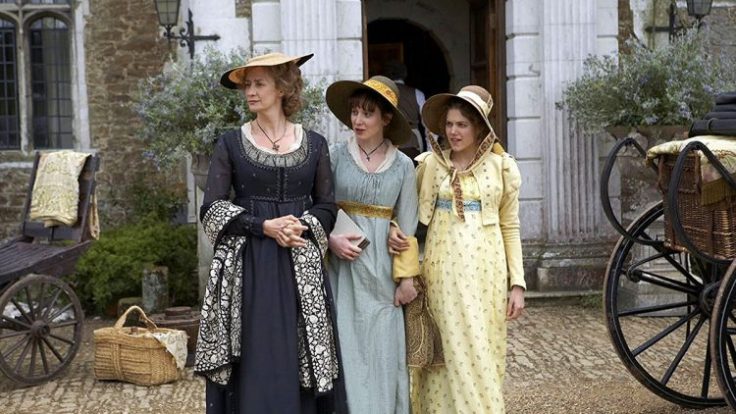
The cast is promising, for the most part. Stoic and realistic Elinor Dashwood is well matched to Hattie Morahan. Thankfully, she is physically appropriate. I love actress Emma Thompson, but she was about ten years too old to play the role in the 1995 film. Impetuous and free-wheeling Marianne Dashwood is aptly portrayed by Charity Wakefield. I still prefer Kate Winslet’s energetic and emotional interpretation.
At times, I think that director John Alexander has laid a heavy hand on the two main female characters by making them such extreme polar opposites – – Elinor incredibly too sensible, to the point of implosion, and Marianne frenzied and bitter to the point of nastiness in defense of her romantic way of opposing propriety. Austen was much more subtle in her approach and I miss that touch of irony and humor that play off the reality of the desperate situation that the Dashwood ladies are thrown into.

My biggest disappointment so far is in the male characters. David Morrissey who some say is a appealing, is duller than dishwater to me as the long suffering Colonel Brandon. Where is the honorable, distinguished war hero and elegant ‘gentle’ man portrayed by Alan Rickman in the 1995 version? This Brandon may very well wear flannel waistcoats under his costume to keep warm because he is icy cold and generates no heat for me. Dominic Cooper as dashing cad John Willoughby is just scary. I distrusted him from the first moment and expected horns to sprout out of that thick black mop of hair! Where is the smooth, affable charm and physical presence of the 1995 Willoughby, Greg Wise? One is puzzled what attractions Marianne saw in either of these two suitors? A big disappointment to me, really. They are the weakest link in the film so far.

The highlight of episode one was the performance of Dan Stevens as Edward Ferrars. He is what Edward ought to be — sensitive, caring, level-headed, and fun. Not the foppish weakling that Hugh Grant turned him into in the 1995 film. Sorry Hugh, but Ang Lee did not direct you correctly, or let you do what you wanted too unfortunately, and it came across all wrong. Dan Stevens, on the other hand, is quite promising as Edward. He shows the inner conflicts honestly, without apology, like a real man, and we are endeared. We also see the attraction that Elinor feels for him. He is believable and appealing, two important characteristics for a hero.
There are many favorable reviews online that I found of interest. One actually credits Andrew Davies script for the success of the film. I must agree, sort of! Even though I do not like all of his choices of interpretation of Jane Austen intensions, and dislike his sex scenes, he has not done any real harm, so far. My biggest disappointment, is the lack of humor. Let’s hope that episode two shows us Austen’s real talent at irony and wit.

Sense and Sensibility continues next Sunday, April 6th on Masterpiece Classic at 9:00 pm on PBS. I am really looking forward to the introduction of some of my favorite characters such as the dotty and crafty Steele sisters, the acerbic and droll Mr. Palmer, and Mrs. Ferrars in all her regal acerbity.
FURTHER READING
- Read our Preview of Sense and Sensibility (2008)
- Read our Review of Sense and Sensibility (2008) Episode Two
Discover more from Austenprose
Subscribe to get the latest posts sent to your email.

Hmmm. I did a paper last spring on Sense and Sensibility adapted by Emma Thompson, and after going through the screenplay and the novel side by side, I think the claim that she only have four or five lines from the book is completely exaggerated. I’d estimate at least 80% of the lines are nearly directly from the book, with only a word or two changed or omitted. I don’t honestly know why this idea has been perpetrated so far – even by Thompson herself. It is a very creative adaptation, to be sure, but a careful analysis shows that it owes most of it’s best lines (and funniest) to Austen herself, with little alteration.
However, I much prefer this latest film. Not being as demanding of humor in my adaptations, I don’t mind the darker, serious tone of Davies Emma and Sense and Sensibility. I don’t really like the sex scene, but I do approve of the chronology. And the film really improves as you get on.
I also really like Mark Williams’ Sir John – a very typical Davies character, friendly, earthy, not too bright, but incredibly warm and welcoming – rather like Sir William Lucas from Pride and Prejudice, Mr. Weston from Emma, and Mr. Allen from Northanger Abbey. His Margaret also fits into his adaptational style, fitting in with the many children he includes in his previous work.
But for me, the star of the show is Elinor. Far from being sensible to the point of explosion, I think Davies and Alexander give her small, solitary ways to express her emotion, such as the rug beating scene. Her inner goodness and kindness to others are powerfully endearing, while her inner passion shows in her eyes and some tiny scenes like the abovementioned one. I really prefer Hattie Morahan’s performance, because of those little moments of relief, where Emma Thompson, for all her brilliance as an actress, tended to do the explosion mentioned.
All in all, a wonderful production – and one I can’t wait for the next part.
LikeLike
LOVE Dan Stevens, but David Morrisey has one thing over Alan Rickman – he more closely resembles the character I had envisioned when I read the book :) However, Alan acted the subtleties of the part better. I can’t wait for the second half!
LikeLike
“….expected horns to sprout out of that thick black mop of hair”
Yes, indeed! :D
LikeLike
Hello Ladies, and thank you for stopping by.
I. Miller, I am very surprised about Emma Thompson’s script being 80% of Austen. I watched it this past week, and I did not catch that. I must listen more closely. Elinor is wonderful and I agree.
lookingforlifeshumor, I don’t think that either Morrissey or Rickman have gotten Brandon right. I won’t be convinced until the next attempt sparks a real longing in me for Brandon and Marianne to be together.
cbrunette, why did they make Willoughby so unappealing? What did Marianne see in him except that he was younger than Brandon. I did not feel the chemistry between them at all. Showing the seduction scene at the begining set up his downfall too soon for those who have read the book, or seen other adaptations.
I am looking forward to episode two, Cheers, Laurel Ann
LikeLike
While David Morrissey isn’t perfect as Brandon, I like him in the role much better than Alan Rickman (but then again, I’ve always liked Liam Neeson more than Alan Rickman, and that’s who David Morrissey reminds me of). And I like the subtlety in Brandon and Marianne’s early relationship—before she realizes he LIKES her—much better than the ’95 version. It makes it more logical if she liked him in the beginning, as an intelligent man who shared common interests, that she’d eventually fall in love with him.
I can’t stand the new Willoughby. He telegraphs his treacherous nature from the moment he comes on screen (well, the moment he comes on screen when we actually see his face). Greg Wise, apart from being much better looking, gave the character such a sensual playfulness that when I first saw the ’95 film—not having read the book—I was heartbroken right along with Marianne when his true nature was revealed.
I think my biggest gripe (so far) with this adaptation is the purely invented scene between Brandon and Willoughby when Brandon asks W what his intentions toward Marianne are. I know Andrew Davies likes to add scenes to his adaptations that show just the male characters together, but I have a really hard time believing that’s a conversation that would have ever taken place between these two characters.
I’m really looking forward to the introduction of the remaining secondary characters . . . I just have a feeling that Imelda Staunton and Hugh Laurie are going to be greatly missed.
LikeLike
2008? Why is this posted now? I do have this on DVD as well as the other versions. Interesting review.
LikeLike
Sorry, Shelia. I edited the pictures today and I guess that WordPress considered it a new post?
LikeLike