Feeds:
Posts
Comments

Archive for the ‘Jane Austen’s Pride & Prejudice’ Category

The History of England, by Jane Austen excerpt p 171Inquiring reader Lily recently wrote to me and expressed her frustration at not being able to locate the publication dates of Jane Austen’s minor works online. Ever the accommodating Janeite, here is a partial list of her published works.

Novels: (c. 1794-1817)

  • Sense and Sensibility: (30 October 1811) Thomas Egerton, Military Library (Whitehall, London)
  • Pride and Prejudice: (28 January 1813) Thomas Egerton, Military Library (Whitehall, London)
  • Mansfield Park: (July 1814) Thomas Egerton, Military Library (Whitehall, London)
  • Emma: (December 1815) John Murray (London)
  • Northanger Abbey: (December 1817) John Murray (London)
  • Persuasion: (December 1817) John Murray (London)

Image of Jane Austen Minor Works Volume 1 at The Bodleian Library Oxford, England

Juvenilia: (c. 1787-98) Three manuscript notebooks containing 27 items.

Volume the First (c. 1787-90) was first edited by R. W. Chapman and published by Clarendon Press, Oxford in 1933. It is now owned by the Bodleian Library, Oxford.

  • Frederic & Elfredia
  • Jack & Alice
  • Edgar & Emma
  • Henry & Eliza
  • The adventures of Mr. Harley
  • Sir William Mountague
  • Memoirs of Mr. Clifford
  • The Beautiful Cassandra
  • Amelia Webster
  • The Visit
  • The Mystery
  • The Three Sisters
  • A beautiful description
  • The generous Curate
  • Ode to Pity

Volume the Second (c. 1790-93) was first published by Chatto & Windus in 1922. It is now owned by The British Museum.

  • Love and Freindship (Austen’s original spelling of friendship)
  • Lesley Castle
  • The History of England
  • A Collections of Letters
  • The female philosopher
  • The first Act of a Comedy
  • A Letter from a Young Lady
  • A Tour through Wales
  • A Tale

Volume the Third (c. 1792) was first edited by R. W. Chapman and published by Clarendon Press, Oxford in 1951. It is now owned by The British Museum.

  • Evelyn
  • Catharine, or the Bower

Illustration from The History of England, by Jane and Cassandra Austen

Novella:

  • Lady Susan: (c. 1793-4) was first published in part in A Memoir of Jane Austen, by James Edward Austen-Leigh in the second edition of 1871, and later, a full record of the manuscript alterations was edited by R. W. Chapman and included in the Oxford Press edition of 1923. The manuscript is now owned by The Pierpont Morgan Library, New York.

Fragments of Novels:

  • The Watson’s: (c. 1804-5) was first was first published in part in A Memoir of Jane Austen, by James Edward Austen-Leigh in the second edition of 1871. The first six leaves of the manuscript were sold and later acquired by The Pierpont Morgan Library, New York. The remained of the manuscript (minus recently missing pages) was sold last year to The Bodleian Library, Oxford.
  • Sanditon: (1817) an extract was first published (about one-sixth) in A Memoir of Jane Austen, by James Edward Austen-Leigh in the second edition of 1871. The manuscript is now owned by the King’s College Library, Cambridge.

You can visit digital images of many of the existing original Jane Austen manuscripts in her handwriting online at the awe inspiring website Jane Austen Fiction Manuscripts. Enjoy!

Cheers,

Laurel Ann

© 2007 – 2012 Laurel Ann Nattress, Austenprose

Read Full Post »

Pride and Prejudice, by Jane Austen, J. M. Dent & Co, London (1907)I could not let this day pass without wishing Jane Austen’s novel, Pride and Prejudice a happy 199th birthday.

Written between October 1796 and August 1797, Pride and Prejudice was first entitled First Impression and would not premiere on the printed page until after many revisions and another sixteen years. Publisher Thomas Egerton of Whitehall (London) purchased the copyright from Jane Austen for £110 (worth £3,735.60 or $5,867.77 today). She would make no further pecuniary emolument from her most popular novel in her lifetime.

We have all had the pleasure of enjoying her “light, bright and sparkling” prose for almost 200 years now. Renowned for her witty dialogue, the friction between Austen’s hero Mr. Darcy and heroine Elizabeth Bennet has given us some of the most memorable lines in literature. Here are a few of my favorites:

“She is tolerable; but not handsome enough to tempt me; I am in no humour at present to give consequence to young ladies who are slighted by other men. You had better return to your partner and enjoy her smiles, for you are wasting your time with me.” (Mr Darcy to Mr. Bingley about Elizabeth Bennet; Ch. 3)

“I could easily forgive his pride, if he had not mortified mine.” (Elizabeth Bennet about Mr. Darcy; Ch. 5)

“Your conjecture is totally wrong, I assure you. My mind was more agreeably engaged. I have been meditating on the very great pleasure which a pair of fine eyes in the face of a pretty woman can bestow.” (Mr. Darcy to Miss Bingley; Ch. 6)

“A lady’s imagination is very rapid; it jumps from admiration to love, from love to matrimony, in a moment.” (Mr. Darcy to Miss Bingley; Ch. 6)

“Nothing is more deceitful,” said Darcy, “than the appearance of humility. It is often only carelessness of opinion, and sometimes an indirect boast.” (Mr. Darcy; Ch. 10)

“There is, I believe, in every disposition a tendency to some particular evil— a natural defect, which not even the best education can overcome.”

“And your defect is a propensity to hate everybody.”

“And yours,” he replied with a smile, “is willfully to misunderstand them.” (Mr. Darcy and Elizabeth Bennet; Ch. 11)

“It is particularly incumbent on those who never change their opinion, to be secure of judging properly at first.”

“May I ask to what these questions tend?”

“Merely to the illustration of your character,” said she, endeavouring to shake off her gravity. “I am trying to make it out.”

“And what is your success?”

She shook her head. “I do not get on at all. I hear such different accounts of you as puzzle me exceedingly.” (Mr. Darcy and Elizabeth Bennet; Ch. 18)

“There are few people whom I really love, and still fewer of whom I think well. The more I see of the world, the more am I dissatisfied with it…” (Elizabeth Bennet; Chapter 24)

“There is a stubbornness about me that never can bear to be frightened at the will of others. My courage always rises at every attempt to intimidate me.” (Elizabeth Bennet; Chapter 31)

“I certainly have not the talent which some people possess,” said Darcy, “of conversing easily with those I have never seen before. I cannot catch their tone of conversation, or appear interested in their concerns, as I often see done.”

“My fingers,” said Elizabeth, “do not move over this instrument in the masterly manner which I see so many women’s do. They have not the same force or rapidity, and do not produce the same expression. But then I have always supposed it to be my own fault- because I would not take the trouble of practising…” (Mr. Darcy and Elizabeth Bennet; Ch. 31)

“In vain I have struggled. It will not do. My feelings will not be repressed. You must allow me to tell you how ardently I admire and love you.” (Mr. Darcy; Ch. 34)

“I have never desired your good opinion, and you have certainly bestowed it most unwillingly. I am sorry to have occasioned pain to anyone. It has been most unconsciously done, however, and I hope will be of short duration.” (Elizabeth Bennet; Ch. 34)

“From the very beginning— from the first moment, I may almost say— of my acquaintance with you, your manners, impressing me with the fullest belief of your arrogance, your conceit, and your selfish disdain of the feelings of others, were such as to form the groundwork of disapprobation on which succeeding events have built so immovable a dislike; and I had not known you a month before I felt that you were the last man in the world whom I could ever be prevailed on to marry.” (Elizabeth Bennet; Ch. 34)

“If Mr. Darcy is neither by honour nor inclination confined to his cousin, why is not he to make another choice? And if I am that choice, why may not I accept him?”

“Because honour, decorum, prudence, nay, interest, forbid it. Yes, Miss Bennet, interest; for do not expect to be noticed by his family or friends, if you wilfully act against the inclinations of all. You will be censured, slighted, and despised, by everyone connected with him. Your alliance will be a disgrace; your name will never even be mentioned by any of us.”

“These are heavy misfortunes,” replied Elizabeth. “But the wife of Mr. Darcy must have such extraordinary sources of happiness necessarily attached to her situation, that she could, upon the whole, have no cause to repine.” (Lady Catherine and Elizabeth Bennet; Ch. 56)

“You are too generous to trifle with me. If your feelings are still what they were last April, tell me so at once. My affections and wishes are unchanged, but one word from you will silence me on this subject for ever.” (Mr. Darcy; Ch. 58)

“My dearest sister, now be serious. I want to talk very seriously. Let me know every thing that I am to know, without delay. Will you tell me how long you have loved him?”

“It has been coming on so gradually, that I hardly know when it began. But I believe I must date it from my first seeing his beautiful grounds at Pemberley.” (Jane Bennet and Elizabeth Bennet; Ch. 59)

“I cannot fix on the hour, or the look, or the words, which laid the foundation. It is too long ago. I was in the middle before I knew that I had begun.” (Mr. Darcy; Ch. 60)

These are only a few of the amazing moments in Pride and Prejudice. Did I miss some your favorites? If so, do share.

Cheers,

Laurel Ann

© 2007 – 2012, Laurel Ann Nattress, Austenprose

Read Full Post »

Gentle Readers: in celebration of the ‘Pride and Prejudice without Zombies’ event over the next month, I have asked several of my fellow Jane Austen bloggers to share their knowledge and interest in Austen’s most popular novel. Today, please welcome guest blogger Jane Odiwe from Jane Austen Sequels blog and author of Lydia Bennet’s Story and Willoughby’s Return who shares with us her extensive knowledge of Austen’s memorable characterizations of her hero and heroine, Mr. Darcy and Elizabeth Bennet. Watch for Jane’s new Pride and Prejudice sequel Mr. Darcy’s Secret* to be released in February 2011 by Sourcebooks.

Thank you Laurel Ann for asking me to guest blog today!

Elizabeth Bennet and Fitzwilliam Darcy are perhaps Jane Austen’s most beloved characters. Pride and Prejudice was written more than two hundred years ago, yet these characters remain as fresh and irresistibly fascinating to us as they were for the first generations that read their tale, and remain the standard by which all other characters in a love story are judged.

So, why do we love them so much? Jane Austen tells their story through Elizabeth’s eyes so it’s easy to identify with this heroine who is lively, witty, and loveable as much for her faults as for her charms. We identify with her because we feel she is like us. She is capable of making mistakes, but having realised her errors, she changes and grows as a result. We see her character develop as the story enfolds.

The first time we really meet Elizabeth it is at the Meryton Assembly where the proud Mr Darcy is also in attendance with his affable friend Mr Bingley. There is a lack of gentlemen at the ball, and Lizzy has to sit out for two dances. Mr Darcy is seen to be behaving in a particularly disagreeable manner. He only dances with Mr Bingley’s sisters and ignores everyone else in the room. Everyone has heard that he is a rich landowner, but his wealth and power coupled with his anti-social manners only serve to make him appear arrogant. He doesn’t seem to care that his words may be overheard or that his speech is insulting. In fact, he is almost goading Elizabeth whom he has heard described as a pretty girl. He actually makes sure that Lizzy is looking at him before he speaks. It’s almost as if he wants her to hear, and make her aware that he can attract, and have any woman in the room.

“She is tolerable; but not handsome enough to tempt me; and I am in no humour at present to give consequence to young ladies who are slighted by other men.”

It’s a real put down, and as an unsurprising consequence, she dislikes him instantly!

Continue reading at Jane Austen Sequels

Further reading

Upcoming event posts

Day 22   July 24   Swag winners announced

*Mr. Darcy’s Secret, by Jane Odiwe: After capturing the heart of one of the richest man in England, Elizabeth Darcy believes her happiness is complete until mysterious affairs involving Mr Darcy’s past, and concerns over his sister Georgiana’s own troubled path to happiness present Elizabeth with fresh challenges to test her integrity, honour, and sweet nature as she fights her old fears and feelings of pride and prejudice. However, nothing can daunt our sparkling and witty heroine or dim her sense of fun as Elizabeth and the powerful, compelling figure of Mr Darcy take centre stage in this romantic tale set against the dramatic backdrops of Regency Derbyshire and the Lakes amongst the characters we love so well. (beautiful watercolor illustration of Darcy and Lizzy above is by ©Jane Odiwe as well!)

Read Full Post »

“But, Lizzy, you look as if you did not enjoy it. You are not going to be missish, I hope, and pretend to be affronted at an idle report. For what do we live, but to make sport for our neighbours, and laugh at them in our turn?” Mr. Bennet, Chapter 57

Quick synopsis

Elizabeth reflects upon the meaning of Lady Catherine’s visit. A letter arrives from Mr. Collins strongly warning Elizabeth not to enter into an unsanctioned engagement with Lady Catherine’s nephew. Mr. Bennet thinks it highly amusing and absurd that Mr. Darcy is interested in his daughter. Darcy returns and renews his affections. Elizabeth accepts his present assurances with gratitude and pleasure. Darcy admits his pride and Elizabeth humbled him into changing. She tells Jane who is incredulous and thinks she is joking. She tells her father and he is incredulous. The couple confess all to each other. Lizzy teases that he liked her because she was impertinent. Lady Catherine’s actions had removed any of his doubts and gave him hope. Elizabeth writes and informs Mrs. Gardiner. Happy is the day that Mrs. Bennet got rid of two of her daughters.

Musings

It was a rational scheme, to be sure! but from what the report of their engagement could originate, Elizabeth was at a loss to imagine; till she recollected that his being the intimate friend of Bingley, and her being the sister of Jane, was enough, at a time when the expectation of one wedding made everybody eager for another, to supply the idea. That Narrator, Chapter 57

Lady Catherine departs in a cloud of anger after her battle of words with Elizabeth leaving the victor wondering how she had been informed of Mr. Darcy being on the brink of proposing. Being very inquisitive, Elizabeth runs through all the options and decides it is her sister Jane leaking info to her fiancé Mr. Bingley. I think Austen is being so true to human nature through her heroine. After a big blow up, most women need to deconstruct to understand feelings and rationalize  facts. Whom among us has not done the exact thing with their girlfriends? Elizabeth, being the “conceited independent” discusses it with herself like a sleuth sorting out the facts and suspects. When Mr. Collins’ letter arrives warning Mr. Bennet against his daughter entering into an engagement with Lady Catherine’s nephew, the Lucas’ are fingered. Elizabeth will not know the truth until the man himself informs her, and of course Austen supplies a nice ironic twist to it that which I will mention a bit later. Mr. Bennet’s reaction to Mr. Collins’ is classic. He finds only the amusement in it and cannot fathom any truth to the rumor. “Had they fixed on any other man, it would have been nothing; but his perfect indifference, and your pointed dislike, make it so delightfully absurd!” His reaction is just. Elizabeth has not shown or shared with her family her preference for him, only her previous dislike. Elizabeth’s reply softens his resistance to her entering into a match without love. She does love him and that is enough for her father to give his consent.

“You are too generous to trifle with me. If your feelings are still what they were last April, tell me so at once. My affections and wishes are unchanged; but one word from you will silence me on this subject for ever.” Mr. Darcy, Chapter 58

Upon his return to Hertfordshire, Darcy soon informs her of his feelings with one of Austen’s most memorable lines (for me). At this moment, both of their lives hang in the balance. We are on pins and needles even though we know the outcome. He has put himself at her mercy. Her decision will decide their fate. He has applied himself in an open and nonthreatening way. All of his pride and arrogance has subsided. What a different man this is before her. Her reaction in the face of an important life decision is quite different than the first time around and in alignment with his tone and openness.

Elizabeth, feeling all the more than common awkwardness and anxiety of his situation, now forced herself to speak; and immediately, though not very fluently, gave him to understand that her sentiments had undergone so material a change since the period to which he alluded, as to make her receive with gratitude and pleasure his present assurances. The happiness which this reply produced was such as he had probably never felt before, and he expressed himself on the occasion as sensibly and as warmly as a man violently in love can be supposed to do. The Narrator, Chapter 58

As with most life altering events, one is numb and unable to speak. “They walked on, without knowing in what direction.” Ha!

Done. Huzzah! Love prevails and we only have the lover’s tête à tête to tie things up neatly. They both make important confessions; Darcy more so. Elizabeth wants him to forget the past, especially the circumstances that prompted him to write the “Be not alarmed, madam” letter.

“But think no more of the letter. The feelings of the person who wrote and the person who received it are now so widely different from what they were then, that every unpleasant circumstance attending it, ought to be forgotten. You must learn some of my philosophy. Think only of the past as its remembrance gives you pleasure.” Elizabeth Bennet, Chapter 58

As if Darcy confessing his love and previous faults was not enough, Austen really pushes the contrition and absolution thing farther than we could ever expect from any man. This next line may be the reason why Mr. Darcy is the romantic icon of the ages.

“Such I was, from eight to eight-and-twenty; and such I might still have been but for you, dearest, loveliest Elizabeth! What do I not owe you! You taught me a lesson, hard indeed at first, but most advantageous. By you I was properly humbled. I came to you without a doubt of my reception. You shewed me how insufficient were all my pretensions to please a woman worthy of being pleased.” Mr. Darcy, Chapter 58

Swoon. This, I believe, is so appealing to women because what man ‘DO’ we know who would confess his love, bare his soul, and tell you that you have made him a better man? I haven’t met one yet. Do they exist? It seems too much to expect of any one person. Men don’t think that way, at least in my experience. You know – the Venus and Mars thing. I believe that Mr. Darcy is so appealing because he does admit his faults and change for the sake of the love of a woman. He may have been Austen’s fantasy, but she sent him out into the world and he is now everyone’s ideal.

“You are joking, Lizzy. This cannot be! — engaged to Mr. Darcy! — No, no, you shall not deceive me. I know it to be impossible.” Jane Bennet, Chapter 59

Elizabeth shares her news with Jane, her dearest friend who knows her best in the world, and she thinks she is joking with her. “And do you really love him quite well enough? Oh, Lizzy! do anything rather than marry without affection.” (Shades of Jane Austen advising her niece Fanny Austen Knight on her own love and romance in the future.) And in proper Austen style of following a character revelation, she supplies us with a joke.

“It has been coming on so gradually, that I hardly know when it began. But I believe I must date it from my first seeing his beautiful grounds at Pemberley.” Elizabeth Bennet, Chapter 59

Much has been discussed about this line. Was Elizabeth mercenary or so moved by seeing how un-prideful and un-ostentatious Pemberley was that she fell in love with its owner? This is a toss-up for me. I am inclined to say both, leaning on the later. When she arrived at Pemberley her feeling for him had softened since their last tumultuous first proposal scene and his subsequent letter. Seeing his home and listening to his servants praise him changes her even more. When he arrived and his civility matched his surroundings, she was amazed. So yes, she was swayed by seeing his beautiful grounds at Pemberley, but not entirely for financial reasons. Now she must convince her sister who she has shared almost all of her secrets with that she does love him.

And, then the same incredulous reaction from her father!

“Lizzy,” said he, “what are you doing? Are you out of your senses, to be accepting this man? Have not you always hated him?” Mr. Bennet

“I do, I do like him,” she replied, with tears in her eyes; “I love him. Indeed he has no improper pride. He is perfectly amiable. You do not know what he really is; then pray do not pain me by speaking of him in such terms.” Elizabeth Bennet, Chapter 59

He offers his consent, with this poignant caveat. “My child, let me not have the grief of seeing you unable to respect your partner in life. You know not what you are about.” One wonders at this line the full extent of the back story of why Mr. and Mrs. Bennet married. We are never told, but if Lydia’s personality and impulsiveness are similar to her mother’s, one can project the outcome.

Ok, so chapter 60 does seem like overkill to me, but I still read it and weep. Best line for me.

“I cannot fix on the hour, or the spot, or the look, or the words, which laid the foundation. It is too long ago. I was in the middle before I knew that I had begun.” Mr. Darcy, Chapter 60

And the mystery of how Lady Catherine was informed of her nephew’s serious interest and possible proposal to Elizabeth are revealed by a primary source, Mr. Darcy himself. The irony of it is that if Lady Catherine had not been officious and superior, they may not of had the means of re-uniting. So, her trip to visit Elizabeth and exact her promise not to marry her nephew had the exact opposite effect of her initial motive. Another Austen reproof checked off the list.

“Lady Catherine’s unjustifiable endeavours to separate us were the means of removing all my doubts.” Mr. Darcy, Chapter 60

Elizabeth writes to her aunt Gardiner to tell her the news of their engagement. She is such a tease she cannot just flatly state the facts. Ha!

“But now suppose as much as you (Mrs. Gardiner) chuse; give a loose to your fancy, indulge your imagination in every possible flight which the subject will afford, and unless you believe me actually married, you cannot greatly err. You must write again very soon, and praise him a great deal more than you did in your last.” Elizabeth Bennet, Chapter 60

And we come to the final denouement where Austen wraps up all the loose ribbons with bits of irony and amusement. The novel opened with Mrs. Bennet fretting over her five unmarried daughters and by the last chapter she has seen three of them married. The business of her life is almost complete.

Happy for all her maternal feelings was the day on which Mrs. Bennet got rid of her two most deserving daughters. The Narrator, Chapter 61

Austen adds a closing passage for most of the minor characters. Georgiana is happy with her new sister, Kitty’s situation and deportment improves with the influence of her two elder sisters social standings and connections, Lydia and Wickham out spend their income and his “affection for her soon sunk into indifference: her’s lasted a little longer; and in spite of her youth and her manners, she retained all the claims to reputation which her marriage had given her.” I have often wondered if Austen was slyly implying that Lydia would cuckold him. ;-)

Ah, and Miss Bingley. She cannot be forgotten and is given her reprove as well.

Miss Bingley was very deeply mortified by Darcy’s marriage; but as she thought it advisable to retain the right of visiting at Pemberley, she dropt all her resentment; was fonder than ever of Georgiana, almost as attentive to Darcy as heretofore, and paid off every arrear of civility to Elizabeth. The Narrator, Chapter 61

And ending on a happy note of gratitude and regard “towards the persons (Mr. and Mrs. Gardiner)who, by bringing her into Derbyshire, had been the means of uniting them” Elizabeth and Darcy ride off into the sunset. (in a barouche-landau of course)

Finis

‘Pride and Prejudice without Zombies’: Day 20  Giveaway

Enter a chance to win one copy of the Dover Classics  edition of Pride and Prejudice, by Jane Austen by leaving a comment stating if you think chapter 60 is overkill gushing or which your favorite quote is from the novel by midnight, Saturday, July 24th, 2010. Winner will be announced on Sunday, July 25th. Shipment to continental US addresses only. Good luck!

Upcoming event posts

Day 21   July 16   Mr. Darcy & Elizabeth Bennet
Day 22   July 24   Swag winners announced

Read Full Post »

Gentle Readers: in celebration of the ‘Pride and Prejudice without Zombies’ event over the next month, I have asked several of my fellow Jane Austen bloggers to share their knowledge and interest in Austen’s most popular novel. Today, please welcome guest blogger Vic from Jane Austen’s World who shares with us her extensive knowledge of Regency culture and history in four posts during the event. Her fourth contribution is on music during Jane Austen’s era, how it influenced her life, and her writing.

“Yes, yes, we will have a pianoforte, as good a one as can be got for 30 guineas, and I will practice country dances, that we may have some amusement for our nephews and nieces, when we have the pleasure of their company.” – Jane Austen to Cassandra, 1808

Like many ladies of her era, Jane Austen was an accomplished musician. And so were her characters. In Pride and Prejudice, Mary Bennet, Elizabeth Bennet, the Bingley sisters and Georgiana Darcy could all play instruments with skill. Lady Catherine de Bourgh would have been a proficient, as would her daughter Anne, had she learned and practiced. Before the age of electricity and cable the world was largely silent musically speaking, save for the music played by family members, local musicians, or more famous musicians who were paid to play for the rich.

Musicians wandered the land, and London streets offered a pandemonium of sounds, much of it derived from musical instruments. The only music available in the home was that which amateur or professional performers could produce on the spot, so that the ability to play music well was crucial for all walks of life. From childhood on, young ladies were expected to play a musical instrument and study with music masters. Gentlemen sang as well and formed impromptu amateur groups that entertained in taverns and men’s clubs.

Continue reading at Jane Austen’s World

Further reading

Upcoming event posts

Day 20   July 14   Group Read: Chapters 57 – 61
Day 21   July 16   Mr. Darcy & Elizabeth Bennet
Day 22   July 24   Swag winners announced

Read Full Post »

“How pleasant it is to spend an evening in this way! I declare after all there is no enjoyment like reading! How much sooner one tires of anything than of a book! When I have a house of my own, I shall be miserable if I have not an excellent library.” Caroline Bingley, Pride and Prejudice, Chapter 11

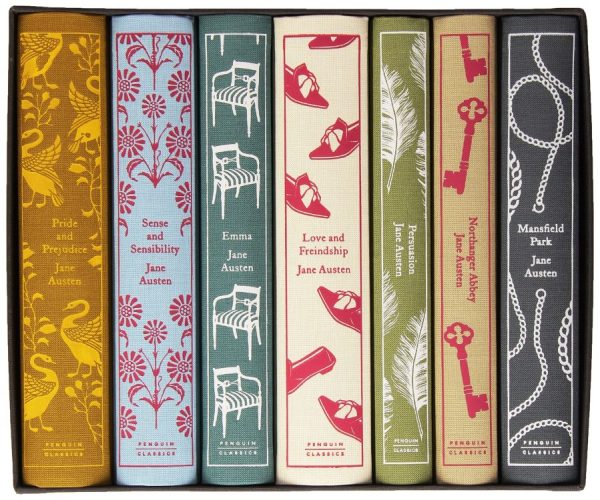
There are hundreds of Pride and Prejudice editions currently in print. Which ones do I like, and why? Here is a list of my ten favorite award winners (if I was giving out awards).

Best “prettyish kind of wilderness” cover

Pride and Prejudice (White’s Fine Edition), cover design by Kazuko Nomoto. Let’s start with the vanity editions because we all know that “vanity is a weakness indeed. But pride — where there is a real superiority of mind, pride will be always under good regulation.” Thank you very much Mr. Darcy for giving me permission to buy yet another edition of Pride and Prejudice for my library solely based on pride in my library. This lovely new edition of P&P has a striking cover design by Kazuko Nomoto of Regency-era slippers, Hessian boots, frocks and breeches that wraps around to the back; Decorative end papers; Colored page tops; Marker ribbon; Elegant type face; An authorative text (without attribution) and Thick, acid-free paper. Elegant and stylish, the couples are facing each other and I assume dancing, but since we do not see above their waists, they could be kissing! Naaagh. It is truly an edition to “exhibit” on your coffee or bedside table and not one to just read; its hefty 1 pound 9 ouches alone being the main deterrent. White’s Books (2009), hardcover, unabridged text (376) pages, ISBN: 978-0955881862

Best not your “common garden variety” cover

Pride and Prejudice (Penguin Classics Deluxe Edition), cover design by Reuben Toledo. Even though the silhouettes might look like stick insect runway models strutting to the black and white ball at Netherfield, I recognize them as our favorite literary duo appropriately walking away from each other after Darcy steps on her dress! I just imagine that Darcy has just given Lizzy the “be not alarmed Madame letter” and it all works for me. Get hip Janeites. We can now all be Austen fashionistas and exhibit our superior designer taste on our bedside tables. Now, (pray forgive) if our husbands, boyfriends, significant others or friends were ever in doubt of our obsession, this will certainly seal the deal. In defense, you can remind them that this new edition with the haute couture cover contains Penguin Classics definitive text and a brief biography of Jane Austen that Paris Hilton won’t read, but she might deem useful as a door stop. Read my full review of this edition here. Penguin Group (2009), trade paperback, unabridged text (339) pages, ISBN: 978-0143105428

Best “classic commentary” by dead authors

Pride and Prejudice (The Modern Library Classics Edition), introduction by Anna Quindlen. Supplemental material: Commentary by noted authors; Notes on the text; Brief biography of the author and a reading group guide. This compact and lightweight edition’s highlights (besides the obvious text) are the essays by authors Margaret Oliphant, George Saintsbury, Mark Twain, A. C. Bradley, Walter A. Raleigh and Virginia Woolf. Great for a student or veteran who needs to stash an extra copy in their car boot or desk drawer at work just in case you get in a debate and need a quick reference to quote passages illustrating why Mr. Darcy is proud and not shy. Random House (2000), trade paperback, unabridged text (304) pages, ISBN: 978-0679783268

Best “copycat” edition

Pride and Prejudice (Dover Classics Edition), preface by George Saintsbury, illustrated by Hugh Thomson. This beautiful replica of the ‘peacock edition’ of Pride and Prejudice is the next best thing to the ‘real thing’ since original copies of this highly collectible 1894 edition now command a handsome sum. Hugh Thomson’s illustrations tempered for the Victorian-era book market are a bit saccharine for me, but still beautiful. The preface by leading historian and literary critic of the day George Saintsbury is amusing. Even in 1894 Jane Austen had her fanboys. “In the novels of the last hundred years there are vast numbers of young ladies with whom it might be a pleasure to fall in love, – but to live with and marry, I do not know that any of them can come into competition with Elizabeth Bennet.” Dover Publication (2005), unabridged hardcover, text (476) pages, ISBN: 978-0486440910

Best “Twilighted” marketing ploy

Pride and Prejudice (Harper Teen Edition), no introduction. Supplemental material: No forward, no notes or appendixes in sight, but cool (for teens) selection of P&P Extras: The Jane Austen – Twilight Zone, by Shirley Kinney and Wallace Kinney; Which Pride and Prejudice Girl are You? Quiz; 10 Things You Didn’t Know About Jane Austen; What if Elizabeth and Mr. Darcy Lived Now and Were on Facebook?; and a short biography of the author thrown in for good measure. I will side with Mr. Collins in his evaluation of young ladies book taste in that “I have often observed how little young ladies are interested by books of a serious stamp, though written solely for their benefit. It amazes me, I confess; for, certainly, there can be nothing so advantageous to them as instruction.” The lack of supplemental information that might have “explained” the hard bits to young or neophyte readers would in this case, have been an advantage. Otherwise, the cover is a nice rip-off of the Twilight black background and inanimate objects representing the Twilight characters and wholly unconnected to Miss Austen’s. Harper Teen, trade paperback, unabridged text (472) pages, ISBN: 978-0061964367

Best “anecdotes and asides” for young readers with a Christian slant

Pride and Prejudice (Insight Edition), foreword by Nancy Moser. Supplemental material: Questions for conversation and a short biography of the author. The editors attempt to disarm reproof right out of the gate by stating that no “Regency historian, Austen scholar or doctoral literary critic” was harmed in the making of this edition. Well not quite. But that is my pithy (or not) take. The tidbits and factoids listed in the margins are from Austen fans and admirers from the Bethany House staff (one presumes since no individuals are credited) and they “highlight, inform and entertain” by tagging passages or words with symbols for: Historical and cultural details and definitions from England in the early 1800’s; Facts and tidbits from Austen’s life that parallel or illuminate the novel; References to Pride and Prejudice in today’s culture, particularly in films; Tips for love and romance; Themes of faith drawn from Austen’s life and Pride and Prejudice; Comments and asides on the book’s characters and plot and parts of the novel that just make us smile. They are very user friendly and not scholarly pedantic or religiously didactic. So sorry Mary Bennet and Mr. Collins, but you must look elsewhere for the advantages of instruction along the Fordyce’s Sermon’s vein. Great for a new readers, or fans that just want to squee along. Bethany House Publishers, trade paperback, unabridged text (360) pages, ISBN: 978-0764203886

Best “midlin” supplemental material

Pride and Prejudice (Oxford World’s Classic), introduction by Fiona Stafford. The supplemental material includes: Notes on text; Select bibliography; Chronology of Jane Austen; Explanatory notes on text; Appendix A Rank and social status; Appendix B Dancing and Textural notes. One of my favorite compact working editions of P&P, the supplemental material is excellent (except for the eh introduction) and the definitive text and notes are very “instructive”. Great for students who want a bit more explanation with notes that are presented in the back of the book highlighting historical, cultural and personal references to Austen and her family throughout the text. Pleasure readers will appreciate the compact size and beautiful design. Read my full review of this edition here. Oxford University Press (2008), trade paperback, unabridged text (333) pages, ISBN: 978-0199535569

Best “kick ass” introduction

Pride and Prejudice (Penguin Classics Edition), introduction by Vivien Jones. Supplemental material includes: Brief author biography; Reinstated original Tony Tanner introduction; Chronology of Jane Austen; Further reading and General notes on the text. It is not often that when a new edition of a classic novel is re-issued that it also includes an introduction from a previous edition from thirty years ago. Tony Tanner’s 1972 introduction is considered one of the best ever written and so popular that it was also included as an appendix in this edition. This volume is very similar in size of supplemental material to the OUP edition mentioned above. In quality and purpose, they are neck and neck, with OUP having slightly more info and this edition the better introduction. Either one is an excellent choice for students and pleasure readers. Penguin Books (2005), trade paperback, unabridged text (435) pages, ISBN: 978-0141439518

Best “friendly” edition

The Annotated Pride and Prejudice (Anchor Books), introduction and annotation by David M. Shapard. Supplemental material includes: Note on the text of the novel; Chronology of the novel; Bibliography and Maps. The most extensively noted edition that I have read, it is packed full of every cultural, historical and aside on Jane Austen and her family’s that one could wish for. The book is easily navigated with the text on the left hand page and the annotation on the right. This makes for a hefty volume of 739 pages of pure text and facts culled from innumerable resources. I like having so much information at hand in one volume. First time readers, student and veterans love this edition. So do I. Random House (2007), trade paperback, unabridged text (739) pages, ISBN: 978-0307278104

Best “powerhouse” edition

Pride and Prejudice (Longman Cultural Edition), edited and introduced by Claudia L. Johnson and Susan J. Wolfson. In addition to a biography, chronology, maps and a bibliography, this densely supplemented edition with a full text has numerous essays and selected excerpts of Austen’s contemporaries. This is definitely a labor of love by two eminent Princeton professors who present Jane Austen’s famous novel in several provocative and illuminating contexts – cultural, critical and literary. Suitable for AP high school & college students and serious Austen enthusiasts.  It is an impressive Austen achievement and a solid chunk of Pride and Prejudiceism, but the average pleasure reader could read this till the cows come home and not understand it all. Pearson Education (2003) trade paperback, unabridged text (459) pages, ISBN: 978-0321105073

Happy reading,

Laurel Ann

Read Full Post »

How Wickham and Lydia were to be supported in tolerable independence, she could not imagine. But how little of permanent happiness could belong to a couple who were only brought together because their passions were stronger than their virtue. The Narrator, Chapter 50

Quick Synopsis

Mrs. Bennet is ecstatic over Lydia and Wickham’s marriage, but Mr. Bennet will not admit them to Longbourn until Elizabeth and Jane convince him otherwise. Lydia lets slip that Mr. Darcy was at her wedding. Elizabeth writes to Mrs. Gardiner who in turn reveals Mr. Darcy’s involvement in securing the wedding. She realizes that he is exactly the man to suit her. After silly theatrics, Lydia and Wickham depart for Newcastle. Bingley and Darcy return to Netherfield and call on the Bennet’s. Bingley proposes to Jane. Lady Catherine arrives at Longbourn determined to make Elizabeth promise not to marry Mr. Darcy. Are the shades of Pemberley to be thus polluted? Elizabeth will not oblige her wishes.

Musings

Lydia and Wickham are married, but what a “patched up business” it is. Mrs. Bennet is ecstatic, Mr. Bennet is peeved, Elizabeth and Jane embarrassed and all of Meryton think they are an unfortunate family. Lydia and Wickham are allowed to visit at Longbourn only after Elizabeth and Jane convince their angry father that more harm would be done socially if he refuses to admit them. This was a wise move by team Bennet. The couple arrive and amazingly act like nothing is amiss. They truly have no scruples. While Elizabeth watches her younger sister and new brother-in-law’s unprincipled behavior, she continues to reflect upon her experience at Pemberley and comes to an important conclusion.

She began now to comprehend that he was exactly the man who, in disposition and talents, would most suit her. His understanding and temper, though unlike her own, would have answered all her wishes. It was an union that must have been to the advantage of both; by her ease and liveliness, his mind might have been softened, his manners improved; and from his judgment, information, and knowledge of the world, she must have received benefit of greater importance. The Narrator, Chapter 50

She has come full circle from hate and prejudice to love and respect. Now that she realizes he is the exact man to suit her, he is beyond her reach. She surmises that he would never want to be connected to her family with Mr. Wickham as a brother-in-law and Lydia as a sister-in-law.

Elizabeth was disgusted, and even Miss Bennet was shocked. Lydia was Lydia still — untamed, unabashed, wild, noisy, and fearless. She turned from sister to sister, demanding their congratulations; and when at length they all sat down, looked eagerly round the room, took notice of some little alteration in it, and observed, with a laugh, that it was a great while since she had been there. The Narrator, Chapter 51

Careless Lydia let’s slip that Mr. Darcy was at her wedding and Elizabeth is stunned by the connection, writing to her aunt Gardiner for all the details. Her aunt complies with a detailed account of Mr. Darcy’s involvement to locate the couple and convince them to marry. She also learns that he has paid for everything but insisted that Mr. Gardiner be given the credit for it. Mrs. Gardiner is convinced that he did it for Elizabeth’s sake, even though Darcy claimed that it was his fault for not making Wickham’s bad reputation known. Honorable man either way.

Prospects for Jane and Elizabeth look grim. Their chances to attract a suitable marriage after thoughtless and wild Lydia’s elopement have ruined the family’s reputation. They have little money for a dowry and few connections outside of Hertfordshire. When news reaches them that Mr. Bingley has returned to Netherfield Jane tries to be unaffected and unmoved. When he calls and brings his friend, Elizabeth does not know what to think.

Her astonishment at his coming — at his coming to Netherfield, to Longbourn, and voluntarily seeking her again, was almost equal to what she had known on first witnessing his altered behaviour in Derbyshire. Chapter 53

And when he is there, neither of them say much to each other nor actively engage in conversation. Our Elizabeth reserved? It must be love.

She was in no humour for conversation with any one but himself; and to him she had hardly courage to speak. The Narrator, Chapter 53

Elizabeth tries to analyze his behavior. She is baffled that he would not seek her out and talk as openly as they had at Pemberley.

“If he fears me, why come hither? If he no longer cares for me, why silent? teasing, teasing, man! I will think no more about him.” Elizabeth Bennet, Chapter 54

She rationalizes, as only women can, that she is feeling something he is not. Why would he be interested in her again after she refused him so vehemently the first time? No man could be THAT forgiving and gracious.

“A man who has once been refused! How could I ever be foolish enough to expect a renewal of his love? Is there one among the sex who would not protest against such a weakness as a second proposal to the same woman? There is no indignity so abhorrent to their feelings!” Elizabeth Bennet. Chapter 54

And then he departs for London with no real re-connection between them. Bingley on the other hand remains, continues to court Jane and then proposes! This was a surprise. Jane had not thought he was partial again and she continued to act in her usual and unaffected manner, certainly not encouraging him as much as Charlotte Lucas would have approved of. Elizabeth is truly happy for her sister but of course finds the irony in it.

“And this,” said she, “is the end of all his friend’s anxious circumspection! of all his sister’s falsehood and contrivance! — the happiest, wisest, most reasonable end!” Elizabeth Bennet, Chapter 55

The family is even more ecstatic and in Mrs. Bennet’s eyes Jane and Bingley have superseded Lydia and Wickham as her favorite daughter and son-in-law.  Of course she thinks of the financial and social benefits. What carriages Jane will have. What pin money. Everything is appearances to Mrs. Bennet. She is off in a flash to tell her sister Mrs. Phillips the good news, who, then proceeds to pass it on to the Meryton grapevine.

The Bennets were speedily pronounced to be the luckiest family in the world, though only a few weeks before, when Lydia had first run away, they had been generally proved to be marked out for misfortune. The Narrator, Chapter 55

Ha! And now in Austen’s usual style she follows good news with bad when Lady Catherine de Bourgh pays an unexpected call on the Bennet family, specifically targeting Elizabeth.

“A report of a most alarming nature reached me two days ago. I was told that not only your sister was on the point of being most advantageously married, but that you, that Miss Elizabeth Bennet, would in all likelihood be soon afterwards united to my nephew — my own nephew — Mr. Darcy.” Lady Catherine de Bourgh, Chapter 56

What transpires is one of the most brilliantly written “battle of wits” in literature. Lady Catherine with all of her arrogance and officious interference is determined to make Elizabeth agree not to enter into an engagement with her nephew. Elizabeth won’t even acknowledge her right to ask such questions.

“I do not pretend to possess equal frankness with your ladyship. You may ask questions which I shall not choose to answer.” Elizabeth Bennet, Chapter 56

So much dignified impertinence, but totally appropriate. We silently root for our heroine. When Lady Catherine sees that she will not comply to her wishes, she stoops to conquer by attacking Elizabeth’s family.

“Not so hasty, if you please. I have by no means done. To all the objections I have already urged, I have still another to add. I am no stranger to the particulars of your youngest sister’s infamous elopement. I know it all: that the young man’s marrying her was a patched-up business, at the expence of your father and uncle. And is such a girl to be my nephew’s sister? Is her husband, is the son of his late father’s steward, to be his brother? Heaven and earth — of what are you thinking? Are the shades of Pemberley to be thus polluted?” Lady Catherine de Bourgh, Chapter 56

The shades of Pemberley to be thus polluted! Ha! One of my favorite lines in the novel. If anyone does not understand the reference, shades are used in this instance in the ancient visage meaning ancestors. Lady Catherine is implying that by Elizabeth marrying her nephew their ancient family line would be tainted by Elizabeth’s bad blood. Snob.

Elizabeth does take the field and the war handling herself with more dignity and aplomb than an aristocrat three times her age and experience. Bravo. This amazing intercourse between them does however, give her renewed hope. A rumor of Mr. Darcy’s intended proposal is encouraging. He is not one to discuss this with anyone lightly, so it could be true. But who could have betrayed her to the great Lady?

‘Pride and Prejudice without Zombies’: Day 17 Giveaway

Enter a chance to win one copy of the Penguin Classics Deluxe edition of Pride and Prejudice, by Jane Austen by leaving a comment stating how Lady Catherine lost the argument with Elizabeth or which your favorite quote is from the novel by midnight, Saturday, July 24th, 2010. Winner will be announced on Sunday, July 25th. Shipment to continental US addresses only. Good luck!

Further reading

Upcoming event posts

Day 18   July 11   Top Ten P&P editions in print
Day 19   July 12   Music at the Netherfield Ball
Day 20   July 14   Group Read: Chapters 57 – 61

Read Full Post »

Dovedale in the Peak district of Derbyshire from Observations on the Mountains and Lakes of Cumberland and Westmoreland etc, by William Gilpin (1786)

Gentle Readers: in celebration of the ‘Pride and Prejudice without Zombies’ event over the next month, I have asked several of my fellow Jane Austen bloggers to share their knowledge and interest in Austen’s most popular novel. Today, please welcome guest blogger Julie from Austenonly who shares with us her extensive knowledge of Regency culture and history in two posts during the event. Her second contribution is on travel writer William Gilpin whose influence upon Jane Austen is seen in Pride and Prejudice. Discover how she was able to describe the Derbyshire countryside even though she had never traveled there and why the use of the “picturesque” is a hidden joke in the plot.

Having read Henry Austen’s biographical notice of his sister, published in the posthumously printed first edition of Northanger Abbey and Persuasion, I knew from an early age, that Jane Austen was

enamoured of Gilpin on the Picturesque at a very early age…

and so when aged 15 I found a copy of his Observations on the Mountains and Lakes of Cumberland in what was then one of my favourite haunts, a second-hand bookshop in Dr Johnson’s home city of Lichfield, I bought it  immediately…But now comes a confession…Prepare yourself for something very dreadful… I didn’t read it for another 20 years.

I thought it would be deadly boring.

How wrong I was.

I should have trusted Jane Austen’s taste and judgement, and realised exactly why she was enamoured of him…..but we are getting ahead of ourselves. Before we explore his books and the reasons why I think she adored him, we ought properly to learn a little about William Gilpin’s life.

William Gilpin was born on 4 June 1724 near Carlisle, in Cumberland. He was the son of Captain John Bernard Gilpin and a Matilda Langstaffe . Captain Gilpin was considered to be one of the best amateur painters of the time, and this artistic talent seems to have passed through to the next generation, for William was obsessed with the correct way to view both pictures and landscape, and his younger brother, Sawrey Gilpin was to become a famous animal painter and indeed later contributed some illustrations to Williams books.

Continue reading on Austenonly

Further Reading

Upcoming event posts

Day 17  July 10     Group Read: Chapters 50 – 56
Day 18  July 11     Top Ten P&P editions in print
Day 19  July 12     Music at the Netherfield Ball

Read Full Post »

Elizabeth was delighted. She had never seen a place for which nature had done more, or where natural beauty had been so little counteracted by an awkward taste. They were all of them warm in their admiration; and at that moment she felt that to be mistress of Pemberley might be something! The Narrator, Chapter 43

Quick Synopsis

Elizabeth and the Gardiner’s travel to Pemberley by carriage and are awed by its splendor. “of this place, I might have been mistress.” The housekeeper’s account of Mr. Darcy’s character counters Elizabeth previous conclusions. Mr. Darcy’s surprise arrival and attentive manner changes the course of their relationship. Elizabeth is grateful that he is not bitter over the past and her feelings toward him change. News from Longbourn of Lydia’s elopement shocks Elizabeth into tears and Darcy into retreat. Elizabeth and the Gardiner’s return home in pursuit of finding Lydia. Wickham’s bad debts and reputation are discovered by others. Mr. Collins writes to console the family but actually insults them. Mr. Bennet receives news from London that the couple will marry on very easy financial terms. He is suspicious, Mrs. Bennet ecstatic and the Bennet daughters relieved.

Musings

Elizabeth begins another journey of discovery when she and the Gardiner’s visit Pemberley, Mr. Darcy’s Derbyshire estate. Never had she seen a place where “nature had done more, or where natural beauty had been so little counteracted by an awkward taste.” They are awed by its splendor and Elizabeth reflects, “and of this place I might have been mistress.” I think this chapter is one of the rare instances in which Austen describes a residence and grounds in such detail. I believe it is a build up to what Elizabeth will experience when they apply to the housekeeper Mrs. Reynolds for a tour of Pemberley House. Not only is his home furnished according to his wealth, but its style is elegant, not gaudy or ostentatious like Rosings. This is a reflection of Darcy’s personality that Elizabeth had not realized before, coupled with the praise of his character by his faithful servant and Elizabeth is astonished and the Gardiner’s puzzled over her previous account of his proud and arrogant nature. As she gazes upon his portrait in the family gallery her feelings for him begin to change and respect and admiration take over her former prejudices. When they meet by surprise in the garden both of their reactions are classic as they blush and stammer for conversation. I love this scene. Here is Lizzy who is never at a loss for words or self-confidence frozen in silence. Ha! And Darcy the well-educated and eloquent man who she previously accused of having a taciturn nature only ready to speak if he can amaze the room, unable to do so. Their next scenes as they come together and walk through the grounds of Pemberley are one of Austen’s finest. There were so many passages to quote but I narrowed it down to one of my favorites.

No; hatred had vanished long ago, and she had almost as long been ashamed of ever feeling a dislike against him, that could be so called. The respect created by the conviction of his valuable qualities, though at first unwillingly admitted, had for some time ceased to be repugnant to her feelings; and it was now heightened into somewhat of a friendlier nature by the testimony so highly in his favour, and bringing forward his disposition in so amiable a light, which yesterday had produced. But above all, above respect and esteem, there was a motive within her of goodwill which could not be overlooked. It was gratitude — gratitude, not merely for having once loved her, but for loving her still well enough to forgive all the petulance and acrimony of her manner in rejecting him, and all the unjust accusations accompanying her rejection. The Narrator, Chapter 44

Elizabeth’s transformation from pride and prejudice is almost complete. Gratitude for kindness and understanding is a form of admiration and esteem and a solid basis for a relationship. It is almost the opposite of the conceited independence that Miss Bingley accused her of earlier in the novel. She is sincerely puzzled by his change in manner. His civility and marked attentions could only mean that he is still in love with her and wants to earn her favor.

[F]or to love, ardent love, it must be attributed; and as such, its impression on her was of a sort to be encouraged, as by no means unpleasing, though it could not be exactly defined. She respected, she esteemed, she was grateful to him, she felt a real interest in his welfare; and she only wanted to know how far she wished that welfare to depend upon herself, and how far it would be for the happiness of both that she should employ the power, which her fancy told her she still possessed, of bringing on the renewal of his addresses. The Narrator, Chapter 44

Austen often throws us from a poignant and moving scene of realization or enlightenment for her heroine right into the hornets’ nest of opposition. In this instance it is the re-introduction of acerbic and spiteful Caroline Bingley. She sees Darcy’s interest in Elizabeth as more than admiration of her fine eyes and decides to remind him of her family’s deficiencies with her cutting remark about the loss to her family by the removal of the militia from Meryton. Interestingly, her attempts to disparage Elizabeth in his eyes backfire, when the thought of the regiment also includes the association of Wickham hurting tender Georgiana who is still sensitive to the Ramsgate elopement debacle. Clueless that she has offended Darcy and Georgiana she continues to bad mouth Elizabeth after she departs by listing her physical defects like she is disqualifying a horse at auction.

“I must confess that I never could see any beauty in her. Her face is too thin; her complexion has no brilliancy; and her features are not at all handsome. Her nose wants character — there is nothing marked in its lines. Her teeth are tolerable, but not out of the common way; and as for her eyes, which have sometimes been called so fine, I never could perceive anything extraordinary in them. They have a sharp, shrewish look, which I do not like at all; and in her air altogether there is a self-sufficiency without fashion, which is intolerable.” Caroline Bingley, Chapter 45

It was gratifying to see Caroline fail at enticing neither Georgiana or Darcy to join in in her criticism and to hear him come to Elizabeth’s defense, “Yes,” replied Darcy, who could contain himself no longer, “but that  was only when I first knew her; for it is many months since I have considered her as one of the handsomest women of my acquaintance.” Ouch!

Things are going well for our lovers then the other shoe drops. Darcy arrives at her lodgings at Lambton to find a disturbing scene.

She burst into tears as she alluded to it, and for a few minutes could not speak another word. Darcy, in wretched suspense, could only say something indistinctly of his concern, and observe her in compassionate silence. At length she spoke again. “I have just had a letter from Jane, with such dreadful news. It cannot be concealed from any one. My youngest sister has left all her friends — has eloped; — has thrown herself into the power of — of Mr. Wickham. They are gone off together from Brighton. You know him too well to doubt the rest. She has no money, no connexions, nothing that can tempt him to — she is lost for ever.” The Narrator, Chapter 46

All of Darcy’s former grievances of the deficiencies of Elizabeth’s family come true. Lydia’s elopement will taint their family’s reputation and severely lessen what slim chance the Bennet daughters had to attract suitable husbands. The shame and grief is so great for Elizabeth she is overcome with emotion. Darcy departs and Elizabeth feels that her chance with him is lost.

Be that as it may, she saw him (Mr. Darcy) go with regret; and in this early example of what Lydia’s infamy must produce, found additional anguish as she (Elizabeth) reflected on that wretched business. The Narrator, Chapter 46

She and the Gardiner’s return to Longbourn and Mr. Gardiner continues on to London where Mr. Bennet is in pursuit of the couple.  The household is in shock and Mrs. Bennet despondent, sequestered in her bedroom in a nervous fit of flutterings and spasms. Right. After all of this tragic news and wretched angst Austen gives us moral humor.

“Unhappy as the event must be for Lydia, we may draw from it this useful lesson: that loss of virtue in a female is irretrievable — that one false step involves her in endless ruin — that her reputation is no less brittle than it is beautiful — and that she cannot be too much guarded in her behaviour towards the undeserving of the other sex.” Mary Bennet, Chapter 47

And then of course Mr. Collins must put in his oar.

“They agree with me in apprehending that this false step in one daughter will be injurious to the fortunes of all the others; for who, as Lady Catherine herself condescendingly says, will connect themselves with such a family? And this consideration leads me moreover to reflect, with augmented satisfaction, on a certain event of last November; for had it been otherwise, I must have been involved in all your sorrow and disgrace. Let me advise you then, my dear sir, to console yourself as much as possible, to throw off your unworthy child from your affection for ever, and leave her to reap the fruits of her own heinous offence.” Mr. Collins, Chapter 48

Doom and gloom for the Bennet family until a letter arrives from Mr. Gardiner with the good news that the couple has been found and agrees to marry. Mr. Bennet is rather pensive about it while Lizzy and Jane think it is excellent news. Their father sees the truth between the lines. No one would want Lydia for such a small sum.

“Yes, yes, they must marry. There is nothing else to be done. But there are two things that I want very much to know: one is, how much money your uncle has laid down, to bring it about; and the other, how I am ever to pay him.” Mr. Bennet, Chapter 49

Further reading

‘Pride and Prejudice without Zombies’: Day 15 Giveaway

Enter a chance to win one copy of the Modern Library edition of Pride and Prejudice, by Jane Austen by leaving a comment stating why you think Mr. Darcy has had a change of heart and is so civil to Elizabeth when they meet again at Pemberley or which your favorite quote is from the novel by midnight, Saturday, July 24th, 2010. Winner will be announced on Sunday, July 25th. Shipment to continental US addresses only. Good luck!

Upcoming event posts

Day 16  July 09     William Gilpin and Jane Austen
Day 17  July 10     Group Read: Chapters 50 – 56
Day 18  July 11     Top Ten P&P editions in print

Read Full Post »

Gentle Readers: in celebration of the ‘Pride and Prejudice without Zombies’ event over the next month, I have asked several of my fellow Jane Austen bloggers to share their knowledge and interest in Austen’s most popular novel. Today, please welcome guest blogger Vic from Jane Austen’s World who shares with us her extensive knowledge of Regency culture and history in four posts during the event. Her third contribution is on dinning at the Netherfield Ball. Learn all about what the guests would have been served at Mr. Bingley’s lavish multiple course meal.

“As for the ball, it is quite a settled thing; and as soon as Nicholls has made white soup enough I shall send round my cards.” – Charles Bingley, Pride and Prejudice

The sit-down supper served at the Netherfield Ball in Pride and Prejudice probably occurred around midnight. By that time, people would be famished after their physical exertions or from playing cards nonstop in the card room. They had most likely eaten their dinner between 3-5 p.m. (earlier in the country, and later in Town). Dinners consisted of between 5-16 dishes and could last several hours. The best families would serve up two courses, for a meal’s lavishness depended on the number of courses and dishes that were served. Dishes representing a range of foods, from soups to vegetables and meats, would be spread over the table in a pleasing arrangement and would be set down at the beginning of the meal.

Continue reading at Jane Austen’s World

Further reading

Upcoming event posts

Day 15  July 07     Group Read: Chapters 43 – 49
Day 16  July 09     William Gilpin and Jane Austen
Day 17  July 10     Group Read: Chapters 50 – 56

Read Full Post »

With a strong prejudice against everything he might say, she began his account of what had happened at Netherfield. She read with an eagerness which hardly left her power of comprehension, and from impatience of knowing what the next sentence might bring, was incapable of attending to the sense of the one before her eyes. The Narrator, Chapter 36

Quick Synopsis

Elizabeth reads Darcy’s letter analyzing every point to discover the truth. She does not agree that her sister Jane was indifferent to Bingley, but after Darcy’s account of his dealings with Wickham admonishers herself for being so blinded by prejudice. Until this moment she never knew herself. She returns to Longbourn to hear that the regiment is leaving for Brighton where Lydia wished to go as guest of Col & Mrs. Forster. Elizabeth strongly warns her father against it. She is “the most determined flirt that ever made herself and her family ridiculous.” Mr. Bennet sees no harm, and Lydia is off to flirt with officers. Elizabeth departs with her aunt & uncle Gardiner for a tour of Derbyshire. They stay at Lambton where Mrs. Gardiner had previously lived. Pemberley is near by and she wished to see it again but Elizabeth is anxious not to see Darcy. She agrees to tour the estate only after learning the family is away, and to Pemberley they go.

Musings

Elizabeth’s reaction to the letter is a journey of discovery as she analyzes Mr. Darcy’s account against her own previous conclusions. At the beginning, she is prejudiced against him. She does not want to believe what he has shared about his assumptions about Jane’s indifference to Bingley or Mr. Wickham’s account of Darcy’s ill treatment of him. Like Elizabeth, I re-read Mr. Darcy’s letter and this chapter several times. There is so much to digest for her, and us, as we witness the process of her mind in weighing both sides of the story. Such strong reactions and disbelief on her part makes us resist – like her – that the information that Darcy has shared might be true. As she goes down every point there is a counterpoint in opposition that she presents. The tide in favor of her believing his explanations begins to turn when Mr. Darcy shares the story of his sister Georgiana’s romance and failed elopement with Mr. Wickham. The story does line up with events that she has learned the previous morning from Col Fitzwilliam.  She then recollects her encounters and conversations with Wickham and sees him in a new light.

She was now struck with the impropriety of such communications to a stranger, and wondered it had escaped her before. She saw the indelicacy of putting himself forward as he (Mr. Wickham) had done, and the inconsistency of his professions with his conduct. The Narrator. Chapter 36

And then she realizes her mistakes, and openly admits them to herself.

“How despicably have I acted!” she cried; “I, who have prided myself on my discernment! I, who have valued myself on my abilities! who have often disdained the generous candour of my sister, and gratified my vanity in useless or blameable distrust. How humiliating is this discovery! yet, how just a humiliation! Had I been in love, I could not have been more wretchedly blind. But vanity, not love, has been my folly. Pleased with the preference of one, and offended by the neglect of the other, on the very beginning of our acquaintance, I have courted prepossession and ignorance, and driven reason away, where either were concerned. Till this moment I never knew myself.” Elizabeth Bennet, Chapter 36

With that last statement, a heroine of the ages was born. Elizabeth might have been spirited, defiant and impertinent to a fault, but we have now witnessed her greatest asset, the ability to acknowledge her mistakes, admonish herself and see her life in a new light. This is the axis of the novel. The epiphany that Austen wanted us to experience and identify with. A universal truth that we should all know, but is one of the hardest lessons in life to learn. We are all fallible. What we do with our understanding of this is the measure of our life. If you take anything away with you from reading this novel, let it be this.

Wholly inattentive to her sister’s feelings, Lydia flew about the house in restless ecstacy, calling for every one’s congratulations, and laughing and talking with more violence than ever; whilst the luckless Kitty continued in the parlour repining at her fate in terms as unreasonable as her accent was peevish. The Narrator, Chapter 41

As if in complete opposition to Elizabeth having her break-through moment of growth and maturity, Austen changes the focus of the story to silly Lydia, her quest for officers and the Brighton scheme. And what a divergence we are presented with. Unguarded, imprudent and wildly exuberant, Lydia is so out of control that Elizabeth warns her father that at “she will at sixteen, be the most determined flirt that ever made herself and her family ridiculous.” No kidding! Unfortunately, he would prefer not to deal with her and sees the advantage of allowing her to go to Brighton and expose herself in public with as little cost or inconvenience to her family. Despicable parenting. Obviously, the “put blinders on and let them run wild philosophy” was born long before the “me” generation took all the credit for it. I think Lydia was their original poster girl! This passage certainly confirms it.

She saw herself the object of attention to tens and to scores of them at present unknown. She saw all the glories of the camp — its tents stretched forth in beauteous uniformity of lines, crowded with the young and the gay, and dazzling with scarlet; and, to complete the view, she saw herself seated beneath a tent, tenderly flirting with at least six officers at once. The Narrator, Chapter 41

La! So Lydia departs for Brighton with Col and Mrs. Forster. Out of sight, out of mind. Elizabeth deals with the gloom, misery and lamentations in her household of Kitty and Mrs. Bennet’s grief over the regiment moving to Brighton by looking forward to her trip to the Lakes with her aunt and uncle Gardiner. Their plans change and their travel is redirected to Derbyshire where Mrs. Gardiner formerly lived. She wished to see the beauties of Matlock, Chatsworth, Dovedale, or the Peak once again. Apprehensive about entering the same county as Mr. Darcy’s main residence, Elizabeth and the Gardiners depart on their journey north in pursuit of novelty and amusement. They bend their steps toward Lambton, Mrs. Gardiner’s former residence, and her aunt informs her that Pemberley is only five miles away. She has an inclination to see it again. Elizabeth does not. The possibility of meeting Mr. Darcy while viewing his home would be dreadful. Getting the low down on the Darcy family from the people in the know (the chambermaid) she is assured that the family is away and sees no harm in viewing a grand estate that she has heard so much about. With all of her alarms removed – “To Pemberley, therefore, they were to go.

Further reading

‘Pride and Prejudice without Zombies’: Day 13 Giveaway

Enter a chance to win one copy of Longman’s Cultural edition of Pride and Prejudice, by Jane Austen by leaving a comment stating what Elizabeth’s announcement “Till this moment I never knew myself.” means to you or which your favorite quote is from the novel by midnight, Saturday, July 24th, 2010. Winner will be announced on Sunday, July 25th. Shipment to continental US addresses only. Good luck!

Upcoming event posts

Day 14  July 05     Food at the Netherfield Ball
Day 15  July 07     Group Read: Chapters 43 – 49
Day 16  July 09     William Gilpin and Jane Austen

Read Full Post »

Gentle Readers: in celebration of the ‘Pride and Prejudice without Zombies’ event over the next month, I have asked several of my fellow Jane Austen bloggers to share their knowledge and interest in Austen’s most popular novel. Today, please welcome guest blogger Mags from AustenBlog who shares with us her extensive knowledge of Regency history. Today she explores who drives what in P&P and why. Elizabeth may object to traveling fifty miles from Kent to Hertfordshire, but what is fifty miles of good road if you have a fine carriage? (or Henry Tilney to drive you)

An author—especially a talented and clever one like Jane Austen—subtly imparts information about her characters with details such as their occupation, their mode of conversation, and even something seemingly so minor as their carriage. In Pride and Prejudice, the alert reader can pick up information not only about the characters but about the plot itself from the type of carriage used by a character in a particular situation.

In Jane Austen’s day, a carriage was definitely a luxury item. They were expensive to purchase, naturally, and there were ongoing expenses in repair, storage, coachmen to care for and operate them, and the ongoing expenses of maintaining or renting horses to pull them; so it was a matter of interest to the impertinently nosy whether a person kept a carriage, and what kind. It was almost a method of broadcasting one’s wealth to the world.

“I do not believe a word of it, my dear. If he had been so very agreeable, he would have talked to Mrs. Long. But I can guess how it was; every body says that he is ate up with pride, and I dare say he had heard somehow that Mrs. Long does not keep a carriage, and had come to the ball in a hack chaise.”

Not that he isn’t capable of snobbery, but one suspects Mr. Darcy doesn’t particularly care about Mrs. Long and her carriage or lack thereof, and had plenty of other reasons not to talk to that lady at the Meryton assembly. Mrs. Bennet is here perhaps passing off her own personal snobbery onto Darcy.

Continue reading at AustenBlog

Further reading

Upcoming events posts

Day 13  July 03     Group Read: Chapters 36 – 42
Day 14  July 05     Music at the Netherfield Ball
Day 15  July 07     Group Read: Chapters 43 – 49

Read Full Post »

Lady Catherine seemed quite astonished at not receiving a direct answer; and Elizabeth suspected herself to be the first creature who had ever dared to trifle with so much dignified impertinence. The Narrator, Chapter 29

Quick Synopsis

The grandeur of Rosings Park foretold by Mr. Collins is felt by the Hunsford party, though Elizabeth is equal to Lady Catherine’s authoritative air by astonishing her with her decided opinions and impertinent replies. Nothing is beneath the great Lady’s notice by officiating over her community and scolding them into harmony. While Elizabeth plays the pianoforte she teases Darcy about his behavior while in Hertfordshire. He exclaims that neither of them perform to strangers. Darcy visits the Parsonage frequently. Charlotte thinks he is in love with her friend, though Elizabeth disagrees. Elizabeth learns from Col Fitzwilliam that Darcy contrived to divide her sister Jane from Mr. Bingley. Darcy visits Elizabeth alone at Hunsford and proposes despite his objection to her family. She refuses him, explaining that he is the last man in world she would be prevailed upon to marry. The next day Darcy presents her with a letter explaining the offenses against him made by her. He admits to separating Mr. Bingley and Jane. He did however honor his father’s request and paid Wickham for the living in the church he chose not to take. Wickham squanders the money and then plans an elopement with Georgiana, Darcy’s sister for her money and to injure him. He has faithfully revealed all and closes by adding “God bless you.”

Musings

So we meet the grand Lady of Rosings Park and she is as conceited and officious as Elizabeth expected. It is evident why she chose toady Mr. Collins as the parson for her parish. She needs the distinction of rank to be upheld and he does enough kowtowing for all of her subjects. When they arrive for dinner Sir William Lucas who has seen the grandeur of St. James (the King’s palace) is in awe, Maria Lucas almost frightened out of her senses and Elizabeth equal to the scene. Lady Catherine quizzes Charlotte on her household management correcting and advising her, then turns her attention to Elizabeth attempting to pick apart her family and upbringing. No governess? All of the five of the daughters are “out”? Elizabeth replies to her interrogations coolly and defiantly. Lady Catherine tells her she gives her opinion very decidedly for being so young and asks her age. Coyly Elizabeth will not own it. Lady Catherine is astonished at anyone not answering her directly. We will later learn during the famous pianoforte scene with Col Fitwilliam and Mr. Darcy that nothing intimidates her.

“You mean to frighten me, Mr. Darcy, by coming in all this state to hear me? But I will not be alarmed though your sister does play so well. There is a stubbornness about me that never can bear to be frightened at the will of others. My courage always rises with every attempt to intimidate me.” Elizabeth Bennet, Chapter 31

This interaction at Rosings between Elizabeth, Col Fitzwilliam and Mr. Darcy is one of my favorite scenes in the novel. Darcy sees his cousin Col Fitzwilliam paying attention to Elizabeth. He sees Elizabeth enjoying his company and showing him more attention than he has ever drawn. He is jealous and ready to enter closer into the sphere of her affection and joins them at the pianoforte. She immediately puts him in his place in front of his cousin by reminding him of how badly he behaved to the “savages” in Hertfordshire, dancing only with his immediate friends and talking to no one. He attempts to justify his behavior by explaining that he is ill suited to recommend himself to strangers. She is not buying any of it and retorts that she does not play the piano as well as she should because she does not practice (implying that if he does not extend the effort to converse with new people and be civil in a ball room he will never be able to improve). He knows she is right, and that is the turning point of their relationship. Until that moment he had the upper hand in his eyes. By Elizabeth openly defying his aunt and calling out his bad behavior in front of his cousin it is the beginning of him being “duly humbled”. His attraction to Elizabeth has been heightened by her impertinence.

“What can be the meaning of this?” said Charlotte, as soon as he was gone. “My dear Eliza, he must be in love with you, or he would never have called on us in this familiar way.” Charlotte Collins, Chapter 32

Wise and pragmatic Charlotte sees all. Whenever she speaks to Elizabeth throughout the novel (and it is not often) it is like a warning bell, a foreshadowing of what Elizabeth is blind to, and her insights usually come to pass. Mr. Darcy and Col Fitzwilliam visit the Parsonage every day. Mr. Darcy also seeks Elizabeth out during her solitary walks and their conversations are puzzling to her. His train of thought seems distracted and disjointed. His conversations in the past especially at Netherfield were well reasoned and composed. This is much different behavior than what we have seen in the past. For someone who boasts that she is a keen observer of personalities, she is not putting the pieces together. She easily converses with Col Fitzwilliam while Mr. Darcy is silent and observant when they visit the Parsonage together. Charlotte watches Mr. Darcy and concludes that the main reason why he calls is because he is in love with her friend. Elizabeth does not believe her until Mr. Darcy arrives at the Parsonage alone and proposes to her.

“In vain have I struggled. It will not do. My feelings will not be repressed. You must allow me to tell you how ardently I admire and love you.” Mr. Darcy, Chapter 34

His abrupt declaration astonishes Elizabeth. He then proceeds to insult her by telling her that he loves her against his better judgment, against reason and decorum. She was just learned from Col. Fitzwilliam that Mr. Darcy used his influence to divide his friend Mr. Bingley from her sister Jane. She is angry with him even before he insults her with his blundering proposal. The scene may be one of the most riveting in Austen’s canon. The dialogue is so sharp, so abrasive that even after many re-readings it never fails to give me goose bumps. Her last retort is so cutting and so incisive that I feel the wound to Mr. Darcy’s pride much more keenly than I do to Elizabeth’s.

“From the very beginning — from the first moment, I may almost say — of my acquaintance with you, your manners, impressing me with the fullest belief of your arrogance, your conceit, and your selfish disdain of the feelings of others, were such as to form that groundwork of disapprobation on which succeeding events have built so immoveable a dislike; and I had not known you a month before I felt that you were the last man in the world whom I could ever be prevailed on to marry.” Elizabeth Bennet, Chapter 34

Ouch!

And then, the next day he presents the letter to her. He cares enough about Elizabeth’s good opinion to try to clear his name and apologize for one of the two offences she has lain against him. I love his opening line as he tries to disarm reproof.

“Be not alarmed, madam, on receiving this letter, by the apprehension of its containing any repetition of those sentiments or renewal of those offers which were last night so disgusting to you. I write without any intention of paining you, or humbling myself, by dwelling on wishes which, for the happiness of both, cannot be too soon forgotten;” Mr. Darcy, Chapter 35

So he does not want to renew his proposal, but he feels compelled by pride to explain and defend himself. Interesting. I would say that both of them like to have the last word. Elizabeth definitely won the first round by turning down a wealthy man on principle with her last cutting remark, now we shall see if Mr. Darcy can top it. As he explains his involvement in dividing Jane from Mr. Bingley he slowly builds his case. He did notice Mr. Bingley’s preference for Jane, but she did not appear to return it. The general expectation of their marriage was alarming to him and Mr. Bingley’s sisters and he freely admits to saving his friend from a most unhappy connection by encouraging him to leaving for London and further influencing him not to return to Netherfield. He also admits to concealing his knowledge of Jane being in London from Mr. Bingley. Being an honorable gentleman he apologizes for causing any pain to her sister Jane. Regarding ruining Mr. Wickham’s prospects, he offers no apologies, only the detailed truth. He honored his father’s recommendation in his will to provide Wickham with the church living, but Wickham declined to take orders and took the cash instead. Wickham then goes off and lives a life of dissipation and vice returning to Mr. Darcy after three years expecting him to instate him in the living that he previously declined and was compensated for. When Mr. Darcy refuses, he turns his attentions upon his younger sister Georgiana romancing her into an elopement. His chief object was unquestionably her 30,000 pound fortune as revenge on Mr. Darcy. This was his faithful narrative of every event between them.

After both the heated proposal and the emotional letter, Darcy concludes with a salutation to Elizabeth that befits his position and gentlemanlike behavior:  wishing her health and happiness and finally “God bless you.”

Ok Jane Austen. You really know how to make us weep.

Further reading

‘Pride and Prejudice without Zombies’: Day 11 Giveaway

Enter a chance to win one copy of the Oxford’s Worlds Classic edition of Pride and Prejudice, by Jane Austen by leaving a comment stating if you think you think Elizabeth was too harsh in her rejection of Mr. Darcy’s proposal or which your favorite quote is from the novel by midnight, Saturday, July 24th, 2010. Winner will be announced on Sunday, July 25th. Shipment to continental US addresses only. Good luck!

Upcoming event posts

Day 12  July 02     Carriages in Pride and Prejudice
Day 13  July 03     Group Read: Chapters 36 – 42
Day 14  July 05     Music at the Netherfield Ball

Read Full Post »

Gentle Readers: in celebration of the ‘Pride and Prejudice without Zombies’ event over the next month, I have asked several of my fellow Jane Austen bloggers to share their knowledge and interest in Austen’s most popular novel. Today, please welcome guest blogger Vic from Jane Austen’s World who shares with us her extensive knowledge of Regency culture and history in four posts during the event. Her second contribution is on dancing at the Netherfield Ball covering the etiquette and the popular dances of the day. Enjoy!

“So, he enquired who she was, and got introduced, and asked her for the two next. Then, the two third he danced with Miss King, and the two fourth with Maria Lucas, and the two fifth with Jane again, and the two sixth with Lizzy, and the Boulanger …” Mrs. Bennet about Mr. Bingley at The Netherfield Ball.

The English ballroom and assembly room was the courting field upon which gentlemen and ladies on the marriage mart could finally touch one another and spend some time conversing during their long sets or ogle each other without seeming to be too forward or brash. Dancing was such an important social event during the Georgian and Regency eras that girls and boys practiced complicated dance steps with dancing masters and memorized the rules of ballroom etiquette.

Balls were regarded as social experiences, and gentlemen were tasked to dance with as many ladies as they could. This is one reason why Mr. Darcy’s behavior was considered rude at the Meryton Ball- there were several ladies, as Elizabeth pointed out to him and Colonel Fitzwilliam at Rosings, who had to sit out the dance.

“He danced only four dances, though gentlemen were scarce; and, to my certain knowledge, more than one young lady was sitting down in want of a partner.”

Mr. Bingley, on the other hand, danced every dance and thus behaved as a gentleman should.

Ladies had to wait passively for a partner to approach them and when they were, they were then obliged to accept the invitation. One reason why Elizabeth was so vexed when Mr. Collins, who had solicited her for the first two dances at the Netherfield Ball, was that she’d intended to reserve them for Mr. Wickham. Had she refused Mr. Collins, she would have been considered not only rude, but she would have forced to sit out the dances for the rest of the evening.

Continue reading at Jane Austen’s World

Further reading

    Upcoming event posts

    Day 10  June 30     Group Read: Chapters 29 – 35
    Day 11  July 02     Carriages in Pride and Prejudice
    Day 12  July 03     Group Read: Chapters 36 – 42

    Read Full Post »

    Without thinking highly either of men or of matrimony, marriage had always been her object; it was the only honourable provision for well-educated young women of small fortune, and however uncertain of giving happiness, must be their pleasantest preservative from want. The Narrator, Chapter 22

    Quick Synopsis

    Charlotte’s attention to Mr. Collins redirects his affections to her and he proposes. Elizabeth thinks it impossible, but Charlotte claims she is not romantic and only requires a comfortable home. Mrs. Bennet does not believe it either and thinks the Lucas’ are schemers and everyone has treated her barbarously. Mr. Collins returns to Kent. Caroline Bingley writes from London to Jane putting an end to any doubt of her brother Charles’ return to Netherfield in the near future, if ever. Elizabeth is certain that the Bingley sisters and Darcy have contrived to part Jane from him. Mrs. Gardiner and her family arrive for Christmas. She warns Elizabeth not to fall in love with Wickham. He has no money and it would be imprudent. Mr. Collins and Charlotte marry, departing for Hunsford. Jane returns with the Gardiners to London. Weeks pass and no sign of Caroline Bingley or her brother there. She gives up hope agrees she has been duped. Elizabeth will visit Charlotte, traveling to London to visit Jane and the Gardiners on the way. Wickham’s attentions are now away from her and on an heiress Miss King. The Gardiners invite Elizabeth to tour the Lakes with them next spring. Elizabeth arrives at Hunsford to find Mr. Collins as pompous as ever and Charlotte tolerant.

    Musings

    The very mention of anything concerning the match threw her into an agony of ill-humour, and wherever she went she was sure of hearing it talked of. The sight of Miss Lucas was odious to her. As her successor in that house, she regarded her with jealous abhorrence. The Narrator, Chapter 23

    So the Lucas’ are schemers after the Bennet fortune. This is Mrs. Bennet’s reaction to the news of Charlotte’s marriage to Mr. Collins. Both she and her daughter Elizabeth are incredulous when they are told the news. Mr. Collins has within three days asked two women to marry him. Charlotte saw her chance after Elizabeth refused him and even though Elizabeth thinks she has not chosen well, Charlotte thinks quite the contrary. “I am not romantic, you know; I never was. I ask only a comfortable home; and considering Mr. Collins’s character, connexions, and situation in life, I am convinced that my chance of happiness with him is as fair as most people can boast on entering the marriage state.” Does this point of view appear mercenary? Yes, and no. Her fiancé is a silly, pompous fool, but she will have her own home and not be a burden to her family. Even in today’s modern world it seems quite practical to me, though I would not choose it personally. Lizzy wants only to marry for love so she thinks Charlotte’s settling for Mr. Collins is impossible.  Both ladies personal choices are a gamble. But in life and love, a sure bet is never a certain thing.

    “There are few people whom I really love, and still fewer of whom I think well. The more I see of the world, the more am I dissatisfied with it.” Elizabeth Bennet, Chapter 24

    Romantic disappointment is in the air. So, Jane has been jilted by Bingley, Mr. Collins refused by Elizabeth, Charlotte settles for a loveless life with Mr. Collins and Elizabeth must give up Wickham because he has no money and it would be an imprudent match. No wonder Elizabeth is getting cynical and is dissatisfied with the world. Her conversations with her aunt Gardiner see her sharing thoughts openly on romance and the reality of finances in courtship. Money seems to be fueling the plot. Darcy’s fortune makes him proud and disagreeable to all. Bingley’s fortune makes him agreeable but Jane Bennet the young woman he is interested in lack of fortune makes her unworthy in his family and friends eyes. Charlotte has no money and must accept an odious, pompous man who will inherit the Bennet estate. Wickham is badmouthing Darcy because he feels cheated out of his fortune. Elizabeth is attracted to Wickham but the match would be imprudent because he has no money, nor does she. Wickham must instead chase after a young woman who until she became an heiress, was of no interest to him. What a muddle.

    “Pray, my dear aunt, what is the difference in matrimonial affairs between the mercenary and the prudent motive? Where does discretion end, and avarice begin?” Elizabeth Bennet, Chapter 27

    This question is answered when Elizabeth visits her newly married friend Charlotte at her home with Mr. Collins in Hunsford. It appears from the outside that Charlotte has what she craved; she is the mistress of her own home. Her discretion in marrying Mr. Collins with all of his flaws and foibles was questionable to Elizabeth, but it has given Charlotte the financial security and satisfaction that will not burden her family. Some may view this as avarice, but she thought it quite prudent. It will take Elizabeth a bit longer to see the practicality of it for her friend, even though she may never apply the philosophy to herself.

    “what delight! what felicity! You give me fresh life and vigour. Adieu to disappointment and spleen. What are men to rocks and mountains?” Elizabeth Bennet, Chapter 27

    Amen. Let’s all go to the Lakes instead!

    Further reading

    ‘Pride and Prejudice without Zombies’: Day 9 Giveaway

    Enter a chance to win one copy of the Norton Critical Edition of Pride and Prejudice, by Jane Austen by leaving a comment stating if you think Charlotte Lucas was mercenary in her choice of Mr. Collins as a husband or which your favorite quote is from the novel by midnight, Saturday, July 24th, 2010. Winner will be announced on Sunday, July 25th. Shipment to continental US addresses only. Good luck!

    Upcoming event posts

    Day 10  June 28     Dancing at the Netherfield Ball
    Day 11  June 30     Group Read: Chapters 29 – 35
    Day 12  July 02      Carriages in P&P

    Read Full Post »

    “what delight! what felicity! You give me fresh life and vigour. Adieu to disappointment and spleen. What are men to rocks and mountains?” Elizabeth Bennet, Chapter 27

    Gentle Readers: in celebration of the ‘Pride and Prejudice without Zombies’ event over the next month, I have asked several of my fellow Jane Austen bloggers to share their knowledge and interest in Austen’s most popular novel. Today, please welcome guest blogger Julie from Austenonly, a Regency history buff and Jane Austen aficionado of the first order.  Her first of two contributions during the event takes us on a similar journey that Elizabeth Bennet and her aunt and uncle Gardiner might have experienced on their tour through Derbyshire touring grand country houses.

    Tourism in the United Kingdom, visiting grand country houses and the untamed countryside, developed apace in the 18th century. The diaries of the period reflect this trend containing as they do many, many accounts of visiting differing parts of the country, and of course, the trip that the Gardiners and Elizabeth Bennet make to Derbyshire in Pride and Prejudice is an example of the typical tour that those who could afford to would want to make. Their original destination, The Lakes of Cumberland, Westmoreland and Lancashire, were terribly popular.

    The Gardiner’s second choice, Derbyshire, was almost as celebrated.

    Why this growth in domestic tourism? First, because of the developments in travel: if you couldn’t “get” to a country house/pleasant vale easily you simply couldn’t visit it. Improved roads-both routes and road surfaces- and the system of posting horse and carriages for hire, made travel easier for those who could afford it.  Secondly, The Grand Tour of Europe, as undertaken by Edward Knight, Jane Austen’s brother, was tourism on a grand lavishly expensive and foreign scale, but it became impossible to complete. The wars with Napoleon curtailed safe travel to Europe to a large extent, and so people turned to touring England and Wales for leisure and educational purposes.

    Continue reading on Austenonly

    Further reading

    Upcoming event posts

    Day 09  June 26     Group Read: Chapters 22 – 28
    Day 10  June 28     Dancing at the Netherfield Ball
    Day 11  June 30      Group Read: Chapters 29 – 35

    Read Full Post »

    Elizabeth, happening to see the countenance of both as they looked at each other, was all astonishment at the effect of the meeting. Both changed colour; one looked white, the other red. Mr. Wickham, after a few moments, touched his hat — a salutation which Mr. Darcy just deigned to return. What could be the meaning of it? The Narrator, Chapter 15

    Quick Synopsis

    Mr. Collins has designs on marrying one of the Bennet daughters. The ladies walk to Meryton and are introduced to Mr. Wickham. Bingley and Darcy arrive to join the group. Elizabeth notices Darcy and Wickham’s reaction when they meet. At a card party at the Phillips’, Wickham reveals his history with Mr. Darcy who has treated him badly, ruining his future. This confirms Elizabeth’s dislike of him. The Bennet’s and Mr. Collins attend the Netherfield Ball. Elizabeth dances with Mr. Darcy and she tries to analyses his character which puzzles her exceedingly. Jane and Bingley’s romance progresses. Elizabeth is embarrassed by her family’s inappropriate behavior in front of Darcy and the Bingley sisters. Mr. Collins proposes to Elizabeth. She refuses, much to Mrs. Bennet’s displeasure. A letter arrives from Caroline Bingley. The Netherfield party has departed for London with no immediate plans to return. Elizabeth blames the snooty Bingley sisters for parting them. Jane is heartbroken. Mrs. Bennet is despondent.

    Musings

    Even though Mr. Collins is not a sensible man, Mrs. Bennet’s ill opinion of him changes to favorable once she realizes he is wife hunting at Longbourn. He fancies Jane, but she redirects his attention to Elizabeth, her most ill-suited daughter for his needs. This is a great example of her ineptitude in reading personalities. Her daughter Elizabeth who claims to be a student on the subject observes Mr. Darcy and Mr. Wickham’s reaction when they first meet on the street in Meryton. One turns white and the other red. Which turns what color has long been a favorite Janeite debate. My bet is on Darcy turning white with horror and Wickham red with embarrassment. You can throw your theory into the ring! We learn a bit more about the Bennet’s aunt Phillips and how the grape vine worked so efficiently in Regency times.

    Mrs. Philips a very attentive listener, whose opinion of his consequence increased with what she heard, and who was resolving to retail it all among her neighbours as soon as she could. The Narrator, Chapter 16

    Since communication is by word of mouth or by written letter, visiting their aunt in Meryton for news would be the big event of the day for the Bennet ladies. Mrs. Phillips seems to be the hub of information gathering bits from friends, servants and townsfolk and passing it on. Her party is swimming with news and information. Everyone is enamored with Wickham’s gentlemanlike appearance and all the ladies are eager for his attention, but Elizabeth is the lucky lady. I wonder why he selected her to confide his ill-treatment by Darcy? Because she quickly reveals her dislike of him? On first acquaintance he reveals way too much information for my comfort, but Elizabeth is all ears and eager to side with him against Darcy. We know that Elizabeth is clever and observant, but gullible too? In her defense, his story is so believable. Every question she raises that might challenge the validity is met with a plausible explanation. Why not expose Darcy’s bad behavior to others?He does not want to sully the memory of old Mr. Darcy’s fondness for him. Why can’t he seek legal recourse? There is just such an impediment in the will to prevent it. His story makes him out to be an honorable gentleman and Darcy proud and spiteful. Elizabeth leaves the party satisfied with more information to confirm her beliefs about Darcy and her head full of Mr. Wickham.

    “To find a man agreeable whom one is determined to hate! Do not wish me such an evil.” Elizabeth Bennet, Chapter 18

    The Netherfield Ball sees a confident Elizabeth sparing with Mr. Darcy for her own gratification and then the tables turning on her when her family’s inappropriate behavior embarrasses her in front of him and the Bingley sisters. I have long admired chapter 18 as one of the best that Austen has written. Everything about it just shines. The set-up, the dialogue and the outcome are one of three important axis’ of the novel. The conversation of Elizabeth and Darcy while they dance is eye popping. You can just see the sparks fly. She has gone way beyond playful and is duly impertinent.

    “I have always seen a great similarity in the turn of our minds. We are each of an unsocial, taciturn disposition, unwilling to speak, unless we expect to say something that will amaze the whole room, and be handed down to posterity with all the éclat of a proverb.” Elizabeth Bennet, Chapter 18

    She and the community have called Mr. Darcy proud and arrogant, but she has sunk to that precipice in her indignant goading of Mr. Darcy. She is mocking him. She cannot make out his character. It puzzles her exceedingly. What? She knows exactly what his character is and it has been confirmed by Wickham’s story. She is pleased with herself and above her company until the tide turns with Sir William Lucas’ comment to Darcy about Jane and Bingley’s impending marriage. Now her family’s inappropriate behavior will embarrass her into reality. Her mother brags too loudly about the benefits of Jane and Bingley’s marriage throwing other rich men in the path of her other daughters, Mary plays and sings so badly that her father asks her to stop to let other young ladies exhibit, Lydia and Kitty are chasing after officers and Mr. Collins decides to introduce himself to Mr. Darcy even though they have not been formally introduced. Horrors, mortification and shame.

    That his two sisters and Mr. Darcy, however, should have such an opportunity of ridiculing her relations, was bad enough, and she could not determine whether the silent contempt of the gentleman, or the insolent smiles of the ladies, were more intolerable. The Narrator, Chapter 18

    Much has been written about Mr. Collins’ proposal to Elizabeth and I will be brief. His pompous reasons for marrying and his lack of feelings for Elizabeth are evident. Her turn down is a warm up to what we all know is coming. (No spoilers for first timers, I promise) The effusive language that Austen chooses to use for him is just so perfect. He talks just to hear his own voice. No less than five times he is not dissuaded by her refusal. Is he listening? No, and that is the beauty of his conceit for our enjoyment and Elizabeth’s exasperation. He and Mrs. Bennet have a lot in common in that respect. They both talk for their own gratification, certain that their way is the best. Mr. Bennet seems to pick this up and is amused by their absurd behavior. When his wife insists that he convince Elizabeth to marry Mr. Collins, and then the opposite happens, he gets the last say. It is one of the best examples of Austen’s brilliant use of irony.

    “An unhappy alternative is before you, Elizabeth. From this day you must be a stranger to one of your parents. Your mother will never see you again if you do not marry Mr. Collins, and I will never see you again if you do.” Mr. Bennet, Chapter 20

    And then the other shoe drops. All of Elizabeth’s fears about her family’s crass behavior come to fruition. The Netherfield party departs for London and with them, Jane’s romance and Mrs. Bennet’s hopes of a daughter happily married. Ugh.

    Further reading

    ‘Pride and Prejudice without Zombies’: Day 7 Giveaway

    Enter a chance to win one copy of the Insight Edition of Pride and Prejudice, by Jane Austen by leaving a comment stating what is your favorite scene at the Netherfield Ball or which is your favorite quote from the novel by midnight, Saturday, July 24th, 2010. Winner will be announced on Sunday, July 25th. Shipment to continental US addresses only. Good luck!

    Upcoming event posts

    Day 08  June 25     Tourism in Jane Austen’s Era
    Day 09  June 26     Group Read: Chapters 22 – 28
    Day 10  June 28     Dancing at the Netherfield Ball

    Read Full Post »

    Gentle Readers: in celebration of the ‘Pride and Prejudice without Zombies’ event over the next month, I have asked several of my fellow Jane Austen bloggers to share their knowledge and interest in Austen’s most popular novel. Today, please welcome guest blogger Vic from Jane Austen’s World who shares with us her extensive knowledge of Regency culture and history. Her first of four contributions during the event analyzes the costumes worn at the Netherfield Ball in three movie adaptations in comparison to the fashions of the day.

    The Netherfield Ball. Ah! How much of Jane Austen’s plot for Pride and Prejudice put on show  in this chapter! Elizabeth Bennet – its star – enters the ball room hoping for a glimpse of a strangely absent Mr. Wickham, but is forced to dance two dances with bumblefooted Mr. Collins, whose presence she somehow can’t seem to shake. (From his actions the astute reader comes to understand that this irritating man will be proposing soon.)

    Mr. Darcy then solicits Lizzie for a dance, and his aloofness and awkward silences during their set confirms in Lizzie’s mind that he suffers from a superiority complex. As the evening progresses her family’s behavior is so appalling (Mary hogs the pianoforte with her awful playing; Kitty and Lydia are boisterously flirtatious with the militia men; and Mrs. Bennet brazenly proclaims to all within earshot that Mr. Bingley and Jane are as good as engaged) that the only enjoyment Lizzie takes away from the event is in the knowledge that Mr. Bingley is as besotted with Jane as she is with him.

    In anticipation of furthering her acquaintance with Mr. Wickham, Lizzie probably dressed with extreme care, making sure both her dress and hair looked perfect. In the image below, Jennifer Ehle’s “wig” is adorned with silk flower accessories, and a string of pearls, which was the fashion of the time. She wears a simple garnet cross at her throat (Jane Austen owned one made of topaz) and her dress shows off her figure to perfection.

    Continue reading at Jane Austen’s World

    Further reading

    Upcoming event posts

    Day 7  June 23     Group Read: Chapters 15-21
    Day 8  June 25     Tourism in Jane Austen’s Era
    Day 9  June 26     Group Read: Chapters 22 – 28

    Read Full Post »

    One is humbled to review a book considered a classic of world literature. What could I possibly say about Pride and Prejudice that has not been scrutinized by scholars, exalted by enthusiasts or bemoaned by students who have been forced to read it and just don’t get what all the fuss is about? Plenty, and that is one of its enduring charms. It is so many things to different people. I have read it every year for *ahem* more years than I wish to admit, and still laugh out loud at Austen’s dry wit, wily social commentary and satisfying love story. It often tops international polls as the “the most loved” or “favorite book” of all time, numerous stage and screen adaptations continue to remind us of its incredible draw to the modern audience and its hero and heroine Mr. Darcy and Elizabeth Bennet may be the most famous romantic couple short of Romeo and Juliet. High praise indeed for a novel written almost two hundred years ago by a country clergyman’s daughter, home schooled by her father and unexalted in her lifetime.

    Set in the early nineteenth-century country village of Longbourn in Hertfordshire, the story revolves around the Bennet family and their five unmarried daughters. They are the first family of consequence in the village, unfortunately the Longbourn estate is entailed by default to a male heir, their cousin Mr. William Collins. This is distressful to Mrs. Bennet who knows that she must find husbands for her daughters or they shall all be destitute if her husband should die. Mr. Bennet is not as concerned and spends his time in his library away from his wife’s idle chatter and social maneuvering. The second eldest daughter Elizabeth is spirited and confident, wanting only to marry for love. She teases her eldest sister Jane that she must catch a wealthy husband with her beauty and good nature to support them. The three younger sisters Mary, Catherine and Lydia hinder their sister’s chances for a good match by inappropriate and unguarded behavior.

    When Mr. Bingley, a single man of large fortune, moves into the neighborhood with his fashionable sisters he attends the local Assembly Ball and is immediately taken with beautiful Jane Bennet. His friend Mr. Darcy is even richer with a great estate in Derbyshire, but he is proud and arrogant giving offense to all including Elizabeth by refusing to dance with her. She overhears him tell Bingley that she was only tolerable and not handsome enough to tempt him. This amuses and annoys her enough to repeat it to her friends and family. The whole community declares him the most disagreeable man, eaten up with pride. And thus the famous love story begins. How Mr. Darcy’s pride will be humbled and Elizabeth’s prejudices dissolved is one of the greatest stories of all time. Austen’s astute characterizations and plot machinations never cease to amaze. Society has changed in two hundred years, but human nature, foibles and all, remains constant, much to our amusement and delight.

    Naxos Audiobooks presents us with a professionally produced and finely crafted jewel in this audio recording of Pride and Prejudice. Narrated by British actress Emilia Fox, viewers of the 1995 miniseries starring Colin Firth and Jennifer Ehle will remember her fine performance as shy Georgiana Darcy and be pleasantly surprised by her vocal range and emotional depth in characterization. I particularly appreciated her interpretation of Mrs. Bennet’s frazzled anxiety and Lady Catherine de Bourgh imperious resolve. Listeners will enjoy all thirteen hours of this unabridged recording honoring one of the greatest novels ever written and want to seek out the other six Austen novels that they have also recorded in audio format.

    5 out of 5 Regency Stars

    Pride and Prejudice, by Jane Austen, read by Emilia Fox
    Naxos Audiobooks USA, (2005)
    Unabridged, 11 CD’s (13 h 02 m)
    ISBN: 978-9626343562

    ‘Pride and Prejudice without Zombies’ Day 5 Giveaway

    Enter a chance to win one copy of an audio book recording of Pride and Prejudice, by Jane Austen, read by Emilia Fox (Naxos Audiobooks) by leaving your favorite quote from the novel by midnight, Saturday, July 24th, 2010. Winner will be announced on Sunday, July 25th. Shipment to continental US addresses only, or digital download internationally. Good luck!

    Upcoming Event Posts

    Day 6  June 21     Fashion at the Netherfield Ball
    Day 7  June 23     Group Read: Chapters 15-21
    Day 8  June 25     Tourism in Jane Austen’s Era

    Read Full Post »

    “There is meanness in all the arts which ladies sometimes condescend to employ for captivation. Whatever bears affinity to cunning is despicable.” Mr. Darcy, Chapter 8

    Quick Synopsis

    Elizabeth stays at Netherfield to tend to her ailing sister Jane. The Bingley sisters take every opportunity to criticize her manners to the gentlemen though they do not agree. Caroline chides Darcy about Elizabeth’s fine eyes and low connections. Mrs. Bennet arrives to check on Jane. To Elizabeth’s embarrassment, her mother compliments Bingley and insults Darcy. Elizabeth observes Darcy watching her but cares too little about him to seek his approbation. He is bewitched and if not for the inferiority of her family he would be in serious danger of falling in love. Elizabeth tells him his defect is to hate everyone. He tells her that hers is to willfully misunderstand them. Elizabeth and Jane return home and shortly after their pompous cousin Mr. Collins arrives to offer the olive-branch of friendship to heal the family riff over the entailment. His patroness Lady Catherine de Bourgh advises him to marry with discretion. Mrs. Bennet thinks him odious until she realizes he is a possible son-in-law.

    Musing

    What a pill Caroline Bingley is. So much of the tone of the conversation in chapters 8-12 is driven by her. As soon as Elizabeth leaves the room she attacks her manners. This happens several times. When she does say something positive it is a back handed compliment. She allows her to be a good walker and then claims her scampering about the muddy countryside to visit her sister is conceited independence. She tries to get Mr. Darcy to agree with her assessment of her bad behavior by mocking his admiration of her fine eyes but he defies her insult by complimenting them. In fact, almost every conversation in which Caroline attempts to insult and disparage Elizabeth to Darcy, he counteracts her. Much of the bad behavior that she accuses Elizabeth of, she is in fact exhibited herself.

    “Eliza Bennet,” said Miss Bingley, when the door was closed on her, “is one of those young ladies who seek to recommend themselves to the other sex by undervaluing their own; and with many men, I dare say, it succeeds. But, in my opinion, it is a paltry device, a very mean art.” Caroline Bingley, Chapter 8

    The scenes at Netherfield are some of my favorites in the novel. It is all about observations, evaluating personality and actions, and disagreeing with opinions. Caroline and Louisa see only fault with Elizabeth and says so to the gentlemen repeatedly. Charles never agrees and Darcy rarely. Bingley did not notice Elizabeth’s petticoat three inches in mud. He does not agree that her arrival at Netherfield was impertinent. Caroline mockingly accuses Elizabeth of despising cards taking pleasure in nothing because she prefers to read at that moment. Elizabeth disagrees. Bingley defends her by noticing that she takes pleasure in tending to her sister. Charles Bingley thinks all young ladies are accomplished. Caroline disagrees listing what skills an accomplished lady possesses:

    “a through knowledge of music, singing, drawing, dancing, and the modern languages, to deserve the word; and besides all this, she must possess a certain something in her air and manner of walking, the tone of her voice, her address and expressions, or the word will be but half deserved.” Caroline Bingley, Chapter 8

    Elizabeth is surprised at them knowing anyone to fill that list. She has never seen such a woman. Elizabeth thinks poetry drives away love. Darcy thinks poetry is the food of love. Darcy asks Elizabeth if she is inspired by the music to dance a reel. She defiantly replies in a classic put down that she did not respond because if she said yes, he could despise her taste. She prefers to cheat a person out of that satisfaction and dares him to despise her. He does not. Darcy states that when his “good opinion once lost is lost forever.” Elizabeth cannot laugh at him for being implacably resentful. He thinks people have a tendency toward defects which education cannot overcome. She tells him his defect is to hate everybody. He replies that hers is to “willfully misunderstand them.” There are other examples. Every conversation is laced with divergent opinions. It’s like a tennis match. Back and forth. It makes for great dialogue. Austen verbal sparring at its finest.

    “He (Mr. Collins) must be an oddity, I think,” said she, “I cannot make him out. There is something very pompous in his style. — And what can he mean by apologizing for being next in the entail? — We cannot suppose he would help it if he could. — Can he be a sensible man, sir?”

    “No, my dear; I think not. I have great hopes of finding him (Mr. Collins) quite the reverse. There is a mixture of servility and self-importance in his letter, which promises well. I am impatient to see him.” Elizabeth and Mr. Bennet, Chapter 13

    Mr. Collins arrives at Longbourn and through him we will learn a lot about Mr. Bennet. His cousin is to inherit his estate by entail. This fact is distressful to Mrs. Bennet who even after years of explanation does not understand how her home will be given to a male cousin and not her daughters when her husband dies. Even though she has not met Mr. Collins she declares him an odious man until his letter reveals a glimmer of hope. He could be a possible son-in-law and she could stay in her home. His letter to Mr. Bennet offering the olive-branch over the family dispute regarding the entail and inviting himself to stay at Longbourn is one of Austen’s best. His pompous language sends up a red flag to Lizzy, who has admitted to being a keen studier of character, intricate ones being the most amusing. Mr. Collins is definitely intricate, to the point of exhaustion. When he finally arrives, Mr. Bennet cannot resist testing him and goads him into talking about his esteemed patroness Lady Catherine de Bourgh.

    “I am happy on every occasion to offer those little delicate compliments which are always acceptable to ladies. I have more than once observed to Lady Catherine, that her charming daughter seemed born to be a duchess, and that the most elevated rank, instead of giving her consequence, would be adorned by her. These are the kind of little things which please her ladyship, and it is a sort of attention which I conceive myself peculiarly bound to pay.” Mr. Collins, Chapter 14

    What a toad. Lest we be disappointed, he might also lick her boots. This is just fuel to the fire for Mr. Bennet, who like his daughter Elizabeth, dearly loves to laugh at follies and nonsense. Since she thinks like him, this may be why she is his favorite daughter. They have similar personalities in that respect. The fact that he prompts Mr. Collins into revealing his prepping complements in advance is just too hilarious.

    Mr. Bennet’s expectations were fully answered. His cousin was as absurd as he had hoped, and he listened to him with the keenest enjoyment, maintaining at the same time the most resolute composure of countenance, and, except in an occasional glance at Elizabeth, requiring no partner in his pleasure. The Narrator, Chapter 14

    *snort*

    Further reading

    ‘Pride and Prejudice without Zombies’: Day 4 Giveaway

    Enter a chance to win one copy of Harper Collins Classics edition Pride and Prejudice, by Jane Austen by leaving a comment stating which is your favorite scene from Netherfield Park or which is your favorite quote from the novel by midnight, Saturday, July 24th, 2010. Winner will be announced on Sunday, July 25th. Shipment to continental US addresses only. Good luck!

    Upcoming Event Posts

    Day 5 – June 20 P&P (Naxos Audio) Review
    Day 6 – June 21 Fashions at the Netherfield Ball
    Day 7 – June 23 Group Read: Chapters 15-21

    Read Full Post »

    First edition of Pride and Prejudice

    Gentle Readers: in celebration of ‘Pride and Prejudice without Zombies’ I have asked several of my fellow Jane Austen bloggers to share their knowledge and interest in Austen’s most popular novel. Today, please welcome guest blogger Katherine from November’s Autumn as she shares with us the long and winding publishing history of Jane Austen’s “darling child”, Pride and Prejudice.

    It’s difficult to believe that the work synonymous with Jane Austen struggled being published. Originally titled First Impressions Jane completed the first draft when she was only twenty-one years old. Often read aloud at home it became a family favorite. Her father, the Rev. George Austen, sent a copy to Thomas Cadell of London’s Cadell & Davies publishing on November 1, 1797 introducing it as:

    “A Manuscript Novel, comprised in three Vols. about the length of Miss Burney’s Evelina”

    It was rejected by a return of unopened post. It’s curious to ponder what would have happened had it been published at this point. No doubt Austen’s genius still shone through. Maybe early success as a writer would have given us more than the precious six novels. Alas, Pride and Prejudice wouldn’t be published until eleven years later. It went through extensive revision, changing from a series of letters, perhaps from Elizabeth to Jane, into the famous novel we’re acquainted with.

    Continue reading at November’s Autumn

    Further reading

    Upcoming Event Posts

    Day 4 – June 19 Group Read: Chapters 8-14
    Day 5 – June 20 P&P (Naxos Audio) Review
    Day 6 – June 21 Fashions at the Netherfield Ball

    Read Full Post »

    It is a truth universally acknowledged that a single man in possession of a good fortune, must be in want of a wife. The Narrator, Chapter 1

    Quick Synopsis

    Charles Bingley, a single man of good fortune lets the estate of Netherfield Park, bringing his two fashionable sisters and rich friend Mr. Darcy into the social sphere of the Bennet family of Longbourn, local gentry who have five daughters to marry off with little dowry. Bingley is immediately attracted to eldest sister Jane, but Mr. Darcy finds no beauty in anyone and snubs second daughter Elizabeth by refusing to dance with her. His proud airs and arrogant manners give offense to all. The ladies of Longbourn visit the supercilious Bingley sisters at Netherfield. Elizabeth and Darcy cross paths. He is intrigued by her spirit and fine eyes. She thinks him disagreeable and proud. Mrs. Bennet brags about Jane and Bingley’s romance, convinced they will marry. Charlotte Lucas is not so certain. Jane is invited to Netherfield arriving on horseback in the rain, catching a cold. Elizabeth visits her having walked 3 miles in the mud. The Bingley sisters are appalled by her appearance, but ask her to stay to tend to her sister.

    Musings

    For as many times as I have seen the often over-quoted first line of Pride and Prejudice it still makes me laugh. Its verbal irony just sets the tone of the novel and makes me value Austen’s skill as a storyteller all the more. Mr. Bingley and Mr. Darcy, two wealthy and eligible bachelors, do not enter the neighborhood in want of a wife. Quite the contrary. That they should be the rightful property of one of the local daughters is the truth universally acknowledged. It is the ladies of the community who are in need of a husband. A good match was what was expected of a young lady, and Mrs. Bennet with her five daughters, little dowry and an entailed estate is determined that it will happen. The fact that two such eligible gentlemen land unannounced in a neighborhood with few other local prospects is a gold mine to her, and every other mother in the county. No wonder she is in frenzy and determined to beat the other local families to his door. Mr. Bennet is nonplused. He would rather stay in his library than do his duty to his family, keeping them in suspense with the news that he has already introduced himself to his new neighbor. When Mr. Bingley and his party do appear at the Meryton Assembly, only one of the two gentlemen makes the cut. Bingley is amiable and agreeable, dancing and socializing. A true good catch. But his friend Mr. Darcy, though handsome, and richer, gives immediate offense to all with his arrogance and pride.

    His character was decided. He was the proudest, most disagreeable man in the world, and every body hoped that he would never come there again. The Narrator, Chapter 3

    When he snubs our heroine Elizabeth Bennet by calling her only tolerable and not handsome enough to tempt him to dance, we know that this black mark will not be easy to erase. I have always been puzzled that the community would be so quick to condemn him just based on his haughty demeanor. Money and social standing can be a strong equalizer of any shortfall. It is easy to forgive a rich man his offenses because, he has all the power. Wise Charlotte Lucas sees this and tells her friend Lizzy so, though in a round-about-way.

    “His pride,” said Miss Lucas, “does not offend me so much as pride often does, because there is an excuse for it. One cannot wonder that so very fine a young man, with family, fortune, everything in his favour, should think highly of himself. If I may so express it, he has a right to be proud.”

    “That is very true,” replied Elizabeth, “and I could easily forgive his pride, if he had not mortified mine.” Charlotte Lucas and Elizabeth Bennet, Chapter 5

    That Mrs. Bennet is so quick to disqualify Darcy as a prospect for one of her daughters is amusing. Both Bingley and Darcy are rich and socially connected, yet she is vehemently opposed to Darcy because of his arrogant manners. In the Regency world, that is not prudent. Austen is showing us that Mrs. Bennet is not a clever woman, or she would be scheming to win his favor for one of her girls. Charlotte Lucas on the other hand reveals to Elizabeth how the world really works. Elizabeth who has declared she will only marry for love is quick to disqualify Darcy for her own personal reasons. He has wounded her pride by calling her only tolerable. She instantly agrees with her mother on her assessment of him. “I believe, ma’am, I may safely promise you never to dance with him.” Austen is showing us Elizabeth’s rash judgment in siding with her mother. We know from Mrs. Bennet’s previous conversations that she is not the best judge of character or the sharpest knife in the drawer. Elizabeth is clever. For her to succumb to her mother’s level is a red flag.

    Mr. Darcy had at first scarcely allowed her to be pretty; he had looked at her without admiration at the ball; and when they next met, he looked at her only to criticise. But no sooner had he made it clear to himself and his friends that she had hardly a good feature in her face, than he began to find it was rendered uncommonly intelligent by the beautiful expression of her dark eyes. The Narrator, Chapter 6

    Hmm? Darcy is changing his tact? Why? What intrigues him about Elizabeth enough to admit his interest in a young lady of no wealth and little consequence to his friends? That opens himself up for attack. Elizabeth notices him watching her and is puzzled. Her reaction is to harden her line of defense. “He has a very satirical eye, and if I do not begin by being impertinent myself, I shall soon grow afraid of him.” Then in an act of total defiance she refuses to dance with him when he finally asks her, walking away in triumph. Nice psychological interchange here. Unknowingly, Elizabeth has just given him the strongest reasons to want her. Her indifference and rejection. It’s as old as the ages and works every time. Men cannot stand to lose. They love the chase. We know how much this has affected him when of all people, he admits to Caroline Bingley that he admires her fine eyes. Bold strategy to derail Caroline’s interest in him, or the impulse of smitten man? Caroline’s reaction is classic female counteract. Deride your opponent. “I am all astonishment. How long has she been such a favourite? — and pray, when am I to wish you joy?”  Ouch.

    “I admire the activity of your benevolence,” observed Mary, “but every impulse of feeling should be guided by reason; and, in my opinion, exertion should always be in proportion to what is required.” Mary Bennet, Chapter 7

    Just a brief word on Mary Bennet. A minor character, she only has eight passages of lines in the novel. This is one of her best. On the few occasions that she does speak, they are gems of ironic subjection. A giant punctuation point of out-of-sync advice that never fails to roll my eyes. Hear, hear for the clueless, the inept, and the oblivious! Thanks for the laughs Mary.

    Further reading

    ‘Pride and Prejudice without Zombies’: Day 2 Giveaway

    Enter a chance to win one copy of Barnes & Noble Classics edition Pride and Prejudice, by Jane Austen by leaving a comment stating what intrigues you about Mr. Darcy’s change of heart toward Elizabeth, or which is your favorite quote from the novel by midnight, Saturday, July 24th, 2010. Winner will be announced on Sunday, July 25th. Shipment to continental US addresses only. Good luck!

    Upcoming Event Posts

    Day 3 – June 18 P&P Publishing History
    Day 4 – June 19 Group Read: Chapters 8-14
    Day 5 – June 20 P&P (Naxos Audio) Review

    Read Full Post »

    Welcome

    Over the next month we will be delving into Jane Austen’s most popular work, Pride and Prejudice by celebrating our origins, the novel, without any paranormal or mythical creatures mashed into it. Included with the event will be a group read, guest blogs on history, culture, plot, characterization, movie and book reviews and its burgeoning legacy, the sequels. Be sure to check out the complete event schedule and mark your calendars.

    Novel Introduction

    Considered a masterpiece of world literature by scholars and critics, Pride and Prejudice is equally appreciated by the general reading public often topping international polls of the “the most loved” or “favorite books” of all time. Numerous stage and screen adaptations continue to remind us of its incredible draw to the modern audience and reaffirm its value financially and culturally. Its hero and heroine Mr. Darcy and Elizabeth Bennet may be the most famous romantic couple short of Romeo and Juliet. Its plot, characters and style have been widely admired, often emulated but rarely equaled. High praise indeed for a novel written almost two hundred years ago by a clergyman’s daughter raised in the English countryside of Hampshire, home schooled by her father and unexalted in her lifetime. If Pride and Prejudice is the long shot of literature, then we are the lucky owners in the winner’s circle.

    First published in 1813, Pride and Prejudice was Jane Austen’s second novel after Sense and Sensibility in 1811. Written between 1796 and 1797, when Jane was not one and twenty, the edition we see today was not her first concept. Originally called First Impressions it was written in the epistolary format popular with contemporary novels such as Fanny Burney’s Evelina. Jane’s father Rev. George Austen was so confident in his daughter’s work that he pursued publication contacting one of the leading publishers Cadell & Davies in London only to have the manuscript returned by post unopened. After the success of Sense and Sensibility, Austen would make extensive revisions “lopping and cropping” the manuscript, retitling it and presenting it to her current publisher Thomas Egerton. He paid her £110 for the copyright. That was the only money she would ever earn from her most popular work. It is estimated that 20 million copies of it have been sold world-wide to date.

    Set in the country village of Longbourn in Hertfordshire, the story revolves around the Bennet family and their five unmarried daughters. They are the first family of consequence in the village, unfortunately the Longbourn estate is entailed by default to a male heir, their cousin Mr. William Collins. This is distressful to Mrs. Bennet who knows that she must find husbands for her daughters or they shall all be destitute if her husband should die. Mr. Bennet is not as concerned and spends his time in his library away from his wife’s idle chatter and social maneuvering. The second eldest daughter Elizabeth is spirited and confident, wanting only to marry for love. She teases her eldest sister Jane that she must catch a wealthy husband with her beauty and good nature and support them. The three younger sisters Mary, Catherine and Lydia hinder their sister’s chances for a good match by inappropriate and unguarded behavior.

    When Mr. Bingley, a single man of large fortune, moves into the neighborhood with his fashionable sisters he attends the local Meryton assembly ball and is immediately taken with beautiful Jane Bennet. His friend Mr. Darcy is even richer with a great estate in Derbyshire, but is proud and arrogant giving offense to all including Elizabeth by refusing to dance with her. She overhears him tell Bingley that she was only tolerable and not handsome enough to tempt him. This amuses and annoys her enough to repeat it to her friends and family. The whole community declares him the most disagreeable man, eaten up with pride.

    Elizabeth and Darcy continue to cross paths and she challenges his contempt with impertinence. He is intrigued. She is indifferent. When the militia regiment arrives at Meryton, Elizabeth is introduced to the handsome Lieutenant Wickham who quickly reveals Mr. Darcy’s ill treatment of him, ruining his future. This only confirms Elizabeth’s prejudices against him. Jane and Bingley’s blossoming relationship seems to be a certain match in Mrs. Bennet’s view. As she brags about it to her neighbors, Elizabeth’s friend Charlotte Lucas is not so sure, advising her that Jane should show more affection than she feels. The Bennet’s cousin Rev. Collins arrives with the design of marrying one of the Bennet daughters. He is an odious, pompous man who extols upon the condescension of his patroness, Lady Catherine de Bourgh and his comfortable arrangement as her pastor on her estate in Kent. He proposes to Elizabeth and she is appalled, refusing him. Mrs. Bennet will never speak to Lizzy if she does not marry Mr. Collins. Ironically, her father will not speak to her if she does, winning the argument and saving Elizabeth from certain misery.

    Then, as abruptly as Mr. Bingley arrived in the county, he and his party depart for London with no immediate plans to return. Jane is heartbroken, Elizabeth puzzled and Mrs. Bennet despondent. Elizabeth is pleased that Mr. Darcy is gone, but saddened for her sisters loss of Bingley. What could it all mean? Elizabeth suspects Mr. Darcy and Bingley’s snobbish sisters have influenced his decision. The Bennet’s are not refined or rich enough for their society and they have separated them. Surprisingly, Charlotte Lucas reveals that she and Mr. Collins are to be married. Impossible declares Elizabeth who is told by her friend that she is not romantic like her. Elizabeth now realizes that marrying only for love might mean not marrying at all.

    List of Characters

    Reading Resources

    We hope that you can join us during ‘Pride and Prejudice without Zombies’ as we discover the delights of one of Jane Austen’s most witty and romantic novels. We can guarantee absolutely a whole month of P&P madness sans zombies, vampires, werewolves, sea monsters, mummies, androids, trolls, angels, demons and any other paranormal or mythical creatures that are even thinking about appearing in a Jane Austen mash-up, prequel, retelling or sequel.

    If you would like to join in the group read it’s time to read (or recite from memory) the first seven chapters. Be prepared to express your opinions decidedly. You can check out the event schedule and join in the group read of the novel which begins tomorrow, June 16th. Laurel Ann is also in a spring cleaning frenzy and culling her overflowing Austen bookshelves, so swag will run amuck.

    We promise that no natural beauty will be counteracted by an awkward taste. ;-) Cross our heart and swear upon our Old Manor House edition of The Novels of Jane Austen, edited by R. Brimley Johnson (1906).

    Laurel Ann

    ‘Pride and Prejudice without Zombies’ Day 1 Giveaway

    Enter a chance to win one copy of Penguin Classics edition Pride and Prejudice, by Jane Austen by leaving a comment stating what intrigues you about the novel, or which is your favorite quote by midnight, Saturday, July 24th, 2010. Winner will be announced on Sunday, July 25th. Shipment to continental US addresses only. Good luck!

    Upcoming Event Posts

    Day 2 – June 16 Group Read: Chapters 1-7
    Day 3 – June 18 P&P Publishing History
    Day 4 – June 19 Group Read: Chapter 8-14

    Read Full Post »

    “I could easily forgive his pride, if he had not mortified mine.”

    Elizabeth Bennet, Chapter 5

    Welcome, to ‘Pride and Prejudice without Zombies’, an in depth look at Jane Austen’s delightfully witty and compellingly romantic novel Pride and Prejudice. Please join us June 15th through July 17th 2010 as we reclaim Jane Austen’s classic novel back from the unmentionables and celebrate it as the classic of world literature that it deserves to be. Included will be a group read of the novel and discussion, guest bloggers, and plenty of great giveaways.

    Is Mr. Darcy proud or shy?

    Is Elizabeth Bennet playful or impertinent?

    How can two such divergent personalities

    find common ground and affection?

    Event introduction Group reading schedule Event Schedule

    Read Full Post »

    The ‘Pride and Prejudice without Zombies’ event begins right here on Austenprose on Tuesday, June 15th with an introduction to the novel and list of characters. To prime readers for the group read that starts the following day, here is the group reading schedule and some great reading and listening sources.

    Group Reading Schedule

    Pride and Prejudice, by Jane Austen

    Wednesday, June 16th – Chapters 1 – 7
    Saturday, June 19th – Chapters 8 – 14
    Wednesday, June 23rd – Chapters 15 – 21
    Saturday, June 26th – Chapters 22 – 28
    Wednesday, June 30th – Chapters 29 – 35
    Saturday, July 03rd – Chapters 36 – 42
    Wednesday, July 07th – Chapters 43 – 49
    Saturday, July 10th – Chapters 50 – 56
    Wednesday, July 14th – Chapters 57 – 61

    Online eText’s

    Print Editions

    Pride and Prejudice (Oxford Worlds Classics), by Jane Austen, edited by Fiona Stafford

    One of my favorite compact working editions of P&P, the supplemental material is excellent (except for the eh introduction) and the definitive text and notes are excellent. (Publishers description) Pride and Prejudice has delighted generations of readers with its unforgettable cast of characters, carefully choreographed plot, and a hugely entertaining view of the world and its absurdities. With the arrival of eligible young men in their neighborhood, the lives of Mr. and Mrs. Bennet and their five daughters are turned inside out and upside down. Pride encounters prejudice, upward-mobility confronts social disdain, and quick-wittedness challenges sagacity, as misconceptions and hasty judgments lead to heartache and scandal, but eventually to true understanding, self-knowledge, and love. In this supremely satisfying story, Jane Austen balances comedy with seriousness, and witty observation with profound insight. This new edition includes a new introduction, updated notes, and new appendices on social rank and dancing in 19th-century England.

    Supplemental material: Introduction, Note on the text, Select bibliography, Chronology, Textural notes, Appendixes on rank, social status and dancing.

    Oxford University Press (2008)
    Trade paperback (382) pages
    ISBN: 978-0199535569

    Pride and Prejudice (Penguin Classics), by Jane Austen, edited by Tony Tanner

    This edition has many fine features equivalent to the Oxford Worlds Classics edition, but a far superior introduction by Tony Tanner that may be the most deigned in the industry. (Publishers description) Many consider this rich social commentary to be Jane Austen’s finest novel. It is certainly among her more famous ones. Austen sets her entertaining study of manners and misconceptions against the backdrop of a class-conscious society in 18th-century England.

    Spirited, intelligent Elizabeth Bennet is alternately enchanted and affronted by Mr. Darcy. She is quick to suspend her usual, more rational judgment when it comes to him. She also is quick to believe the worst gossip about this haughty, opinionated man, who soon manages to alienate Elizabeth and her family. But is the condescending air that Mr. Darcy wars an indication of his real character? Or has Elizabeth’s pride gotten in the way of her chance for true romance?

    Supplemental material includes: Chronology, Introduction, Notes on the Text, Corrections and emendations to the 1813 text, Thomas Egerton and the publication history, Legal and military background, Pemberley and its models, Explanatory notes.

    Penguin Books (2002)
    Trade paperback (480) pages
    ISBN: 978-0141439518

    The Annotated Pride and Prejudice, by Jane Austen, edited by David M. Shapard

    If you crave even more supplemental and explanatory notes than the two previous editions mentioned, this edition is one of the best. The entire text is annotated supplying the complete text on the left hand page and notes and explanations of the right. It’s about as detailed as any student or enthusiast could hope for. (Publishers description) This first-ever fully annotated edition of one of the most beloved novels in the world is a sheer delight for Jane Austen fans. Here is the complete text of Pride and Prejudice with more than 2,300 annotations on facing pages. Of course, one can enjoy the novel without knowing the precise definition of a gentleman, or what it signifies that a character drives a coach rather than a hack chaise, or the rules governing social interaction at a ball, but readers of The Annotated Pride and Prejudice will find that these kinds of details add immeasurably to understanding and enjoying the intricate psychological interplay of Austen’s immortal characters.

    Supplemental material: Notes to the reader, Introduction, Notes on the text, Chronology, Bibliography, Maps.

    Anchor Books (2007)
    Trade paperback (739) pages
    ISBN: 978-0307278104

    The Oxford Illustrated Jane Austen: Volume II: Pride and Prejudice (Oxford Illustrated Austen), by Jane Austen, edited by R. W. Chapman

    The recommended choice of The Jane Austen Society of North America, this edition of Jane Austen’s Pride and Prejudice is part of a six volume set first published in 1926 and edited by the eminent Austen scholar R.W. Chapman. I find it indispensable in my library. (Publishers description) Elizabeth Bennet is at first determined to dislike Mr. Darcy, who is handsome and eligible. This misjudgment only matched in folly by Darcy’s arrogant pride. Their first impressions give way to truer feelings in a comedy concerned with happiness and how it might be achieved.

    Supplemental material, Introduction, Notes, Chronology, Pride and Prejudice and Cecilia, Character list and Feigned places.

    Oxford University Press (1988)
    Hardcover (432) pages
    ISBN: 978-0192547026

    Audio Books

    Pride and Prejudice (Naxos Classics), by Jane Austen, read by Emilia Fox

    Audio books can be hit or miss totally dependent upon the listener’s connection to the reader. Happily actress Emilia Fox, who portrayed Georgiana Darcy in the 1995 BBC/A&E mini-series of Pride and Prejudice, has a lovely voice and engaging delivery. (Publishers description) Jane Austen’s most popular novel, originally published in 1813, some 17 years after it was first written, presents the Bennet family of Longbourn. Against the background of gossipy Mrs. Bennet and the detached Mr. Bennet, the quest is on for husbands for the five daughters. The spotlight falls on Elizabeth, second eldest, who is courted by Darcy though initially she is more concerned with the fate of her other sisters. This marvelous account of family life in Regency England is read with vigor and style by Emilia Fox.

    Naxos Audio Books (2005)
    11 Unabridged CD’s, 15 hours
    ISBN: 978-9626343562

    Pride & Prejudice (dramatized), by Jane Austen, adapted by Christina Calvit

    Here is a bit of a novelty for you. An audio recording of a full stage dramatization of P&P. Next best thing would be attending the play itself. (Publishers description) Jane Austen s classic romantic comedy is the sparkling tale of the Bennets, a family blessed with five daughters and a mother desperate to marry them off. The tempestuous pairing of the witty, independent Elizabeth and her arrogant but honorable suitor Mr. Darcy, sets the standard for all great couples of stage and screen. Although many have tried, few literary romances have matched the wit and gentle satire of Austen s Pride and Prejudice. Staring Kate Burton, Miriam Margolyes and Kevin Theis.

    L.A. Theatre Works (2007)
    Unabridged dramatization CD
    ISBN: 978-1580813594

    eBooks

    Pride and Prejudice, by Jane Austen

    The Austen elves at Girlebooks have assembled an excellent selection of Jane Austen’s Works, Juvenilia and Letters in their usual thoughtful and well formatted layout for your desk top or eReader, all free for your reading enjoyment. (Publishers description) First published in 1813, Pride and Prejudice is the most famous of Jane Austen’s novels. Its manuscript was first written between 1796 and 1797, initially called First Impressions, but was never published under that title. It follows the story of the Bennets, a family of 5 daughters, and their trials through romance, economics, pride, and prejudice.

    Available formats: Adobe Reader PDF, ePub, Microsoft Reader LIT, Mobipocket/Kindle PRC, Plain Text.

    GirleBooks.com
    eBook

    Please join in the celebration of ‘Pride and Prejudice without Zombies’ starting Tuesday, June 15th. I am looking forward to reading Jane Austen’s most popular novel together with you all. We can all express our opinions quite decidedly to irritate Lady Catherine and exorcise the zombies.

    Cheers, Laurel Ann

    Read Full Post »

    Older Posts »

    Follow

    Get every new post delivered to your Inbox.

    Join 7,562 other followers

    %d bloggers like this: