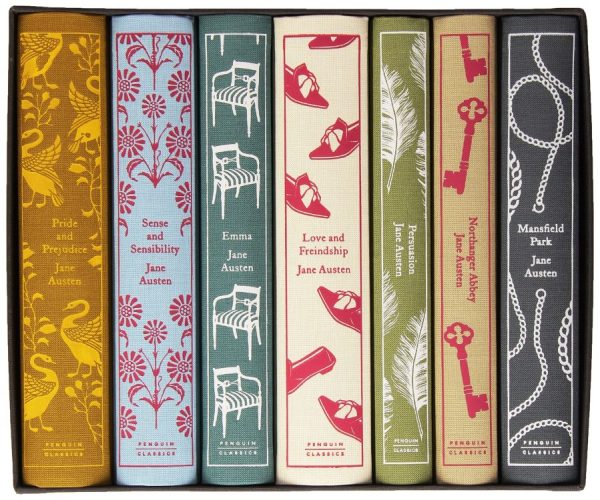
Inquiring reader Lily recently wrote to me and expressed her frustration at not being able to locate the publication dates of Jane Austen’s minor works online. Ever the accommodating Janeite, here is a partial list of her published works.
Novels: (c. 1794-1817)
- Sense and Sensibility: (30 October 1811) Thomas Egerton, Military Library (Whitehall, London)
- Pride and Prejudice: (28 January 1813) Thomas Egerton, Military Library (Whitehall, London)
- Mansfield Park: (July 1814) Thomas Egerton, Military Library (Whitehall, London)
- Emma: (December 1815) John Murray (London)
- Northanger Abbey: (December 1817) John Murray (London)
- Persuasion: (December 1817) John Murray (London)
Juvenilia: (c. 1787-98) Three manuscript notebooks containing 27 items.
Volume the First (c. 1787-90) was first edited by R. W. Chapman and published by Clarendon Press, Oxford in 1933. It is now owned by the Bodleian Library, Oxford.
- Frederic & Elfredia
- Jack & Alice
- Edgar & Emma
- Henry & Eliza
- The adventures of Mr. Harley
- Sir William Mountague
- Memoirs of Mr. Clifford
- The Beautiful Cassandra
- Amelia Webster
- The Visit
- The Mystery
- The Three Sisters
- A beautiful description
- The generous Curate
- Ode to Pity
Volume the Second (c. 1790-93) was first published by Chatto & Windus in 1922. It is now owned by The British Museum.
- Love and Freindship (Austen’s original spelling of friendship)
- Lesley Castle
- The History of England
- A Collections of Letters
- The female philosopher
- The first Act of a Comedy
- A Letter from a Young Lady
- A Tour through Wales
- A Tale
Volume the Third (c. 1792) was first edited by R. W. Chapman and published by Clarendon Press, Oxford in 1951. It is now owned by The British Museum.
- Evelyn
- Catharine, or the Bower
Novella:
- Lady Susan: (c. 1793-4) was first published in part in A Memoir of Jane Austen, by James Edward Austen-Leigh in the second edition of 1871, and later, a full record of the manuscript alterations was edited by R. W. Chapman and included in the Oxford Press edition of 1923. The manuscript is now owned by The Pierpont Morgan Library, New York.
Fragments of Novels:
- The Watson’s: (c. 1804-5) was first was first published in part in A Memoir of Jane Austen, by James Edward Austen-Leigh in the second edition of 1871. The first six leaves of the manuscript were sold and later acquired by The Pierpont Morgan Library, New York. The remained of the manuscript (minus recently missing pages) was sold last year to The Bodleian Library, Oxford.
- Sanditon: (1817) an extract was first published (about one-sixth) in A Memoir of Jane Austen, by James Edward Austen-Leigh in the second edition of 1871. The manuscript is now owned by the King’s College Library, Cambridge.
You can visit digital images of many of the existing original Jane Austen manuscripts in her handwriting online at the awe inspiring website Jane Austen Fiction Manuscripts. Enjoy!
Cheers,
Laurel Ann
© 2007 – 2012 Laurel Ann Nattress, Austenprose


Persuasion, Jane Austen’s last completed novel was written between 1815 and 1816, with final chapter revisions in August of that year. Published posthumously in late 1817 with her earlier work Northanger Abbey, each of the novels represents the alpha and omega of her writing career. Even though they are divergent in tone and topic, they each share a commonality in being partially set in Bath and display Austen’s trademark play on social strata, money and courtship. Austen finished the manuscript of Persuasion in declining health which may account for its slim size in comparison to her heftier previous efforts Mansfield Park (1814) and Emma (1816). Or, quite possibly it is exactly the length that she preferred for her story, allowing for a simpler plot and focus on fewer characters. Its size in no way diminishes it value. Some scholars consider it her finest achievement and readers have long cherished it for its jab at social mobility and moving love story. 
Don’t miss the encore presentation of
“Any acquaintance of Anne’s will always be welcome to me,” was Lady Russell’s kind answer. 

Vanity was the beginning and the end of Sir Walter Elliot’s character; vanity of person and of situation. He had been remarkably handsome in his youth; and, at fifty-four, was still a very fine man. Few women could think more of their personal appearance than he did; nor could the valet of any new made lord be more delighted with the place he held in society. The Narrator on Sir Walter Elliot, Persuasion, Chapter 1
Oxford World’s Classics launched its new re-designed classics line in April, and the improvements are quite stunning both visually and texturally. With over 750 titles of world literature to choose from, their commitment to scholars and pleasure readers is nonpareil. You can browse their catalogue
Product Details: Edited by James Kinsley, with a new introduction and notes by Adela Pinch, the author of 

Eloquent is the perfect word to describe my experience at the
The first five minutes of any production are always a struggle for me. I am always suspect, needing to be drawn into the enchantment of the story and characters before I can be taken away into that special make-believe world of live theater. My hesitant resistance to the dialogue lingered a bit longer. Where was Jane Austen’s prose? The characters and plot were the same, but the language? I concede sincere attachment to the novel, and may be too close to be objective, – but this did disappoint.
I know that I am a severe critic having been warped by years of quivering over opera reviews, but I willed myself into enjoyment, and purposely set aside my magnifying glass and overlooked some the costume and stage prop blunders to focus on the acting, which was quite impressive. This is a first rate repertory theatre of seasoned and skilled professionals, aptly cast and decisively directed by Myra Platt. Chiara Motley who portrayed Anne Elliot was a lovely willowy thing; dutiful, sensitive, and patient. All the qualities that we expect in Jane Austen’s most stoic heroine.
Within the talented ensemble cast, two performances were standouts in my mind, and both had plum roles to reincarnate; the dotty Mary Musgrove, (Carol Roscoe) played with great energy and comedic timing, and the tragic Captain Benwick, (Jamie Rush), sensitively played by a promising young actor whose brief dialogue I remember more for its prominent pauses, than content. This was a welcome relief after a few lost moments from previously rushed scenes.
The matinee performance was a sell-out, which is the best remedy for a struggling repertory company, who deserve a far better venue to perform in than the constraints of the Center House Theater at Seattle Center. Ah…the financial challenges of a nonprofit arts organization. That I don’t miss!
Be sure to mark your calendars and set your watches for the premiere of the Masterpiece Theatre presentation of The Complete Jane Austen, on Sunday the 13th of January at 9:00pm. The first adaptation will be Persuasion, staring Sally Hawkins as our heroine Anne Elliot. You can read further details on the series in my post,