Feeds:
Posts
Comments

Archive for the ‘Jane Austen’s Emma’ Category

The History of England, by Jane Austen excerpt p 171Inquiring reader Lily recently wrote to me and expressed her frustration at not being able to locate the publication dates of Jane Austen’s minor works online. Ever the accommodating Janeite, here is a partial list of her published works.

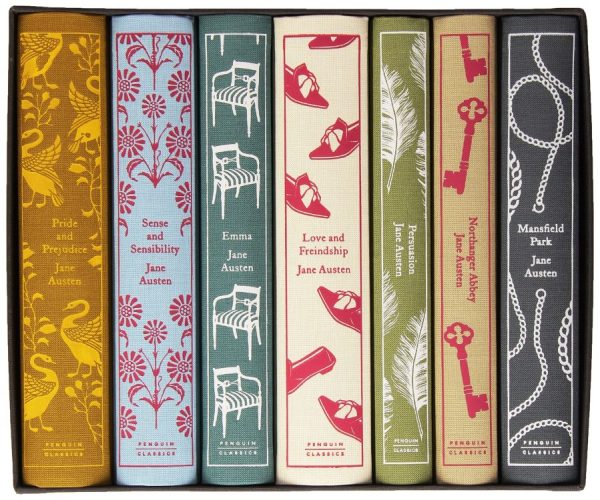
Novels: (c. 1794-1817)

  • Sense and Sensibility: (30 October 1811) Thomas Egerton, Military Library (Whitehall, London)
  • Pride and Prejudice: (28 January 1813) Thomas Egerton, Military Library (Whitehall, London)
  • Mansfield Park: (July 1814) Thomas Egerton, Military Library (Whitehall, London)
  • Emma: (December 1815) John Murray (London)
  • Northanger Abbey: (December 1817) John Murray (London)
  • Persuasion: (December 1817) John Murray (London)

Image of Jane Austen Minor Works Volume 1 at The Bodleian Library Oxford, England

Juvenilia: (c. 1787-98) Three manuscript notebooks containing 27 items.

Volume the First (c. 1787-90) was first edited by R. W. Chapman and published by Clarendon Press, Oxford in 1933. It is now owned by the Bodleian Library, Oxford.

  • Frederic & Elfredia
  • Jack & Alice
  • Edgar & Emma
  • Henry & Eliza
  • The adventures of Mr. Harley
  • Sir William Mountague
  • Memoirs of Mr. Clifford
  • The Beautiful Cassandra
  • Amelia Webster
  • The Visit
  • The Mystery
  • The Three Sisters
  • A beautiful description
  • The generous Curate
  • Ode to Pity

Volume the Second (c. 1790-93) was first published by Chatto & Windus in 1922. It is now owned by The British Museum.

  • Love and Freindship (Austen’s original spelling of friendship)
  • Lesley Castle
  • The History of England
  • A Collections of Letters
  • The female philosopher
  • The first Act of a Comedy
  • A Letter from a Young Lady
  • A Tour through Wales
  • A Tale

Volume the Third (c. 1792) was first edited by R. W. Chapman and published by Clarendon Press, Oxford in 1951. It is now owned by The British Museum.

  • Evelyn
  • Catharine, or the Bower

Illustration from The History of England, by Jane and Cassandra Austen

Novella:

  • Lady Susan: (c. 1793-4) was first published in part in A Memoir of Jane Austen, by James Edward Austen-Leigh in the second edition of 1871, and later, a full record of the manuscript alterations was edited by R. W. Chapman and included in the Oxford Press edition of 1923. The manuscript is now owned by The Pierpont Morgan Library, New York.

Fragments of Novels:

  • The Watson’s: (c. 1804-5) was first was first published in part in A Memoir of Jane Austen, by James Edward Austen-Leigh in the second edition of 1871. The first six leaves of the manuscript were sold and later acquired by The Pierpont Morgan Library, New York. The remained of the manuscript (minus recently missing pages) was sold last year to The Bodleian Library, Oxford.
  • Sanditon: (1817) an extract was first published (about one-sixth) in A Memoir of Jane Austen, by James Edward Austen-Leigh in the second edition of 1871. The manuscript is now owned by the King’s College Library, Cambridge.

You can visit digital images of many of the existing original Jane Austen manuscripts in her handwriting online at the awe inspiring website Jane Austen Fiction Manuscripts. Enjoy!

Cheers,

Laurel Ann

© 2007 – 2012 Laurel Ann Nattress, Austenprose

Read Full Post »

As Jane Austen fans around the world celebrate her birthday on December 16th, one lucky (and very rich) Janeite will win an auction at Sotheby’s in London for an extremely rare presentation copy of Emma sent to author Maria Edgeworth from Austen’s publisher as a gift from the author after its publication on 23 December 1815. This is the second presentation copy to be offered at auction in as many years after Bonhams sold a copy given by Austen to her dear friend Anne Sharp for £180,000 setting a new auction record for a printed book by the British author. The new owner Jonkers Books resold the edition earlier this year to an undisclosed British collector for £325,000. Considering that the Edgeworth edition has remained in her family for close to two hundred years and is “unique in being the only known copy of Emma given by Jane Austen to a fellow writer,” the estimated price for volumes I and III (volume II is missing?) of £70,000-100,000 seems rather low. One assumes that the missing volume II is the diminishing factor.

Engraving of Maria Edgeworth from Evert A. Duyckinck’s A Portrait Gallery of Eminent Men and Women of Europe and America, with Biographies ( Johnson, Fry and Co, 1872)

Austen admired Maria Edgeworth’s work greatly expressing her enthusiasm to her niece Anna Austen an aspiring novelist in 1814, “I have made up my mind to like no novels really, but Miss Edgeworth’s, yours & my own.” Unfortunately, Edgeworth’s esteem was not reciprocated. After reading Emma she wrote to her half-brother Charles Sneyd Edgeworth that “There was no story in it…” Julie at Austenonly has written an excellent account of Jane Austen and Maria Edgeworth’s relationship, and her honest opinion of what many claim to be Austen finest work.

Also available in the same lot is a Wedgewood Dinner Set that has been on display at the Jane Austen House Museum in Chawton. It has been passed down in the Knight family since it was originally purchased in London by Jane’s brother Edward Austen Knight in 1813. Jane actually assisted her brother and his daughter Fanny in making the selection. “We then went to Wedgwoods where my brother and Fanny chose a Dinner Set, I believe the pattern is a small Lozenge in purple, between Lines of narrow Gold; – and it is to have the Crest.” An estimate of £50,000-70,000 is in place. It is sad that the family needs to sell the china and a great loss to the museum. Maybe another benevolent Janeite will step forward and rescue it from speculators. It is a lovely set.

Both of the extremely rare items with an Austen association will be available in Sothebys sale of English Literature, History and Children’s Books & Illustrations in London on the 16th of December, 2010.

Photos: Sotheby’s.

Related posts:

© 2007 – 2010 Laurel Ann Nattress, Austenprose

Read Full Post »

Jonkers Rare Books, of Hart Street, Henley-on-Thames has announced today that an undisclosed British collector has paid £325,000 for the rare first edition presentation copy of Jane Austen’s novel Emma once owned by her dear friend Anne Sharp. Jonkers has owned the three volume set since June 2008 when it outbid all other participants at Bonham’s Auction House in London. The £180,000 sales price set a new auction record for a printed book by the British author. 

Bookshop director Christiaan Jokers revealed some amazing facts in his statement to the Henley Standard regarding the copy of Emma that I find quite debatable. 

“The important thing is the signature of Jane Austen to her best friend. That’s what moves it from being a £20,000 book to a £300,000 book.” 

“The fact that it is the only presentation copy is also really something.” 

When the copy was presented for sale in 2008, Bonham’s researched the history of its provenance and the hand writing prior to listing for auction. Since this was a presentation copy sent directly to Anne Sharpe from Jane Austen’s publisher John Murray, Bonham’s did not believe that the inscription was Jane Austen’s but had been written by her publisher before it was sent to Anne. I also doubt that it is the only known remaining presentation copy of Emma. Out of the twelve copies sent, nine went to her family and one to the Prince Regent. There must be another one still in the family or in the Royal library. 

Come what may, I am quite pleased that the sale was to a British collector and hope that it was to a museum or a certain millionairess in Chawton who will exhibit it to the public. 

  • Read my original post regarding the history of Anne Sharp’s presentation copy and her relationship with Jane Austen.

Share

Read Full Post »

Emma, Jane Austen’s fourth novel was published in 1815 and dedicated to the Prince Regent, later King George IV.  Austen privately abhorred the Regent for the treatment of his wife Princess Caroline and his dissipated lifestyle. In 1813 she wrote to her friend Martha Lloyd, “I suppose all the World is sitting in Judgement upon the Princess of Wales’s Letter. Poor woman, I shall support her as long as I can, because she is a Woman, & because I hate her Husband.” She did however recognize the value of his name and agreed to the dedication. Upon publication Emma also had its own share of critics. What impressed early readers was not that it lacked energy and style, but that its story was dull and uneventful. Even Austen’s famous publisher John Murray thought it lacked “incident and romance” and Maria Edgeworth, a contemporary author so greatly admired by Austen that she sent her one of the twelve presentation copies allotted by her publisher, could not read past the first volume and thought “there was no story in it.” Ironically, what these two prominent and well read individuals attributed as a weakness is actually Emma’s greatest strength.

If one looks beyond the surface, Emma is an intricate story focused on the astute characterization and social reproof which Austen is famous for. Emma Woodhouse is a complex character that on first acquaintance is rather a pill. Austen gave herself a great challenge in creating “a heroine whom no one but myself will like.”  In contrast with her other heroines, Miss Woodhouse does not have any social or financial concerns and thus no compelling need to marry. Therein lives the rub. We have no sympathy for her whatsoever. She’s rich, she’s spoiled and she’s stuck up. Who indeed could possibly like such a “troublesome creature”? During the course of the novel we witness her exerting her superior notions of who is suitable for whom as she match makes for her friends with disastrous results. It is no wonder that Maria Edgeworth gave up reading Emma after the first volume. At that point we have met most of the characters in Emma’s insular world and are coming to fully understand her ignorance and misguided perceptions in relation to them. She is truly exasperating. Austen tests our endurance fully as the novel progresses and her heroine continues to make mistakes. It is a testament to her skill as a writer and deft comedian that she holds our fascination with the “busy nothings” of every-day country life in Highbury, a small village filled with endearingly flawed characters. The transformation of the heroine from spoiled and insufferable into a contrite, mature and likeable young lady that you want to root for, is nothing less than remarkable. It is truly a shame that Edgeworth could not recognize the genius of Austen’s sly sashay of characterization into a world that could be your own neighborhood. We can only account that, “One half of the world cannot understand the pleasures of the other.” 

If you liked the new BBC/PBS miniseries Emma (2009), enjoy the original novel with all of Austen’s resplendent language in this expertly produced audio recording. Read by acclaimed British actress Juliet Stevenson, viewers of the 1996 movie adaptation of Emma will remember her superb portrayal of the vulgar a vacuous Mrs. Elton and know you are in for a treat. Adding equal measure of energy and humor to each of the characters, Stevenson’s perfect blending of a classic novel and a sensitive interpretation enhanced my enjoyment greatly. Pop this one into your CD player or iPod during your commute to work. I highly recommend it. “It is such a happiness when good people get together — and they always do.” Ch 21

5 out of 5 Regency Stars

Emma, by Jane Austen, read by Juliet Stevenson
Naxos AudioBooks (2007)
Unabridged (13) CD’s, 16h 40m
ISBN: 978-9626343944

GIVEAWAY CONTEST

Enter a chance to win one copy of a Naxos AudioBooks recording of Jane Austen’s novel Emma by leaving a comment by midnight PST February 16th, 2010 stating who is your favorite character in the novel or movie adaptation of Emma. Winners will be announced on February 17th, 2010. Shipping to continental US addresses only. Good luck!

UPDATE 02/17/10: The contest has concluded. The winner was announced. Follow this link to discover if it was YOU!

Share

Read Full Post »

James Fairfax, by Jane Austen and Adam Campan (2009)Gentle Readers: In yet the third announcement in less than a week, another publisher is jumping on the classic literary re-imagining/mash-up band wagon and hitching their star to Austen’s prose. Independent publisher Norilana Books has announced today a new novel entitled James Fairfax, combining Jane Austen’s original text of Emma with new scenes by Adam Campan. Described as a “re-envisioning of Jane Austen’s world, where gay marriage is commonplace and love is gender-blind,” one is all astonishment as to this new premise.

Here is the publicity blurb:

In this stunning, gender-bending, stylish dance-of-manners version of Jane Austen’s beloved classic novel EMMA — an alternate Regency where gay marriage is commonplace and love is gender-blind — matchmaking Emma Woodhouse tries to find a suitable spouse for her lover Harriet Smith, and is embroiled in the secrets of the relationship between the mysterious and accomplished James Fairfax and the handsome Frank Churchill…

Last week Quirk Books, the publisher of the surprising best-seller Pride and Prejudice and Zombies, revealed its next Austen mash-up would be Sense and Sensibility and Sea Monsters, followed by Beautiful Books announcement of Murder at Mansfield Park on Monday. With recent deluge of Jane Austen inspired books, this writer like Austen’s character Mary Bennet, “wished to say something very sensible, but knew not how.”

Further reading

Read Full Post »

Illustration from Emma, by Phillip Gough, Macdonald & Co (1948)It was hot; and after walking some time over the gardens in a scattered, dispersed way, scarcely any three together, they insensibly followed one another to the delicious shade of a broad short avenue of limes, which stretching beyond the garden at an equal distance from the river, seemed the finish of the pleasure grounds. It led to nothing; nothing but a view at the end over a low stone wall with high pillars, which seemed intended, in their erection, to give the appearance of an approach to the house, which never had been there. Disputable, however, as might be the taste of such a termination, it was in itself a charming walk, and the view which closed it extremely pretty. The considerable slope, at nearly the foot of which the Abbey stood, gradually acquired a steeper form beyond its grounds; and at half a mile distant was a bank of considerable abruptness and grandeur, well clothed with wood; and at the bottom of this bank, favourably placed and sheltered, rose the Abbey-Mill Farm, with meadows in front, and the river making a close and handsome curve around it.  

It was a sweet view — sweet to the eye and the mind. English verdure, English culture, English comfort, seen under a sun bright, without being oppressive. Narrator, Emma, Chapter 42 

We are having exceptionally fine weather in my neck of the woods in the country near Seattle, with nary a cloud in the sky and warm temperatures. The fruit trees are blooming and spring is in full flower. There is green everywhere, reminding me of this beautiful passage in Emma. As Austen describes the sweet view of the English landscape that her characters are experiencing, I am amazed how similar it is to my local landscape on a rare day when it is not raining or overcast. One wonders if Austen was feeling the same amazement with a fine clear day as I am, close to 200 years later. 

Wishing everyone a great holiday weekend in the states. 

*Illustration by Phillip Gough from Emma by Jane Austen, Macdonald & Co Publishers, London (1948)

urn flourish

Read Full Post »

My class assignment taken to the fullest extent!

Mr. Elton on Facebook


 And of course he must have his say.

Mr. Elton's Facebook Page Notes

Virginia Claire

Virginia Claire, our Austen at Large roving reporter is a college student studying English literature and history who just returned from her time studying abroad in Bath England and working as an intern at the Jane Austen Centre. She is the Regional Coordinator of JASNA North Carolina and a lifelong Janeite. She will be sharing her thoughts on all things Austen this semester and remembering her travels in Austenland.

Read Full Post »

Illustration by Willian C. Cooke, Emma, J. M. Dent & Co (1892)“And now, let me talk to you of something else. I have another person’s interest at present so much at heart, that I cannot think any longer about Frank Churchill. Ever since I left you this morning, Emma, my mind has been hard at work on one subject.”  

The subject followed; it was in plain, unaffected, gentleman-like English such as Mr. Knightley used even to the woman he was in love with, how to be able to ask her to marry him, without attacking the happiness of her father. Emma’s answer was ready at the first word. “While her dear father lived, any change of condition must be impossible for her. She could never quit him.” Part only of this answer, however, was admitted. The impossibility of her quitting her father, Mr. Knightley felt as strongly as herself; but the inadmissibility of any other change, he could not agree to. He had been thinking it over most deeply, most intently; he had at first hoped to induce Mr. Woodhouse to remove with her to Donwell; he had wanted to believe it feasible, but his knowledge of Mr. Woodhouse would not suffer him to deceive himself long; and now he confessed his persuasion, that such a transplantation would be a risk of her father’s comfort, perhaps even of his life, which must not be hazarded. Mr. Woodhouse taken from Hartfield! No, he felt that it ought not to be attempted. But the plan which had arisen on the sacrifice of this, he trusted his dearest Emma would not find in any respect objectionable; it was, that he should be received at Hartfield; that so long as her father’s happiness — in other words his life — required Hartfield to continue her home, it should be his likewise.  

Of their all removing to Donwell, Emma had already had her own passing thoughts. Like him, she had tried the scheme and rejected it; but such an alternative as this had not occurred to her. She was sensible of all the affection it evinced. She felt that, in quitting Donwell, he must be sacrificing a great deal of independence of hours and habits; that in living constantly with her father, and in no house of his own, there would be much, very much, to be borne with. She promised to think of it, and advised him to think of it more; but he was fully convinced, that no reflection could alter his wishes or his opinion on the subject. He had given it, he could assure her, very long and calm consideration; he had been walking away from William Larkins the whole morning, to have his thoughts to himself. Mr. Knightley & Emma Woodhouse, Chapter 51 

I have always been disappointed in Mr. Knightley’s marriage proposal to our heroine Emma Woodhouse. If you are not paying close attention, you might miss it altogether! No long speech declaring his esteem, admiration and love. No “will you be mine dearest, loveliest Emma?” No ardent realization that they are destined to be together. No jubilant acceptance by her. Nothing! And Emma is also at fault. She is as much about the business transaction as Knightley, concerned more about her father’s reaction and comforts, Mr. Knightley’s estate manager Mr. Larkins being inconvenienced by Mr. Knightey’s absence if they should live at Hartfield, and finally Harriet’s reaction to the news. This is more business merger negotiations than the final romantic reward for the build up by Jane Austen over the last 448 pages of the novel. For me, it is the biggest weakness in the plot to an otherwise brilliant story. If Austen had given us a romantic and moving marriage proposal, Emma might be more favorably accepted. I know that sounds shallow, but there your have it from this hopeless romantic.     

* Illustration by William C. Cooke, “Mr. Knightley’s proposal”, Emma, The Novels of Jane Austen, J. M. Dent & Co, London (1892)

flourish 5

Read Full Post »

Illustration by Edmund H. Garrett, Emma, Roberts Bros, Boston (1892)“Dear me! it is so odd to hear a woman talk so!”  

“I have none of the usual inducements of women to marry. Were I to fall in love, indeed, it would be a different thing! but I never have been in love; it is not my way, or my nature; and I do not think I ever shall. And, without love, I am sure I should be a fool to change such a situation as mine. Fortune I do not want; employment I do not want; consequence I do not want: I believe few married women are half as much mistress of their husband’s house, as I am of Hartfield; and never, never could I expect to be so truly beloved and important; so always first and always right in any man’s eyes as I am in my father’s.”  

“But then, to be an old maid at last, like Miss Bates!”  

“That is as formidable an image as you could present, Harriet; and if I thought I should ever be like Miss Bates! so silly — so satisfied — so smiling — so prosing — so undistinguishing and unfastidious — and so apt to tell every thing relative to every body about me, I would marry to-morrow. But between us, I am convinced there never can be any likeness, except in being unmarried.”  

“But still, you will be an old maid — and that’s so dreadful!”  

“Never mind, Harriet, I shall not be a poor old maid; and it is poverty only which makes celibacy contemptible to a generous public! A single woman, with a very narrow income, must be a ridiculous, disagreeable, old maid! the proper sport of boys and girls; but a single woman, of good fortune, is always respectable, and may be as sensible and pleasant as anybody else. And the distinction is not quite so much against the candour and common sense of the world as appears at first; for a very narrow income has a tendency to contract the mind, and sour the temper. Harriet Smith and Emma Woodhouse, Emma, Chapter 10 

Miss Emma Woodhouse is such a prig! She proclaims that only poverty makes an old maid contemptible. Oh really? She need not marry because it offers her nothing that she does not already possess: fortune, employment or consequence. Arrogance! The first time a read Emma, I scowled so much my face hurt. 

Some readers complain that they can not identify with Emma. Jane Austen has certainly created “a heroine whom no-one but myself will much like.” It is difficult for a reader to sympathize with her struggles, because her arrogance is her biggest fault, and who can feel empathy with that? When I think of other literary heroines we love to hate, I think of Scarlet O’Hara, that smug southern belle in Gone With the Wind. Even though we want to give them both a swift kick in the rear, we are mesmerized over the prospect of what silliness they will do next and who will eventually knock them off their self appointed pedestals. It’s along fall, but worth the wait! 

*Illustration by Edmund H. Garrett, Emma, Chapter 10, Roberts Bros, Boston (1892)

Vintage flourish urn

Read Full Post »

Woodhouse weather6, Seattle snow storm (2008)“This will prove a spirited beginning of your winter engagements, sir. Something new for your coachman and horses to be making their way through a storm of snow.”  

Poor Mr. Woodhouse was silent from consternation; but every body else had something to say; every body was either surprized or not surprized, and had some question to ask, or some comfort to offer. Mrs. Weston and Emma tried earnestly to cheer him and turn his attention from his son-in-law, who was pursuing his triumph rather unfeelingly.  

“I admired your resolution very much, sir,” said he, “in venturing out in such weather, for of course you saw there would be snow very soon. Every body must have seen the snow coming on. I admired your spirit; and I dare say we shall get home very well. Another hour or two’s snow can hardly make the road impassable; and we are two carriages; if one is blown over in the bleak part of the common field there will be the other at hand. I dare say we shall be all safe at Hartfield before midnight.” John Knightley, Emma, Chapter 15 

Enjoy these snowy photos. They are a “spirited beginning to my winter engagement” as John Knightley would say.

Woodhouse weather5, Seattle snow storm (2008)

Woodhouse weather4, Seattle snow storm (2008)

We are in the midst of a bitter snow storm here near Seattle. I live in the country and took these photos of our pastures and trees yesterday morning. It looks so pretty and peaceful, but the snow and cold are causing quite a bit of anxiety and stress. Mr. Woodhouse would be comatose. 

Woodhouse weather3, Seattle snow storm (2008)

Woodhouse weather2, Seattle snow storm (2008)

I have always enjoyed this passage from Emma. Wicked John Knightley. He knows just how to terrify his poor father-in-law Mr. Woodhouse with the possibility of snowy bleak parts and carriage blow overs! Jane Austen is really the wicked one. She knows just how to make us laugh at his expense. 

Woodhouse weather1, Seattle snow storm (2008)

I am off to work tomorrow morning to attempt to sell books and holiday gifts to anyone foolish enough to venture out of their homes. We are expecting an even bigger storm with high winds by 4:00pm, so if you don’t hear from me for days, I am without electricity, huddled under my down quilt with a flashlight reading Emma

Cheers,

Laurel Ann

Read Full Post »

Illustration by CE Brock, Persuasion (1894)Vanity was the beginning and the end of Sir Walter Elliot’s character; vanity of person and of situation. He had been remarkably handsome in his youth; and, at fifty-four, was still a very fine man. Few women could think more of their personal appearance than he did; nor could the valet of any new made lord be more delighted with the place he held in society. The Narrator on Sir Walter Elliot, Persuasion, Chapter 1 

As a clergyman’s daughter Jane Austen would have been well aware of the significance of the seven deadly sins, those cardinal vices identified by the Catholic church in the 6th- century and later adopted by other Christian religions as the most offensive and serious of sins against god and humanity.  Listed as luxuria (extravagance, later lust), gula (gluttony), avaritia (greed), acedia (sloth), ira (wrath), invidia (envy), and superbia (pride), they were all egregious offenses that would qualify the sinner to at least one foot in hell unless they confessed and were penitent. This collection, though not identified in the Bible, was in the eyes of the church the foundation of moral corruption and considered mortal sins, a most serious offense threatening eternal damnation. Pretty serious stuff.   

Throughout Jane Austen’s novels, her characters exhibit a wide range of qualities from integrity to dissipation and vice making them very realistic, and not unlike people of our own acquaintance or popular renown. One could say that the struggle against the seven deadly sins is the driving force in her plots and one of the main reasons why people connect with them so readily. Her most popular characters Mr. Darcy and Elizabeth Bennet from Pride and Prejudice are prime examples of two of the deadly sins, the offence of pride and wrath. Though Austen does not condemn them for it (as the church might), their vices are the whole axis of the story.  

Today we shall look at the sin of pride, also known as vanity which was one of Jane Austen’s most popular choices of the seven deadly sins in her novels. Vanity appears 85 times and pride 111 times. Here are a few choice quotations: 

Vanity working on a weak head, produces every sort of mischief. Emma 

With insufferable vanity had she believed herself in the secret of every body’s feelings; with unpardonable arrogance proposed to arrange every body’s destiny. Emma 

Their vanity was in such good order that they seemed to be quite free from it, and gave themselves no airs; while the praises attending such behaviour, secured and brought round by their aunt, served to strengthen them in believing they had no faults. Mansfield Park 

Henry Crawford, ruined by early independence and bad domestic example, indulged in the freaks of a cold-blooded vanity a little too long. Mansfield Park 

Catherine listened with astonishment; she knew not how to reconcile two such very different accounts of the same thing; for she had not been brought up to understand the propensities of a rattle, nor to know to how many idle assertions and impudent falsehoods the excess of vanity will lead. Northanger Abbey 

From pride, ignorance, or fashion, our foes are almost as many as our readers. Northanger Abbey 

In vanity, therefore, she gained but little; her chief profit was in wonder. Northanger Abbey 

It was a struggle between propriety and vanity; but vanity got the better, and then Elizabeth was happy again. Persuasion 

“That is very true,” replied Elizabeth, “and I could easily forgive his pride, if he had not mortified mine.” Pride and Prejudice 

Vanity and pride are different things, though the words are often used synonimously. Pride and Prejudice 

“Pride relates more to our opinion of ourselves, vanity to what we would have others think of us.” Pride and Prejudice 

“Yes, vanity is a weakness indeed.” Pride and Prejudice 

If his own vanity, however, did not mislead him, he was the cause, his pride and caprice were the cause. Pride and Prejudice 

The world had made him extravagant and vain — extravagance and vanity had made him cold-hearted and selfish. Sense and Sensibility 

Vanity while seeking its own guilty triumph at the expense of another, had involved him in a real attachment, which extravagance, or at least its offspring, necessity, had required to be sacrificed. Sense and Sensibility 

Of all of Austen’s characters guilty of vanity, Sir Walter Elliot in Persuasion is definitely the leading offender. Austen leaves us in no doubt of his priorities in life toward his appearance and how it impacted his family. Mrs. Allen in Northanger Abbey arrives at a distant second being excessively fond of her clothing and constantly commenting on the inferiority of others choice of fabrics and garments. Who would dare dispute that Mr. Darcy in Pride and Prejudice has the most pride since an entire novel stems from it. Mrs. Fanny Dashwood in Sense and Sensibility in my mind is second in offence of pride after Mr. Darcy. She is so arrogant and prideful that she basically evicts her mother-in-law Mrs. Dashwood out of her home after the death of her father-in-law and talks her own husband out of giving them a decent living –  all for her vanity. There are others who come to mind: Miss Elizabeth Elliot in Persuasion who is definitely her father’s daughter, Mrs. Elton in Emma who is arrogance and puffery personified, Miss Mary Crawford in Mansfield Park who thinks herself above the truth, and that tactfully bereft General Tilney in Northanger Abbey who ejects poor Catherine Morland out of his house when he learns that she is not as flush as he thought. The list goes on and on with different degrees of offence, but in the end, we can rest assured that Austen does not treat these offenders lightly, passing her judgment according to propriety and her Christian principles.

Which characters do you find prideful and vain, and do you think that Austen portrayed them correctly?

Read Full Post »

You would have held the memory of your friend Jane too in tender regret I am sure. – But the Providence of God has restored me – & may I be more fit to appear before him when I am summoned, than I sh’d have been now! – Sick or Well, beleive me ever your attached friend. J. Austen Letter to Anne Sharp, 22 May 1817

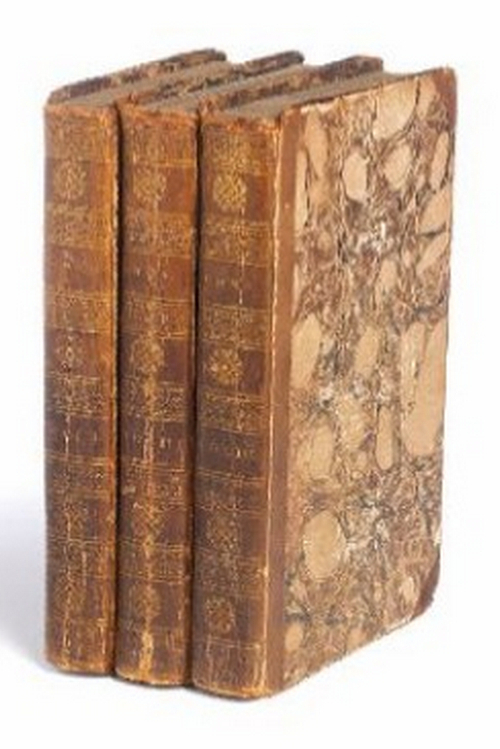
Image of three volumes first edition of Emma, presented to Ann SharpJaneites with deep pockets and warm hearts will be winging their way to London for the June 24th auction of a first edition of Emma being offered at Bonham’s Auction House. The rare three volume presentation copy of Jane Austen’s fourth and final novel to be published in her lifetime was a gift from the authoress to Anne Sharp, a dear friend and previous governess to her brother Edward Austen Knight’s daughter Fanny at Godmersham, Kent.

Bonham’s online catalogue description contains some interesting facts.

Jane Austen was allocated twelve presentation copies by the publisher John Murray. Of these, nine were sent to family members (including Jane herself), one to the librarian of the Prince Regent (to whom the work was dedicated), and one to Countess Morley, these last under obligation from the publisher. The present copy is the only one given to a personal friend, testament to the strength of Jane’s feelings for Anne.

First editions of Jane Austen’s novels can garner healthy prices. A November 2007 article in Antiquarian Books listed a recent sale of a three volume set of Sense and Sensibility by Bloomsbury Auctions in New York for $48,000.00. (1) Because the ‘Anne Sharp’ edition of Emma has unique provenance, and no known presentation copies of Emma have ever hit the market before, Bonham’s is anticipating a sale price between £50,000 to £70,000. This could be quite a windfall for its present UK owner who had the volumes shelved in their family library for three generations without a clue as to how their ancestors acquired them. One wonders what else they have loitering about, and why they chose this moment to dispose of them!

Illustration of Godmersham Park, Kent, England

Godmersham Park, Kent, home of the Edward Austen Knight family circa 1804

Anne Sharp served as governess to Fanny Knight (1793-1882) Jane Austen’s niece, at Godmersham from 1804 to 1806, resigning for health reasons. (2) She is mentioned fondly several times in Jane Austen’s letters to her sister Cassandra and in this wonderful passage from Claire Tomalin’s biography of Jane Austen.  (more…)

Read Full Post »

Image of Jane Austen commanding the apples to bloom

It was a sweet view — sweet to the eye and the mind. English verdure, English culture, English comfort, seen under a sun bright, without being oppressive…It might be safely viewed with all its appendages of prosperity and beauty, its rich pastures, spreading flocks, orchard in blossom, and light column of smoke ascending. Emma, Chapter 42 

An orchard in bloom in June? Did Jane Austen get her seasonal timing wrong? Most fruit trees bloom in May, as my apple-trees in the Pacific Northwest will confirm. This anomaly is unusual, since Austen is so correct with other facts throughout her novels according to scholar R. W. Chapman. Many have questioned this slip-up, including Jane Austen’s brother Edward, who pointed out the discrepancy to her, ‘Jane, I wish you would tell me where you get those apple-trees of yours that come into bloom in July?‘ Well, Edward, it was June but we’re splitting hairs here. 

Image of the cover of Who Betrays Elizabeth Bennet, by John SutherlandThere are two possible explanations; one by a scholar and the other by a meteorologist. In the book Is Heathcliff a Murderer: Great Puzzles in Nineteenth-Century Fiction  (new edition 2002), author John Sutherland questions Austen’s timing in chapter two, Apple blossoms in June?  His creative theory prompted a few polite objections from leading authorities; Dr. Claire Lamont and Deirdre le Faye, which are included in the next volume in the series, Who Betrays Elizabeth Bennet?: Further Puzzles in Classic Fiction (1999). They pretty much shoot holes in his theory. You can read the discussion here and draw your own conclusions, but honestly, I was so relieved to discover that a meteorologist Euan Nisbet of the Royal Holloway College in London was a Janeite, and has closely studied Jane Austen’s astute observance of accurate weather in her novels and wrote this enlightening article(more…)

Read Full Post »

Image of the cover of Emma, by Jane Austen, Oxford World Classic, (2008) “Be satisfied,” said he, “I will not raise any outcry. I will keep my ill-humour to myself. I have a very sincere interest in Emma. Isabella does not seem more my sister; has never excited a greater interest; perhaps hardly so great. There is an anxiety, a curiosity in what one feels for Emma. I wonder what will become of her!”  

“So do I,” said Mrs. Weston gently; “very much.” Mr. Knightley and Mrs. Weston discussing Emma Woodhouse, Emma, Chapter 5 

The Austen book sleuth is afoot again and happy to reveal new discoveries for our gentle readers! The news is quite exciting, and like Miss Emma Woodhouse, we are always intrigued with a piece of news.   

Oxford University Press is rolling out six new Jane Austen trade paperback editions of its Oxford World’s Classics series in June. They will include full unabridged texts, new introductions, notes on the text, selected bibliography,  chronology, biography, two appendixes, textual notes and explanatory notes on each of the major novels; Sense and Sensibility, Pride and Prejudice, Mansfield Park, Emma, Persuasion, and Northanger Abbey with a bonus of Lady Susan, The Watson’s and Sandition included.  

Image of the cover of Pride and Prejudice, by Jane Austen, Oxford World Classics, (2008)Oxford World’s Classics launched its new re-designed classics line in April, and the improvements are quite stunning both visually and texturally. With over 750 titles of world literature to choose from, their commitment to scholars and pleasure readers is nonpareil. You can browse their catalogue here.  

Here is a description of the new edition of Emm

‘I wonder what will become of her!’ 

So speculate the friends and neighbours of Emma Woodhouse, the lovely, lively, willful, and fallible heroine of Jane Austen’s fourth published novel. Confident that she knows best, Emma schemes to find a suitable husband for her pliant friend Harriet, only to discover that she understands the feelings of others as little as she does her own heart. As Emma puzzles and blunders her way through the mysteries of her social world, Austen evokes for her readers a cast of unforgettable characters and a detailed portrait of a small town undergoing historical transition. 

Written with matchless wit and irony, judged by many to be her finest novel, Emma has been adapted many times for film and television. This new edition shows how Austen brilliantly turns the everyday into the exceptional.  

Image of the cover of Sense and Sensibility, by Jane Austen, Oxford World Classic, (2008)Product Details: Edited by James Kinsley, with a new introduction and notes by Adela Pinch, the author of Strange Fits of Passion: Epistemologies of Emotion, Hume to Austen (Stanford UP, 1996) and numerous articles on eighteenth- and nineteenth-century English literature and culture. 448 pages; ISBN13: 978-0-19-953552-1, retail price $7.95 

Five of the beautiful new cover images are taken from classic paintings of Regency era women, and Northanger Abbey includes an image of Gothic architecture. You can read further about the re-design at the Oxford University Press website. Don’t miss taking the fun literary quiz, and discover which character from Oxford World’s Classics you are most like. I was surprised to learn that ‘today’ I am Emma Woodhouse! Who would guess?

Read Full Post »

Illustration by Philip Gough, Emma, McDonald & Co, (1948)“I lay it down as a general rule, Harriet, that if a woman doubts as to whether she should accept a man or not, she certainly ought to refuse him. If she can hesitate as to “‘Yes,’” she ought to say “‘No’” directly. It is not a state to be safely entered into with doubtful feelings, with half a heart. I thought it my duty as a friend, and older than yourself, to say thus much to you. But do not imagine that I want to influence you.” Emma Woodhouse, Emma, Chapter 7 

Have you ever been in the position to advise a friend on a serious decision knowing full-well what the practical decision should be, – but held back your true opinion for fear of it turning around and biting you in the rear? I was faced with such a dilemma this week, and I was reminded of this passage in Emma. Did I take the high road you ask, or the Woodhouse way? 

Jane Austen’s heroine Emma Woodhouse knows the power of a friendly omission, actually taking it one step further adding clever manipulation to achieve her goal. She advises her friend Harriet Smith by not advising her at all; – asking well placed questions that prompt Harriet’s insecurity, and skillfully guides her toward the decision that Emma wants her to make. Scary stuff! 

Illustration by Philip Gough, Emma, McDonald & Co, London, (1948)

This scene was one of the earliest examples in the novel of how full of herself Miss Woodhouse can be. I have often wondered how a young woman raised without a mother and in a secluded environment learned how to be so conniving beyond her years. The way she moves the conversation away from her having to give Harriet a direct answer to Harriet coming to the conclusion that she should decline Robert Martins proposal is disturbing. 

Some people might admire her strength of conviction and say her cunning was ingenious, but it just throws up a big red flag for me. How can we like a heroine who is so controlling? What will she do next to poor naïve Harriet and the rest of the Highbury community? Was Jane Austen correct in warning her family that she had created a heroine “whom no-one but myself will much like.”? 

Illustration by Philip Gough, Emma, McDonald & Co, London (1948)

Anyone who has read the novel or seen one of the movies knows the answer, but did you also remember the lesson that Jane Austen gave us about advice and when it turns to avarice? I did, and it may have saved me from a very uncomfortable situation. 

*Illustrations by Philip Gough, Emma, McDonald & Co, London, 1948

Read Full Post »

Image of Samantha Morton & Kate Beckinsale in Emma, (1996)  

 INFORMED


Emma wants to see her better informed; it will be an inducement to her to read more herself. They will read together. She means it, I know.” Mrs. Weston, Emma, Chapter 5


Image of the DVD cover of Emma, staring Kate Beckinsale, (1996)I hope that you all enjoyed Emma, staring Kate Beckinsale, Sunday on PBS. This movie version is my favorite of the Emma adaptations. The screenwriter Andrew Davies made some changes from the novel, and I do not agree with all of them, but I do like how he and director Diarmud Laurence brought in the Regency environment and grounded the film with glimpses of the working community. Three scenes come to mind that exemplify this; Mr. Woodhouse, the leading citizen of Highbury, showing concern for the laborers by waving at them from his carriage, the gaggle of giggling school girls in church reminds us of the rest of the families in the community, and the complete invention of the harvest festival showing the differences between the upper and lower classes of the Highbury agricultural community, and the gracious appreciation displayed by their landlord and master, Mr. Knightley.

Image of the DVD cover of Emma, staring Paltrow, (1996)My only regrets about this version of Emma is that it lacked the humor of the novel and the other 1996 film of Emma, staring Gwyneth Paltrow, and that it was not longer in length. One can always wish that film producers would aspire to adapt the entire novel, but one understands the restrictions of the cinematic medium. Being a greedy sort myself, I crave all of Jane Austen’s lovely words, characters and plot in toto!

If this adaptation peaked your curiosity, but you still feel a bit clueless about Emma, I heartily encourage you to read the novel. There are excellent versions in print and online. Like Emma, I am an imaginist and am partial to artistic creativity, prefering a good illustrated edition to visualize the story. You might also be interested in many of the sequels and pastiches about, and here are a few suggestions.

Jane Austen’s Emma through Another’s Eyes (1997)Jane Fairfax: Jane Austen’s Emma through Another’s Eyes, by Joan Aiken, St. Martins Press (1997). Emma Woodhouse feels that Jane Fairfax is too reserved, but she may indeed be the only young lady in Highbury that Emma truly envies. Read about Jane Fairfax’s back story as it is revealed through Aiken’s skilled and accomplished parallel story to Austen’s  Emma. Aiken’s style is easy and affable; – both similar and respectful to Jane Austen, and she does Fairfax due justice. ISBN: 9780312157074 Read a preview here.

Image of cover of Mr. Knightley’s Diary (2007)Mr. Knightley’s Diary: A Novel, by Amanda Grange, The Berkley Publishing Group, (2007). Relive Jane Austen’s Emma – from Mr. Knightley’s point of view. At times, I wish that Mr. Knightley had some of Emma’s energy and imagination, but you know they say that opposites attract, and in this case it is true. This perspective of a gentleman in his late thirties whose chief interests are his estates and the well being of the Highbury community reveals why Knightley is still a bachelor, and make it all the more interesting to see his transformation from friendly neighbor into Emma’s love. ISBN: 9780425217719 Read a review from Ms. Place of Jane Austen Today here.

Image of cover of Lovers’ Perjuries (2007)Lovers’ Perjuries: Or, The Clandestine Courtship Of Jane Fairfax And Frank Churchill, by Joan Ellen Delman, self published, (2007) Description (from the author) Have you ever wondered about the hidden romance contained within Jane Austen’s Emma? Written with great fidelity to the original, Lovers’ Perjuries fills in all the details of scenes only hinted at in Emma. It also introduces new characters in a substantial subplot inspired by Persuasion, but featuring a lively heroine more reminiscent of Elizabeth Bennet than Anne Elliot. ISBN: 9780615150055. Read an excerpt. Read a review by Mags of AustenBlog here.

Image of cover of Amanada (2006)Amanda, by Debra White Smith, Harvest House Publishers, (2006) Publishers description: Book #5 in White Smith’s Austen Series, is a delightful contemporary novel set in Australia that captures the wit and humor of Jane Austen’s Emma. Amanda is a bit bored-until she meets Haley and decides that she would be the perfect wife for the local pastor. Amanda’s plan is falling into place when she discovers that Haley is dating Roger…and Pastor Eldridge is seeing someone else. Not to be thwarted, she steers Haley toward newcomer Frederick West. But when Haley is attracted to Nathaniel, why is Amanda’s heart suddenly anxious? ISBN: 9780736908757 Read a review by Erin Valentine of Novel Journey here.

Image of cover of Emma and Knightley (2008)Emma and Knightley: The Sequel to Jane Austen’s Emma, by Rachel Billington, SourceBooks (2008) Publishers description: After a year of marriage, Emma wants Knightley to stop treating her like a child. Knightley meanwhile wants his young bride to love him as a husband, not as the man she’s always looked up to. With tragedy in the offing, and events unfolding that include beloved characters from Jane Austen’ Emma, the couple must find their way to each other, and to perfect happiness. ISBN: 9781402212079 Read a review by Alison T. on AustenBlog here

Image of cover of Mrs. Elton in America (2004)Mrs. Elton in America: The Complete Mrs. Elton, by Diana Birchall, Edgerton House Publishing (2004) This amusing and often hilarious volume includes the Mrs. Elton triology of three short novels; In Defense of Mrs. Elton, The Courtship of Mrs. Elton, and Mrs. Elton in America. Inspired by Jane Austen’s presumptive and officious character Mrs. Augusta Elton from her novel Emma. Laugh out loud, and then throw things if need be, because Mrs. Elton can just do that to you! It is amazing to think that Mrs. Elton’s ego could get much larger, but it does, and happily to our abject delight! ISBN: 9781905016013 Read an excerpt here.

Image of cover of Emma Adapted (2007)Emma Adapted: Jane Austen’s Heroine from Book to Film, by Marc DiPaolo, Peter Lang Publishing (2007) Description from the publisher: This work of literary and film criticism examines all eight filmed adaptations of Jane Austen’s Emma produced between 1948 and 1996 as vastly different interpretations of the source novel. Instead of condemning the movies and television specials as being “not as good as the book,” Marc DiPaolo considers how each adaptation might be understood as a valid “reading” of Austen’s text for Austen fans, scholars, and students alike.  This book is a bit pricey at $67.95 online, and will be a good library request. ISBN: 9781433100000

A Casebook (2007)Jane Austen’s Emma: A Casebook, edited by Fiona Stafford, Oxford University Press (2007) Interesting title, since it supports my theory that Emma is a mystery story disguised as a comic romance! Description from the publisher: The essays in this collection demonstrate the varied delights of reading Emma. The purpose of the collection is to introduce readers of Austen to new ways of interpreting her most substantial and rewarding novel. The collection opens with an introduction encouraging readers to re-read Emma, and to find its pleasures magnified by the critical interpretations and scholarship represented in this casebook. ISBN: 9780195175318

Image of DVD cover of Clueless (1995)Clueless, the movie, director Amy Herkerling, Paramount Studios (1995) staring Alicia Silverstone, Brittany Murphy and Paul Rudd. Studio description: Loosely based on Jane Austen’s comedy of manners Emma, Clueless employs high school as a microcosm of a larger society; in this case, the sun-drenched paradise of conspicuous consumption known as Beverly Hills. Leading the pack as a rich, blonde cutie named Cher is Alicia Silverstone, in a career-making performance. With the help of her best friend, Dionne (Stacey Dash), well-meaning busybody Cher attempts to turn the school nerd, Tai (Brittany Murphy), into a teen queen — with unexpected results. Heckerling’s witty satire is dead-on, particularly in its rendering of the kids’ speech, an adolescent patois peppered with vacuous expressions like “as if!” and “whatever!” The beauty of Clueless is that, even as it makes fun of Cher’s relentless pursuit of popularity, it reveals an insightful, well-meaning individual beneath its heroine’s image-obsessed surface. Read a review by Peter Stack of the San Francisco Chronicle here

So, read on Janeites!

Read Full Post »

Image of Kate Beckinsale as Emma Woodhouse, Emma, (1996)NEWS

“Emma,” said Mr. Knightley presently, “I have a piece of news for you. You like news — and I heard an article in my way hither that I think will interest you.”

“News! Oh! yes, I always like news. What is it? Why do you smile so? Where did you hear it? Mr. Knightly & Emma Woodhouse, Emma, Chapter 21

Jane Austen’s character Emma Woodhouse loves a bit of news, so I am sure that she will be amused to know that others are talking about her around the Blog-o-spere.

They say that imitation is the sincerest form of flattery, so I am confident in saying that Miss Emma Woodhouse would find Austen-esque author Laurie Viera Rigler’s honest admission that she has, on occasion, offered unsolicited advice quite gratifying! In her recent musing on her Confessions of a Jane Austen Addict Blog, she professes to have been a bit Emma like, missapplyments and all. Her cure was in understanding Austen.

I have this theory that if you read her works enough times and really contemplate the life lessons therein, you can pretty much give up your psychotherapist.

(Hmm? Reminder to myself to cancel next appointment with therapist) You can read her entire humorous and entertaining commentary in the online article, Emma; or How Jane Austen Revealed My Inner Know-it-All, on her delightful blog.

Image of Mark Strong and Samantha Morton in Emma, (1996)

I dare say, that there are few people who know more about Austen’s novel Emma than web mistress and designer Kali Pappas. You can read her guest blogger contribution on the costuming in the upcoming Emma (1996) adaptation on my co-blog, Jane Austen Today entitled, Fashionable Emma Woodhouse: Costuming in Austen’s Emma Adapted. Visit Kali’s blog Emma Adaptations to discover even more about Miss Woodhouse and her Highbury friends.

Read the complete synopsis of the movie at Masterpiece Classic’s Emma webpage.

Image of Box Hill Picnic, Emma, (1996)

Learn all about Emma’s Box Hill picnic at Jane Austen’s World.

Jane Austen Quote of the Day, is featuring some of the best quotes from Emma.

The novel Emma is renown for it’s unique characterizations, so in anticipation of the airing of the 1996 movie of Emma on Sunday, March 23rd at 9:00 pm on PBS, I have focused this week entirely on some of my favorites; Cast Preview, Emma Woodhouse, Harriet Smith, and Mr. Elton. Discover what makes Austen’s characters so appealing, or unappealing as mayhap! I hope that you all enjoy the movie!

Image of group shot of the cast of Emma, (1996)

Read Full Post »

Image of steel engraving frontispiece by William Greatbatch after George Pickering, Emma, (1833)DISCERN

Mr. Elton was only too happy. Harriet listened, and Emma drew in peace. She must allow him to be still frequently coming to look; anything less would certainly have been too little in a lover; and he was ready at the smallest intermission of the pencil, to jump up and see the progress, and be charmed. There was no being displeased with such an encourager, for his admiration made him discern a likeness almost before it was possible. She could not respect his eye, but his love and his complaisance were unexceptionable. Mr. Elton, Emma, Chapter 6

This passage is a great example of why many believe Jane Austen’s Emma is actually a mystery novel, and not a comical romance. Here she has laid out a great physic clue about the fate of Mr. Elton, which until today, had totally passed my notice. To understand Austen foreshadowing, one would have to meet, and or believe in the following three conditions.

  1. You have read the entire novel.
  2. Agreed to the possibility that Emma was a sly mystery disguised as a comic romance.
  3. Believe that in fiction and in true life, characters and or people are often attracted to the exact person that they deserve.

If we investigate further, Mr. Elton is observing Emma Woodhouse sketch a portrait of Miss Harriet Smith. He is hovering over Emma, fussing over her progress, and praising her before the image is even visible. Total foppery and affectation. What a suck-up!

After Mr. Elton’s solicitous attempts to woo Miss Woodhouse are flatly rejected, he quickly marries wealthy but outrageously un-couth Augusta Hawkins on the rebound. She is officious and overbearing. Emma is offended and annoyed, thinking her insufferable and ill-bred; unable to understand what attractions she held to him.

We continue to see examples of Mrs. Elton’s ill judged and presumptuous opinions until Austen drops another clue flatly in our laps. From the following conversation that she has with Mr. Weston regarding his son Frank Churchill, we at once understand Mr. and Mrs. Elton’s ironic attraction to each other.

“A very fine young man indeed, Mr. Weston. You know I candidly told you I should form my own opinion; and I am happy to say that I am extremely pleased with him. You may believe me. I never compliment. I think him a very handsome young man, and his manners are precisely what I like and approve — so truly the gentleman, without the least conceit or puppyism. You must know I have a vast dislike to puppies — quite a horror of them. They were never tolerated at Maple Grove. Neither Mr. Suckling nor me had ever any patience with them; and we used sometimes to say very cutting things! Selina, who is mild almost to a fault, bore with them much better.” Emma, Chapter 38

Here she is, talking and preaching about how she can not abide puppyism, when in fact, the very man that she married is the biggest puppy in Highbury!

Just desserts I say!

*Steel engraving frontispiece, “There was no being displeased with such an encourager”  by William Greatbatch, after George Pickering, Emma, published by Richard Bentley, London, (1833)

Read Full Post »

Image of watercolour painting of poet Sara Coleridge & Edith May Warter, by Edward Nash (1820)VALUABLE

“I cannot rate her beauty as you do,” said he; “but she is a pretty little creature, and I am inclined to think very well of her disposition. Her character depends upon those she is with; but in good hands she will turn out a valuable woman.”Mr. Knightley on Harriet Smith, Emma, Chapter 8

Ah, Harriet Smith, that dear docile creature. So willingly amenable to Emma’s advice and guidance. Sweet natured and supple. Putty, ready to be sculpted into the woman that Emma thinks she ought to be.

Some say that she is a sop, but I LOVE Harriet. Pure of heart, even tempered, and truly artless. Jane Austen has given us a treasure to cherish and root for.

Harriet certainly was not clever, but she had a sweet, docile, grateful disposition; was totally free from conceit; and only desiring to be guided by any one she looked up to. Her early attachment to herself was very amiable; and her inclination for good company, and power of appreciating what was elegant and clever, shewed that there was no want of taste, though strength of understanding must not be expected. Ch 4 

 Even Mr. Knightley, the voice of reason and authority in the novel, who was at first opposed to Emma’s choice of companion, later thinks very highly of her. So why do some misguided souls dislike her?

Image of the cover of Emma, published by Dover Publications (1999)I have heard/read shocking slander about her character. In the introduction to the novel in the Dover (1999) edition of Emma, Harriet is described as “pretty but dreary“; from the on-line article The Modern Sorcerer, author Scott Horton thinks Harriet is “the naïve and rather simple illegitimate daughter of a somebody“; and in The Enigma that is Harriet Smith, further debasement by Ivor Morris ensues.

The question arises whether Harriet’s moderate mental powers would be a hindrance. Emma sees the want of cleverness as adverse; and our own early impressions are of a thoughtlessness and indecision implicit in the “‘Oh, dear, no’” and “‘Oh! dear, yes!’” of Harriet’s hasty assents during their first walk (87), the see-saw response to Emma’s inference that Mr. Martin does not read – “‘Oh, yes! – that is, no – I do not know – but I believe he has read a good deal – but not what you would think anything of’” (29) – and the agonising at Ford’s as to the destination of the purchased muslin and ribbon.

Ok, enough already. If her greatest faults are that she uses short sentences to express herself, and has difficulty choosing ribbon colours, then I think her critics as snobbish as Emma herself. Honestly, I think that poor Harriet is a target and easy prey to those who choose to place her beneath them because of her social position “the natural daughter of somebody“, her scrambled education at Mrs. Goddard’s School, and her inexperience of the ways of the world. Geesh, give her a break, she’s only 17!

A Study of Dialogism, by Barbara Seeber, McGill Queen Press (2000)For further reading in defence of the amiable Miss Harriet Smith, you will enjoy General Consent in Jane Austen: A Study of Dialogism, by Barbara Karolina Seeber, published by McGill Queen Press (2000), where an entire chapter entitled “Exactly the something which her home required“: The “unmerited punishment” of Harriet Smith, is devoted to the author’s opinions and others, of Miss Smith and how she is solely and undeservedly maligned in the novel. Bravo Babs!

*Image of watercolour portrait of poet Sara Coleridge, and Edith May Warter, by Edward Nash (1820) National Portrait Gallery

Read Full Post »

Illustration by Joan Hassall, View of Abbey-Mill Farm, Emma, Folio Society, London (1961)VERDURE

It was a sweet view — sweet to the eye and the mind. English verdure, English culture, English comfort, seen under a sun bright, without being oppressive. The Narrator on Abbey-Mill Farm, Emma, Chapter 42

These poetic lines were prefaced by a description of Abbey-Mill Farm, which Emma and her party of family and friends view on an excursion at Mr. Knightley’s estate, Donwell Abbey. They have assembled to pick strawberries. As they stroll across the countryside, they come to a rise.

it was in itself a charming walk, and the view which closed it extremely pretty. The considerable slope, at nearly the foot of which the Abbey stood, gradually acquired a steeper form beyond its grounds; and at half a mile distant was a bank of considerable abruptness and grandeur, well clothed with wood; and at the bottom of this bank, favourably placed and sheltered, rose the Abbey-Mill Farm, with meadows in front, and the river making a close and handsome curve around it.

This is one of the rare instances when Jane Austen gives more than a brief description of the physical environment. When she does elaborate, it is usually by design. In this scene we see the pastoral beauty of the English countryside, specifically the view toward Abbey-Mill Farm, the property of Mr. Knightley and the residence of the prosperous farmer and former beau of Harriet Smith, – - Robert Martin. This is Jane Austen’s underlying irony at it’s best.

This subtle enlightenment places Emma’s disqualification of Robert Martin as a suitor for her protegee Harriet Smith in a new perspective. Previously through Emma’s eyes, we thought that he was a lowly tenant farmer, below the station in life that she feels her friend is equal to. Now we learn of the extent of Abbey-Mill Farm and it’s improvements and question her decision. 

*Illustration by Joan Hassall, “It was a sweet view”, page 285, Emma, published by The Folio Society, London, (1963)

Read Full Post »

Illustration by Fritz Kredel, Emma,The Heritage Club Press, (1964)MEASURE

“Ah, my dear, as Perry says, where health is at stake, nothing else should be considered; and if one is to travel, there is not much to chuse between forty miles and an hundred. Better not move at all, better stay in London altogether than travel forty miles to get into a worse air. This is just what Perry said. It seemed to him a very ill-judged measure.” Mr. Woodhouse, Emma, Chapter 12  

Mr. Woodhouse, that beacon of hope and optimism! If there is a ounce of concern to be discovered, he will root it out and endlessly obsess about it. Ha!

Opinions on Mr. Woodhouse run hot and cold. But what is the measure of a man? Was he hypochondriac or valetudinarian? Is he a pet or menace to Emma? Did he neglect his parenting skills? These are troubling issues indeed, which have all been investigated with thorough study and expert evaluation by The Benevolent Society for the Preservation of the Good Name of Mr. Woodhouse (a.k.a. The Woodhouse Defence League). Who are the members you ask? They are ladies and gentleman of information who have created an informative web site dedicated to all things Mr. Woodhouse. Read on. You may be both amazed and amused!

*Illustration by Fritz Kredel, “The evening was quiet and conversable”, page 89, Emma, published by The Heritage Press (1964)  

Read Full Post »

Illustration by William C. Cooke, Emma, Chapter 32INSUFFERABLE

“Insufferable woman!” was her immediate exclamation. “Worse than I had supposed. Absolutely insufferable! Knightley! I could not have believed it. Knightley! never seen him in her life before, and call him Knightley! and discover that he is a gentleman! A little upstart, vulgar being, with her Mr. E., and her caro sposo, and her resources, and all her airs of pert pretension and under-bred finery. Actually to discover that Mr. Knightley is a gentleman! I doubt whether he will return the compliment, and discover her to be a lady. Emma Woodhouse on Augusta Elton, Emma, Chapter 32

You go girlfriend! Bet you wish you could say it straight to her face. But decourum and common courtesy prevent your first best instinct. (Oh drat!) But if you said exactly what you were thinking, instead of a witty, subliminal, between the lines, over their head, delayed put-down, zinging repartee, it would not be a Jane Austen novel! Right?

Jane Austen is often accused (by the unenlightened minority) of being that ‘insufferable woman‘ who was a prim boring spinster writing puffy parlor pulp, whose plots are indistinguishable from each other, whose characters are namby-pamby wimps, and whose ultimate from the grave revenge was the feminist satisfaction of tormenting the male half of the world by making their mothers, girlfriends, wives, and daughters compare them against that perfect pinnacle of proud manhood, – - MR. DARCY.

Yea, rrrright! This attitude will not be bourne!

With this excellent example from the novel Emma of how our daintily gloved Jane can dole it out like the big boys, how can you classify her as prim and boring? Emma is a feisty, fallible, and intriguing creature that could only have been imagined by a strong willed writer, totally in command of the of her talent. So there!

Doubt my position? Please peruse the refereed discussion and discover if you love or loath Jane Austen? Is our Jane the “virgin of the vicarage” or “the authorial equivalent of crack cocaine“? Hark, ye of little faith and heed the truth, or a close facsimile of it in this excellent on-line debate presenting the opposing views of two accomplished British journalists Toby Young and Frances Wilson. Be prepared to fume over the folly and cheer the praise!

*Illustration by William C. Cooke, “A little upstart vulgar being”, Emma, Chapter 32, published by J.M. Dent & Company, London (1892)  

Read Full Post »

Illustration by Niroot Puttapipat, Emma, Chapter 39, Folio Society (2007)EXCEEDINGLY

they had suddenly perceived at a small distance before them, … a party of gipsies. A child on the watch, came towards them to beg; and Miss Bickerton, excessively frightened, gave a great scream, and calling on Harriet to follow her, ran up a steep bank, cleared a slight hedge at the top, and made the best of her way by a short cut back to Highbury. But poor Harriet could not follow. She had suffered very much from cramp after dancing, and her first attempt to mount the bank brought on such a return of it as made her absolutely powerless; and in this state, and exceedingly terrified, she had been obliged to remain. The Narrator on Miss Bickerton & Harriet Smith, Emma, Chapter 39

Jane Austen has such a sense of humour. She has taken a potentially dangerous situation for two young ladies walking in the countryside and turned it around; – -making us laugh at them instead. Miss Bickerton high tails it over a hedge, and poor Harriet unable to follow because of dancers cramp (oh my) is paralyzed with fear, throwing money at the gipsies and begging for mercy. Hilarious!

With my over-active imagination in high gear, I envision Jane Austen as a contemporary woman. No doubt that she would be brilliant at whatever profession that she chose, but I believe that she would excel as a comedy writer, testing her material on her family and friends … “a Gentleman, a Baronet, and a Clergyman go into a pub…”

If you too are feeling in the adventurous spirit and ready for a waggish romp through Regency society, check out Laurie Viera Rigler’s exceedingly hilarious new book, The Confessions of a Jane Austen Addict, available at Barnes & Noble Booksellers; – - and join her online at her diverting website.

*Illustration by Niroot Puttapipat, “Such an invitation for attack could not be resisted” page 296, Emma, published by The Folio Society, London (2007)  

Read Full Post »

Frontis Illustration, Emma, Published by J.M. Dent & Co, LondonIMAGINIST

“Oh! to be sure,” cried Emma, “it is always incomprehensible to a man that a woman should ever refuse an offer of marriage. A man always imagines a woman to be ready for anybody who asks her.” Emma Woodhouse, Emma, Chapter 8

Emma has just told Mr. Knightly that her friend Harriet Smith has declined a marriage proposal from Robert Martin, that he thought was very suitable, but Emma did not. He suspects that Emma’s influence upon Harriet has motivated her decision, and is angered by her interference.

Jane Austen has endowed Emma with an active imagination that fuels the novel along like dry brush to a forest fire. She imagines Harriet is a gentleman’s daughter, (not because she has evidence to support it), and as such, deserves a better match than Robert Martin the tennat farmer. It suits her fancy to influence Harriet, and defends her decision to Mr. Knightly by blaming his objections on the jaded male perspective!

Many Austen scholars have written about Emma the imaginist, crediting Jane Austen for coining the word. You can read further how Emma imagines up all sorts of misapplyments in the novel deemed by many critics to be Austen’s masterpiece, on-line at Mollands circulating library. 

Read Full Post »

Ivory Miniature of Lady Emma HamiltonALLOY 

The real evils indeed of Emma’s situation were the power of having rather too much her own way, and a disposition to think a little too well of herself; these were the disadvantages which threatened alloy to her many enjoyments. The danger, however, was at present so unperceived, that they did not by any means rank as misfortunes with her. The Narrator on Emma Woodhouse, Emma, Chapter 1

This is our introduction to Emma Woodhouse’s major character flaws, and the premise for the entire novel condensed into one paragraph! Wow! With words like evil, power, alloy, danger and misfortune packed into two sentences, one wonders how it could get any better!

Prior to writing the novel, Jane Austen candidly remarked to her family that “I am going to take a heroine whom no-one but myself will much like.” She knew that she was creating an endearingly flawed character for her novel, and this witty warning does little to alloy my anticipation of the enjoyment of it! 

Read Full Post »

Older Posts »

Follow

Get every new post delivered to your Inbox.

Join 7,561 other followers

%d bloggers like this: